|
Coronet 6-6 camera
|
The start of the new
#shittycamerachallenge's 'holiday apocalypse' last month, running from November to January, almost neatly coincided with the new coronavirus lockdown restrictions coming into force in England on November 2nd. As with the previous period of 'lockdown' from March this year, the restrictions have not been as stringent as in many continental European countries: working in education, moving from the only then recently introduced tiered system to the lockdown had essentially no difference to my daily life, as I was still physically going to work, face-to-face, in the same way I had been since the start of September, while watching the rolling seven-day figures of cases, hospital admissions, and deaths, rise with what felt like inevitability, once schools and colleges opened at the start of term, and stayed open throughout. I was taking my photographs for the #shittycamerachallenge on my way to work, at lunchbreaks, and, on a couple of occasions, during exercise, alone, which was permitted. Despite taking all the precautions that were practical at work, again, with what felt like inevitability, I became ill halfway through the month, and a test confirmed that this was Covid-19. As a result, I finished my last roll of film while isolating at home.
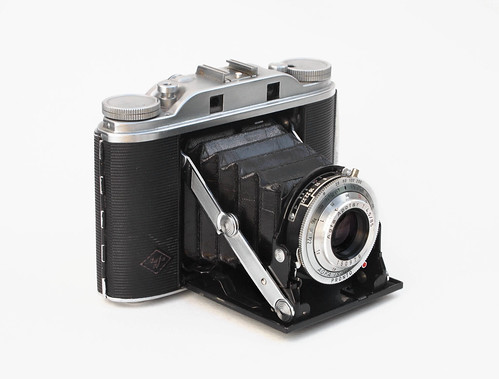
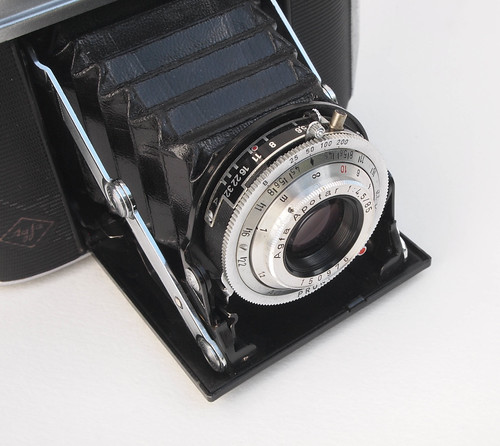
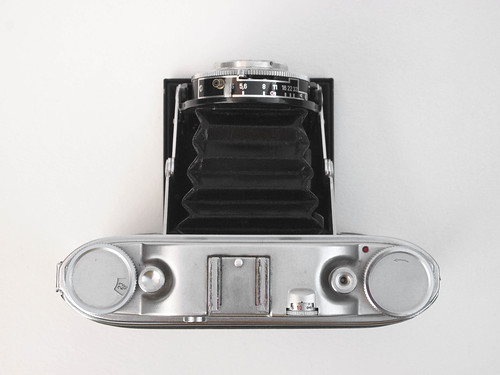
The camera I had picked for the #shittycamerachallenge was the Coronet 6-6. I felt it fitted the spirit of the exercise due to being largely made from plastic, and with the most minimal user controls - and also that the camera had mould inside the body when I first opened it. The camera's name is sometimes written as the Coronet 66; above the lens, the two numerals are separated by the coronet logo, and, taking nominally 6x6cm images, no doubt the name would be said as "six-six" (it's also worth remarking that Coronet made a 127 format camera called the Coronet 4-4 from its negative size, and this is written on the camera as '4-4'). The Coronet 6-6 is a simple point-and-shoot Bakelite-bodied camera from the 1950s, using 120 medium format roll film, taking twelve 6x6cm images. This camera belongs to a class of mid-twentieth century cheap point-and-shoot models which can essentially be considered derivations of the box camera, and, as with the Coronet 6-6, not necessarily as well featured as many of those box cameras. These cameras also tend to reflect the availability of new materials: Kodak's Brownies began with cardboard bodies, before being replaced by metal; by the mid-twentieth century, many of these cameras were made from early plastics. The Coronet 6-6's body is made from Bakelite, one the most popular plastics of the era.
 |
Coronet 6-6 camera
|
The Coronet 6-6 was manufactured by
Coronet, a Birmingham-based company specialising in a broad range of cheap cameras, many of which share very similar features across different models. The Coronet 6-6 is clearly based on the body moulding of the
Coronet Cadet and the
Coronet Flashmaster, but with a different lens and shutter unit: the wider-angle lens of the Coronet 6-6 allows for a more compact camera. The Coronet 6-6 was also the basis for the
Coronet Rapier, which uses an internal mask (and a different position of red window) to achieve sixteen 4x4 exposures on 120 film. (There is also a name variant of the Coronet 6-6 which has 'Flashmaster' on the name plate under the lens, but this is otherwise exactly the same model; there's also a
variant of the Coronet Cadet which looks the same as the 6-6).
The Coronet 6-6 has fixed-focus meniscus lens, which looks and feels to be made from plastic. The focal length is reputedly 65mm, which gives a wide-angle image on the 6x6 format frame. Behind the lens and shutter is a metal plate with a smaller aperture punched into it, possibly around f11 or slightly smaller, such as a non-standard setting like f14. The shutter has a single speed, possibly around 1/30th to 1/50th, and is not provided with a bulb or time setting: it does have a flash sync for a proprietary flash, connecting to two metal ports on the side of the lens unit, as seen in the image above (an image of the flash
here shows it to be almost as big as the camera). The viewfinder, placed directly above the lens, is of the reverse Galilean type. Frame advance is manual, by turning the large plastic knob to the side of the viewfinder, and using the red window on the back of the camera to follow the frame numbers on the film's backing paper.
 |
Coronet 6-6 opened for loading
|
The back of the Coronet 6-6 is made from a piece of stamped metal with riveted spool holders and pressure springs. To load the camera, two catches either side of the camera, to which the carrying strap is attached, slide downwards, and the whole back slides off. Inside the camera, the Bakelite behind the lens is painted with a matte black, presumably to cut down on internal reflections from the smooth surface of the Bakelite. Loading film is simple: the take up spool is placed under the advance knob on the sprung spool holder, the new roll of film positioned in the other holder, and the backing paper stretched across to the take up spool. There is a serial number on the inside of the camera back, printed in very blotchy paint, a little hard to read.
I shot one roll of
Ilford HP5 Plus with the Coronet 6-6, and two rolls of
Fomapan 400. Although both are 400 ISO films, even on sunny days, due no doubt to the late time of year, these were not overexposed. I often read opinions online that, in box cameras (and the Coronet 6-6 can be considered a box camera here) one should use a slow film, as this is what these cameras were designed for. Indeed, the cameras
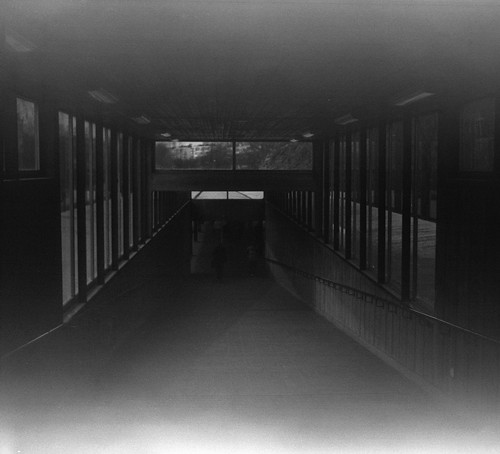
were designed for films which might have been the equivalent of 25 ISO, but they were also intended to only be shot handheld, outside, in sunny weather in the summer months. Using a 400-speed film means being able to use the kind of simple camera that the Coronet 6-6 is in more conditions than those originally intended by the manufacturers, November in the northern hemisphere, with short days, sometimes sunny, sometimes very grey, embodying such conditions. The image below for example, looks like it was shot at dusk (helped, of course, in that interpretation by the lit streetlamp); it was actually taken around noon, but on a very overcast day; with a 100 ISO film it would have been quite underexposed. With a single shutter speed and aperture setting, when using the Coronet 6-6, to get acceptable results in a variety of the lighting conditions relies heavily on the latitude of whichever film is used; far better to use a faster film and potentially overexpose it for some shots, than a slower film and not take a shot because the sun isn't shining.
 |
Coronet 6-6 with Fomapan 400
|
In use, I found the wideness of the lens occasionally surprised me: I'd see what I thought might make a fitting subject, raised the camera to my eye, then realised I had to get closer for a composition anything like what I had thought I'd get. I also hadn't anticipated how slow the shutter was - after developing the first roll from the Coronet, a number of exposures had camera shake. This is also partly due to the shutter button, a big plastic lever offset from the lens. There is a small amount of travel which evidently tensions the shutter, but then it gets quite stiff just before the shutter actually releases. It is also quite flimsy, and bends backwards, and on occasion got caught on a small protrusion on the moulding behind it, none of which made for a smooth release. I was more conscious of this as I shot more with the camera.
 |
Coronet 6-6 with Ilford HP5 Plus
|
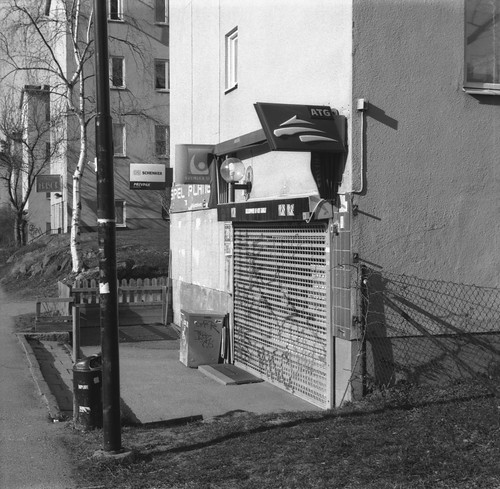
The lens displays all the classic aberrations one would expect from a plastic meniscus: the above image, from my first roll through the camera, does have some camera shake, but also clearly evident is pincushion distortion, seen in the verticals. Without camera shake, the lens is
moderately sharp in the centre, but this falls off quickly towards the sides and corners. I haven't used colour film with the camera, but no doubt some chromatic aberration would be seen. Also discernible is astigmatism and coma, flare, and in a few shots what looks like internal reflections, despite the matte paint. Given the limitations of the lens, it's quite understandable that there would be a version of the camera which only used the central portion of the image in the guise of the Coronet Rapier. The fact that the Coronet 6-6 uses medium format film is somewhat negated by the qualities of the lens: unlike a
Kodak Brownie (and there are simple box cameras with much better lenses), for example, here the larger negative format is lost on the poor definition of much of the image.
 |
Coronet 6-6 with Fomapan 400
|
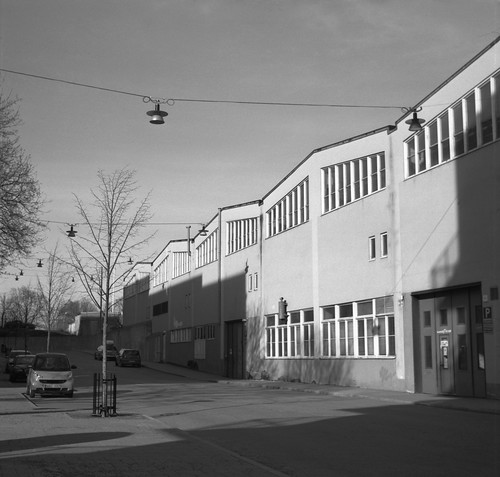
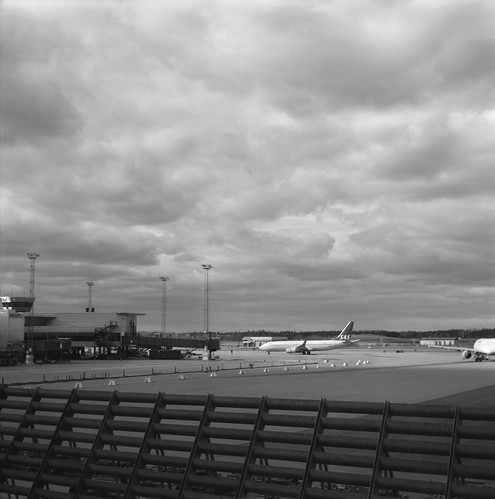
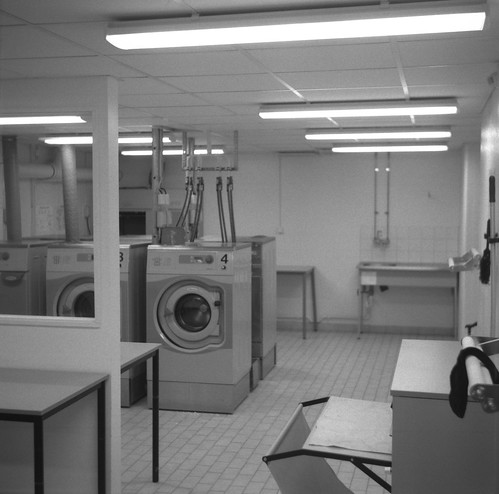
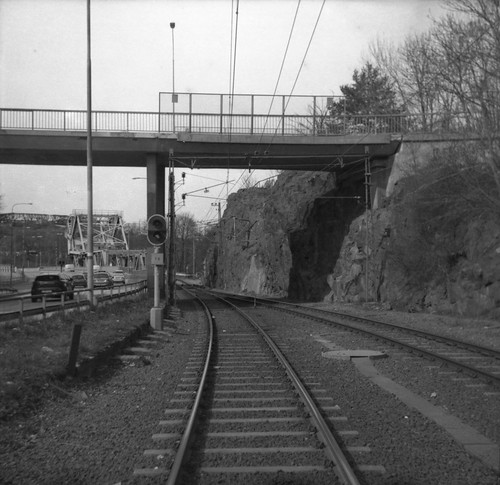
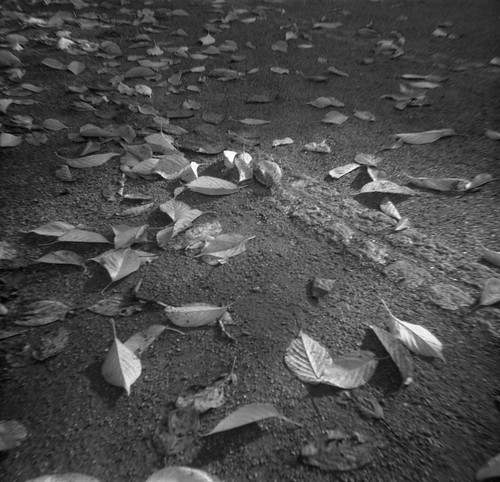
Being aware of the limitations of the Coronet 6-6 meant I sought out subjects and compositions where these limitations either didn't matter, were less obvious, or even added something to the image. With the photograph above, some vignetting, and falling off of definition helps with the sense of depth recession, enhancing the concentration on the lit leaves in the middle of the frame. I also tended to avoid any compositions with clearly rectilinear subjects, choosing more oblique angles where appropriate.
 |
Coronet 6-6 with Fomapan 400
|
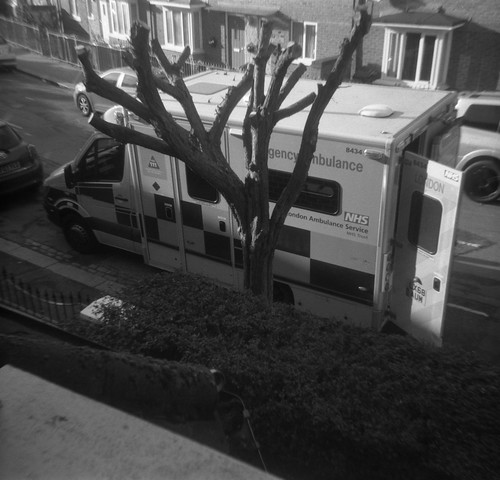
Sometimes none of these approaches really worked, and the photographs that resulted were just unsatisfactory, despite whatever impulses made me press the shutter at the time; frequently, the wide angle of the lens, the lack of definition towards the edges and other aspects just produced images which had a distracting 'busyness' to them. However, the pleasure in using a simple point-and-shoot camera like the Coronet 6-6 largely resides in the fact that the operation of the camera is entirely about the subject and composition with no other concerns in the taking of the photograph.
 |
Coronet 6-6 with Ilford HP5 Plus
|
 |
Coronet 6-6 with Ilford HP5 Plus
|
 |
Coronet 6-6 with Ilford HP5 Plus
|
 |
Coronet 6-6 with Fomapan 400
|
 |
Coronet 6-6 with Fomapan 400
|
 |
Coronet 6-6 with Fomapan 400
|
 |
Coronet 6-6 with Fomapan 400
|
 |
Coronet 6-6 with Fomapan 400
|
Sources/further reading: