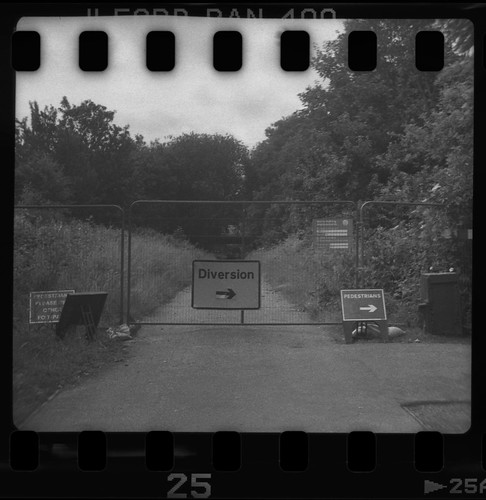
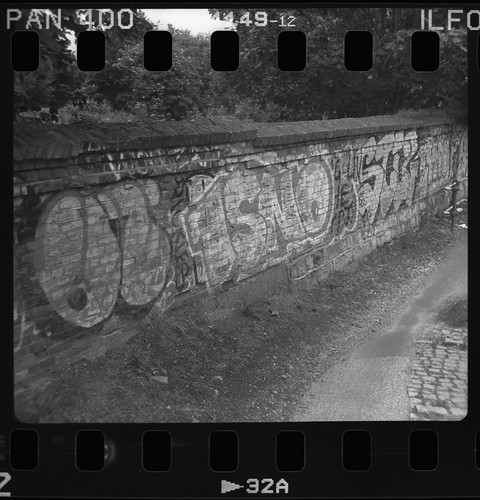
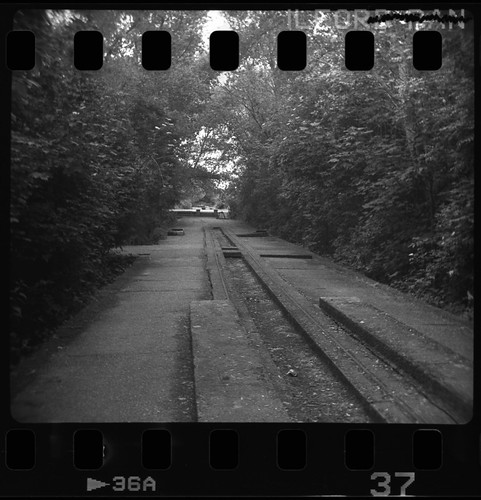
|
| Ilford Pan 400 |
Having used
Ilford Pan 100 last year, and from the research online for my post on the film, I wrote then that "Pan 400 appears to be a bit more popular, or at least seems to come up more often than Pan 100"; as a companion piece to my tests of Ilford Pan 100, it was natural to want to do the same for the 400-speed film. I bought my
Ilford Pan 400 at
Process Supplies Ltd where I'd also got the Pan 100 film previously; when buying the film, I was told that the Ilford Pan films are to be discontinued in favour of the two Kentmere films, Kentmere 100 and 400. The implication from this is that the Pan films and Kentmere films are not the same emulsion, although it's not exactly clear how different they may be: the two brands
do have different development times. To support the idea that the Kentmere films are replacing the Ilford Pan films, the Kentmere films have recently had their packaging redesigned - and the words 'PAN 100' and 'PAN 400' are as prominent as the Kentmere brand: on Ilford's website, there's a
post from last year about the redesign that states "Kentmere 100 and 400 are now officially known as Kentmere PAN 100 and PAN 400..." (Edit 8/11/19: see the post on
Kentmere Pan 400 here).
As I wrote in my post on Pan 100, the Ilford Pan films have not been generally available in the UK; the
data sheet states that:
The ILFORD range of PAN 100 and PAN 400 black and white camera films are not generally distributed and sold worldwide, they are only made available in selected markets.
Like Pan 100, Ilford Pan 400 is a traditional, cubic-type emulsion black and white film from Harman under the Ilford brand, 'Pan', an abbreviation of
panchromatic, is indicative of the basic nature of these films. A
thread on the Amateur Photographer forum quotes an unattributed 'Ilford employee' on the Ilford Pan films that: "They are based on FP4+ and HP5+ technology, but are produced to lower specifications and tolorances [sic]. There are also a
few posts online that suggest the Ilford Pan films were discontinued some years ago and I speculated in my post on Pan 100 that production might have ceased for a period - a data sheet from 2002 mentions both 35mm and 120 - the films are only available in 35mm, for the time being of course. By contrast to the Ilford Pan 100 films that I used last year, the Pan 400 that I used this year had no printing inside the box - an indication of imminent discontinuation perhaps, or just their budget status.
As is my usual approach when testing a new film, I made a latitude test, rating the film successively from an exposure index of 100 through to 3200, in effect going from two stops over-exposed to three stops underexposed. Developing times for Ilford Pan 400 (and Pan 100) are not listed on Ilford's
standard development chart listing their other Ilford-branded films (except Ortho Copy Plus); for this post I used times from the
Massive Dev Chart (the data sheet from 2002 does give times - the same as on the Massive Dev Chart - for Ilford Pan 400 at meter settings from 200 to 3200). The film for the latitude test was developed in R09 One Shot at a dilution of 1+25 for 6 minutes at 20ºC.
 |
| Ilford Pan 400 latitude test |
The test showed the film to have reasonably good latitude: two stops overexposed and the compression of tones towards the highlights begins to become unattractive; underexposed, shadow detail starts to be lost, although in scanning the negatives it was possible to pull out more detail. Inevitably, with a lower contrast subject, over- and underexposure have less effect than higher contrast subjects - the top row on the contact sheet above is higher in contrast, with brighter highlights and deeper shadows; the subject in the second row is more even across the frame.
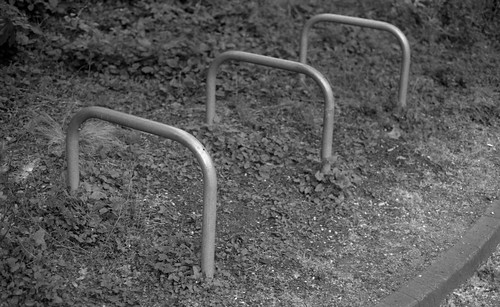 |
| Ilford Pan 400, two stops overexposed |
 |
| Ilford Pan 400, three stops underexposed |
Following the latitude test, I wanted to try both push- and pull-processing. Pull-processing tends to be less demanded by shooting conditions, though with a 400-speed film there may be occasions when it might be advisable. I shot one roll of Ilford Pan 400, rated 200 and developed in R09 One Shot at a dilution of 1+25 for 5 minutes and 30 seconds at a temperature of 19ºC. Pull-processing does reduce contrast, but faster films are inherently lower in contrast than slow films, so this may be less necessary as a result. Some of the shots on this roll were on subjects with differing degrees of
contre-jour illumination; the pull-processing may have helped a little here, though the second shot below, with a brightly lit late afternoon sky towards a low sun would always be problematic in terms of retaining detail across the frame: a simple scan of the negative (as is the case here) might not be as good as a darkroom print, albeit no doubt needing plenty of burning-in for the sky, and possibly spilt-grade contrast printing too.
 |
| Ilford Pan 400, exposed at EI 200 and pull-processed |
 |
| Ilford Pan 400, exposed at EI 200 and pull-processed |
For push-processing, a test for a one stop push to 800 did not seem necessary: frames rated at 800 on the latitude test showed a reasonably full range of tones without extra development. I did push the film to 1600 and 3200 respectively, using Ilfotec LC29 as a developer for these tests rather than R09. The two-stop push to 1600 emphasised the grain but not unattractively so; the increased contrast made for negatives which were easy to scan. I shot most of these in the British Museum, with some galleries being illuminated with low-light levels, making the two-stop push an ideal compromise.
 |
| Ilford Pan 400, rated 1600, developed in Ilfotec LC29 1+19, 14m at 20ºC |
I then shot a roll at 3200, some at dusk on an overcast day, some on the London Underground. With a three-stop push, the contrast of some subjects meant an inevitable lack of shadow detail, but, again, the push-processing here was an acceptable compromise.
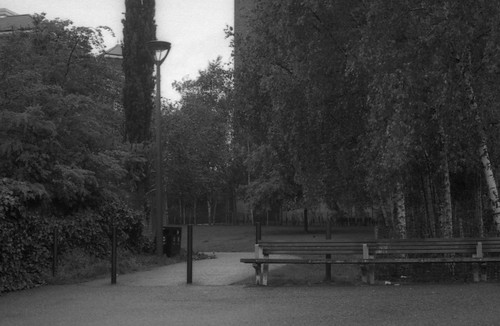 |
| Ilford Pan 400, rated 3200, developed in Ilfotec LC29 1+9, 11m at 20ºC |
 |
| Ilford Pan 400, rated 3200, developed in Ilfotec LC29 1+9, 11m at 20ºC |
Ideally, this post would then test the Kentmere Pan 400 film to compare it with Ilford Pan 400 (edit 8/11/19: I have now tested
Kentmere Pan 400, posted here); I suspect that for most uses, the differences would not be significant: both films are fast, traditional black and white panchromatic emulsions at a lower price than Ilford HP5 Plus or Kodak Tri-X. Generally, the results with Ilford Pan 400 were perfectly acceptable, if lacking anything to distinguish it from other lower-priced black and white films that seem to have proliferated in recent years. In my post on its slower companion, Pan 100, I wrote how that film reminded me of the Foma films in terms of grain; by comparison, Ilford Pan 400 doesn't seem to me as alike to Fomapan 400: Pan 400's grain is perhaps a little more regular, a little less gritty. Perversely, perhaps, I found the results when either pull- or push processing more to my liking: down rated, the grain feels a little tighter, smoother, while pushing the film a couple of stops gives the negatives enough of a contrast boost to make the images feel tonally more dynamic as well as providing better results from a straight scan (of course, mush also depends on the subject contrast of the original scene photographed). Again, ideally I would also test these assertions with printing in the darkroom too; however all the images on this post (except the contact sheet) are scanned from the negative.
 |
| Ilford Pan 400 shot with Agat 18K (half frame) |
 |
| Kiev-4 with Ilford Pan 400 rated 200 |
 |
| Canon A-1 with Ilford Pan 400 at box speed |
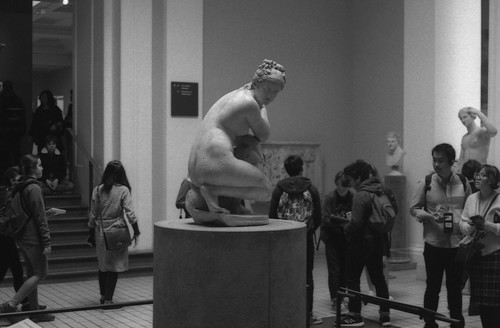 |
| Canon A-1 with Ilford Pan 400 rated 1600 |
 |
| Canon A-1 with Ilford Pan 400 rated 3200 |
Ilford Pan 100 and Pan 400 data sheet (PDF)