Showing posts with label push processing. Show all posts

Saturday, 21 September 2019

Ilford Pan 400

Ilford Pan 400
Having used Ilford Pan 100 last year, and from the research online for my post on the film, I wrote then that "Pan 400 appears to be a bit more popular, or at least seems to come up more often than Pan 100"; as a companion piece to my tests of Ilford Pan 100, it was natural to want to do the same for the 400-speed film. I bought my Ilford Pan 400 at Process Supplies Ltd where I'd also got the Pan 100 film previously; when buying the film, I was told that the Ilford Pan films are to be discontinued in favour of the two Kentmere films, Kentmere 100 and 400. The implication from this is that the Pan films and Kentmere films are not the same emulsion, although it's not exactly clear how different they may be: the two brands do have different development times. To support the idea that the Kentmere films are replacing the Ilford Pan films, the Kentmere films have recently had their packaging redesigned - and the words 'PAN 100' and 'PAN 400' are as prominent as the Kentmere brand: on Ilford's website, there's a post from last year about the redesign that states "Kentmere 100 and 400 are now officially known as Kentmere PAN 100 and PAN 400..." (Edit 8/11/19: see the post on Kentmere Pan 400 here).

As I wrote in my post on Pan 100, the Ilford Pan films have not been generally available in the UK; the data sheet states that:

The ILFORD range of PAN 100 and PAN 400 black and white camera films are not generally distributed and sold worldwide, they are only made available in selected markets.

Like Pan 100, Ilford Pan 400 is a traditional, cubic-type emulsion black and white film from Harman under the Ilford brand, 'Pan', an abbreviation of panchromatic, is indicative of the basic nature of these films. A thread on the Amateur Photographer forum quotes an unattributed 'Ilford employee' on the Ilford Pan films that: "They are based on FP4+ and HP5+ technology, but are produced to lower specifications and tolorances [sic]. There are also a few posts online that suggest the Ilford Pan films were discontinued some years ago and I speculated in my post on Pan 100 that production might have ceased for a period - a data sheet from 2002 mentions both 35mm and 120 - the films are only available in 35mm, for the time being of course. By contrast to the Ilford Pan 100 films that I used last year, the Pan 400 that I used this year had no printing inside the box - an indication of imminent discontinuation perhaps, or just their budget status.

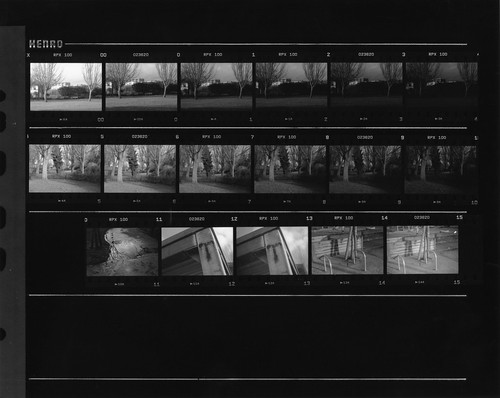
As is my usual approach when testing a new film, I made a latitude test, rating the film successively from an exposure index of 100 through to 3200, in effect going from two stops over-exposed to three stops underexposed. Developing times for Ilford Pan 400 (and Pan 100) are not listed on Ilford's standard development chart listing their other Ilford-branded films (except Ortho Copy Plus); for this post I used times from the Massive Dev Chart (the data sheet from 2002 does give times - the same as on the Massive Dev Chart - for Ilford Pan 400 at meter settings from 200 to 3200). The film for the latitude test was developed in R09 One Shot at a dilution of 1+25 for 6 minutes at 20ºC.

Ilford Pan 400 latitude test
The test showed the film to have reasonably good latitude: two stops overexposed and the compression of tones towards the highlights begins to become unattractive; underexposed, shadow detail starts to be lost, although in scanning the negatives it was possible to pull out more detail. Inevitably, with a lower contrast subject, over- and underexposure have less effect than higher contrast subjects - the top row on the contact sheet above is higher in contrast, with brighter highlights and deeper shadows; the subject in the second row is more even across the frame.
Ilford Pan 400, two stops overexposed
Ilford Pan 400, three stops underexposed
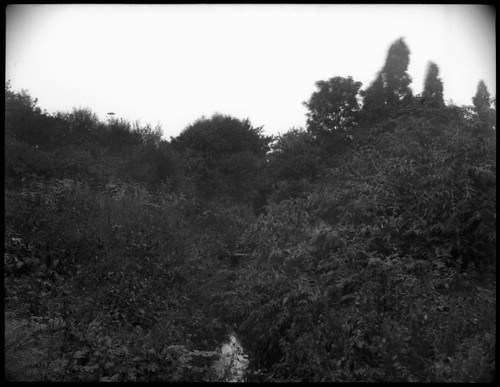
Following the latitude test, I wanted to try both push- and pull-processing. Pull-processing tends to be less demanded by shooting conditions, though with a 400-speed film there may be occasions when it might be advisable. I shot one roll of Ilford Pan 400, rated 200 and developed in R09 One Shot at a dilution of 1+25 for 5 minutes and 30 seconds at a temperature of 19ºC. Pull-processing does reduce contrast, but faster films are inherently lower in contrast than slow films, so this may be less necessary as a result. Some of the shots on this roll were on subjects with differing degrees of contre-jour illumination; the pull-processing may have helped a little here, though the second shot below, with a brightly lit late afternoon sky towards a low sun would always be problematic in terms of retaining detail across the frame: a simple scan of the negative (as is the case here) might not be as good as a darkroom print, albeit no doubt needing plenty of burning-in for the sky, and possibly spilt-grade contrast printing too.

Ilford Pan 400, exposed at EI 200 and pull-processed
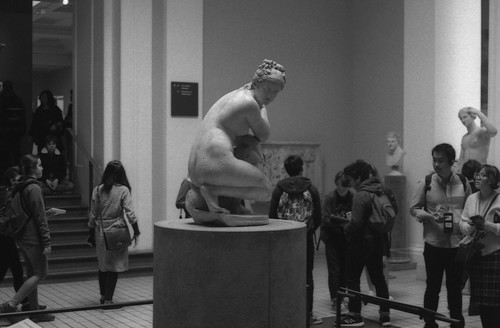
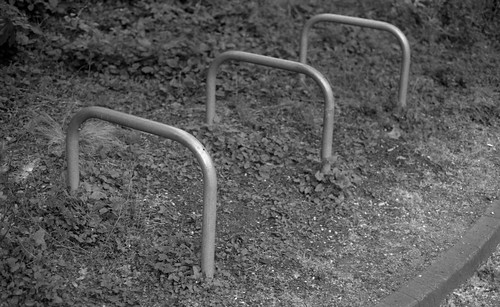
For push-processing, a test for a one stop push to 800 did not seem necessary: frames rated at 800 on the latitude test showed a reasonably full range of tones without extra development. I did push the film to 1600 and 3200 respectively, using Ilfotec LC29 as a developer for these tests rather than R09. The two-stop push to 1600 emphasised the grain but not unattractively so; the increased contrast made for negatives which were easy to scan. I shot most of these in the British Museum, with some galleries being illuminated with low-light levels, making the two-stop push an ideal compromise.

Ilford Pan 400, rated 1600, developed in Ilfotec LC29 1+19, 14m at 20ºC
I then shot a roll at 3200, some at dusk on an overcast day, some on the London Underground. With a three-stop push, the contrast of some subjects meant an inevitable lack of shadow detail, but, again, the push-processing here was an acceptable compromise.
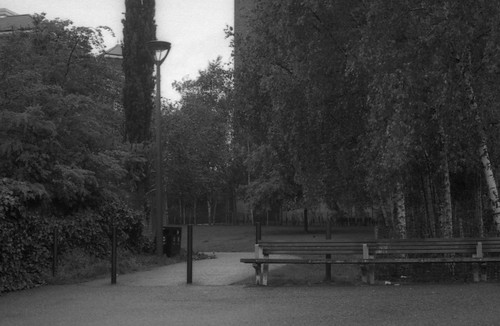
Ilford Pan 400, rated 3200, developed in Ilfotec LC29 1+9, 11m at 20ºC
Ideally, this post would then test the Kentmere Pan 400 film to compare it with Ilford Pan 400 (edit 8/11/19: I have now tested Kentmere Pan 400, posted here); I suspect that for most uses, the differences would not be significant: both films are fast, traditional black and white panchromatic emulsions at a lower price than Ilford HP5 Plus or Kodak Tri-X. Generally, the results with Ilford Pan 400 were perfectly acceptable, if lacking anything to distinguish it from other lower-priced black and white films that seem to have proliferated in recent years. In my post on its slower companion, Pan 100, I wrote how that film reminded me of the Foma films in terms of grain; by comparison, Ilford Pan 400 doesn't seem to me as alike to Fomapan 400: Pan 400's grain is perhaps a little more regular, a little less gritty. Perversely, perhaps, I found the results when either pull- or push processing more to my liking: down rated, the grain feels a little tighter, smoother, while pushing the film a couple of stops gives the negatives enough of a contrast boost to make the images feel tonally more dynamic as well as providing better results from a straight scan (of course, mush also depends on the subject contrast of the original scene photographed). Again, ideally I would also test these assertions with printing in the darkroom too; however all the images on this post (except the contact sheet) are scanned from the negative.

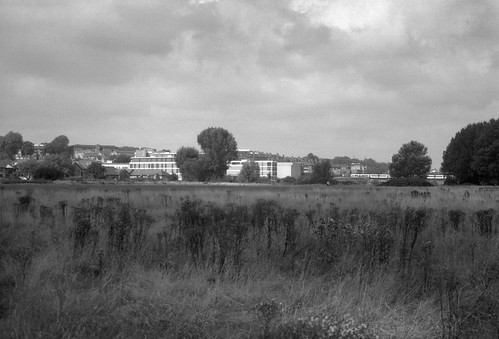
Ilford Pan 400 shot with Agat 18K (half frame)
Kiev-4 with Ilford Pan 400 rated 200
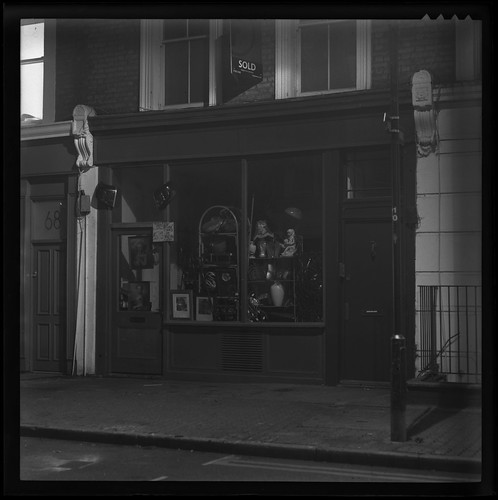
Canon A-1 with Ilford Pan 400 at box speed
Canon A-1 with Ilford Pan 400 rated 1600
Canon A-1 with Ilford Pan 400 rated 3200
Ilford Pan 100 and Pan 400 data sheet (PDF)

Tuesday, 17 February 2015

Twenty Years Since (2)

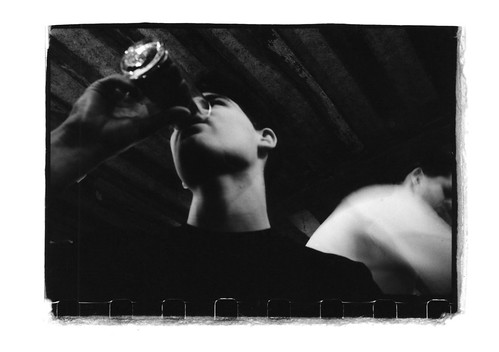
In my post, Twenty Years Since, I wrote about my first experiences developing black and white film while on a foundation course in art and design in 1993. Subsequently, as part of my degree course, I had another introduction to black and white photography in February 1995. This time we were given one roll of film per student, rather than having to share. I shot my film with the Praktica BCA which I had bought to replace the BC1 which had been my first SLR camera. The day before the photography introduction I'd bought a 28mm lens (originally £40, and, although secondhand, I asked for a student discount and was given 10% off the price - as a point of comparison I was paying £39 a week rent on my room in the student hostel at the time); and I had also found a book in the local library in which had a page on push-processing. This was a technique that I had not previously used, but wanted to try because I had heard that the film we were to be given for the introduction was 100 ISO, which I thought would be too limiting to use in February: the film we were given was Jessops 200 (which may have actually been Efke R100, according to this thread here) and in the event I shot most of the film using a tripod and with the camera's self timer. I rated the film at 800, which I recall produced a bit of a sharp intake of breath from the photography tutor, who suggested a time twice as long as indicated for box speed, and in neat ID11 (rather than 1:1). I developed the film for 18 minutes at 22ºC, having heated the developer above 20ºC, and was too impatient to either wait for it to cool, or stand it in cold water to speed its cooling.

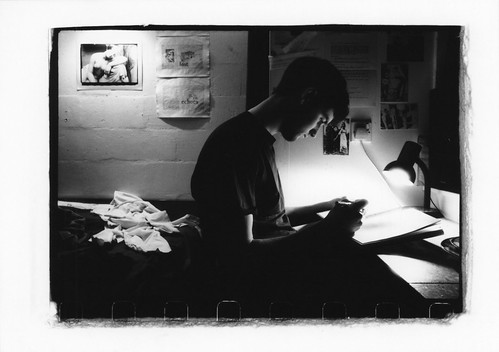
Original contact sheet
The prints that I produced were a series of self portraits in a semi-fictional day-in-the-life. At the start of the introduction, we had been given a slide show, which was mostly about artists using photography rather than photographers, if such a distinction is still meaningful. One of those was Cindy Sherman, which may have influenced my choice of subject matter. I had also made my own negative carrier specifically to allow the film rebate to be shown. This comes across as something of an affectation now, looking back at the prints from the distance of twenty years. At the time I was interested in artists' books as a form, and I made a cover to contain six prints of the images from the introduction. This also had a cover page to which I had given the title 'How Is The Author?' This came from an abbreviation of a Richard Pettibone piece which had appeared on one of our history of art slide lists as 'How Is The Author'.


Retrospectively, the images featured in the first post Twenty Years Since have aged better: as the first photographs that I was developing myself, with my first SLR camera, not uncommonly, I was concerned with formal qualities in most of the photographs, or, with the photographs of the route of the M11 Link Road, the documentary concerns have increased in interest with time. By comparison, the photographs from my second black and white photography introduction do have the feel of juvenilia to them.


Tuesday, 25 March 2014

Take Your Box Camera To Play Day 2014

Lumière Scout Box with Ilford FP4 Plus
In a spirit of inclusiveness, Flickr member art y fotos suggested a 'Take Your Box Camera To Play Day' for those either fortunate - or unfortunate - not to have to go to work and take part in the 'Take Your Box Camera To Work Day'. It was also suggested that it should be a weekend, Saturday and Sunday 22nd and 23rd of March. Again I used my Lumière Scout Box, with two slower speed rolls as the weather was forecast to be fine and bright, Ilford FP4 Plus (with an expiry date April 2009), and a roll of Rollei RPX 100. Both rolls of film were developed in Ilfotec LC29, diluted 1:19, 10 minutes at 19ºC to provide a push of around one stop.

Lumière Scout Box with Ilford FP4 Plus
The FP4 Plus provided the best results, although as the roll progresses there is a problem with film flatness, which can be seen in the image above where the roof line lightly undulates. A yellow filter might have enhanced the tonal modelling in the skies. The roll of RPX 100 has suffered from the emulsion reacting to the printing on the film's backing paper, with the numbering just visible in the sky of the photograph below. Although I haven't experienced this with Rollei RPX films before, it is a manufacturing problem which has sometimes affected batches of medium format films, which, anecdotally, appears to be confined to the cheaper end of the market (I have never found this happen to Ilford films for example, even those decades old, like the FP4 used for some of the 127 Days).

Lumière Scout Box with Rollei RPX 100
See all the photographs in the Take Your Box Camera To Work Day group pool.

Wednesday, 12 February 2014

Rollei RPX 100

Rollei RPX 100 in 35mm and medium format
Since writing the post on Rollei RPX 400 last November, Maco have introduced RPX 25 to the range, repackaged the existing films, and, inevitably, prices have gone up. Macodirect no longer offer the 35mm films in twin packs (as in the image above) and nor are the medium format films sold in packs of five, although discounts are offered on orders of 10 or more. However, at €3.59 for a 35mm roll, and €3.90 medium format, the prices are still low. As I mentioned in the post on RPX 400, there are few stockists for the Rollei RPX films in the UK; at the time of writing West End Cameras' prices remain the same at £4 per film in either format. (Edit 20/2/14: Silverprint are now stocking the range of RPX films, with both RPX 400 and RPX 100 retailing at £3.60).

Rollei RPX 100 latitude test contact sheet
Following my results with Rollei RPX 400, I was keen to pursue the same basic test procedures for Rollei RPX 100. As before, I began with a latitude test, shown on the contact sheet above. The first six frames are rated, left to right, 25-50-100-200-400-800; the next six frames in the second row run 25-25-50-100-200-400; the third row was shot at 100 and at 50 for some bracketing. The film was developed in Rodinal diluted 1:25 for 9 minutes at 20ºC, the manufacturer's recommended time for the box speed of 100 ISO. Although I've printed the contact sheet a little dark to clearly show the detail in the shadow areas, the results show the film to have very similar qualities to RPX 400, notably a similar latitude range, with the same transparent base and tonal rendering.

Rollei RPX 100 at box speed, developed in Rodinal 1:25, 9 minutes at 20º
The data sheet for Rollei RPX 100 from Maco also gives development times when rated 50 and 200 (the Massive Dev Chart also provides times for the same range). I rarely find the need to pull process film, but for completeness, I shot a second roll at 50 EI, and developed for 7 minutes at 20ºC. Although my latitude test appeared to show the film could be exposed at 50 without changing the developing times, one of the benefits of pulling the film would be, in theory, to reduce the contrast of the negatives. This is not especially evident in the results from this roll, although as I did not shoot the same subjects, in the same lighting conditions, as with the first film rated 100, this doesn't give a truly meaningful comparison.

Rollei RPX 100 at 50 EI, developed in Rodinal 1:25, 7 minutes at 20º
I also pushed the film to 200 and, exceeding the manufacturer's recommended settings, also to 400 EI. At 200, developed at the recommended times in Rodinal 1:25 for 13 minutes at 20ºC, the film's qualities do not appear to be compromised, although the contrast is a little higher, more clearly seen by examining the negatives side by side with those rated 100 and 50.

Rollei RPX 100 at 200 EI, developed in Rodinal 1:25, 13 minutes at 20º
Having seen some examples of RPX 100 pushed to 400 on Flickr, I wanted to see how the film would perform at a push of two stops. I erred on the side of over-development and used a time of 18 minutes in Rodinal 1:25 at 20ºC. Ordinarily such a push wouldn't be recommended but if circumstances required it (such as failing light or needing to use a faster shutter speed for moving subjects), it works well enough. The push of two stops has clearly raised the contrast of the images, but the highlights have held detail well. The detail in the shadows is notably less, but depending on the subject matter (and the aesthetics one is after) this isn't too problematic. This could be countered to some degree by using a higher dilution of developer, although as I wanted to keep the times relatively short, I kept with a dilution of Rodinal 1:25.

Rollei RPX 100 at 400 EI, developed in Rodinal 1:25, 18 minutes at 20º
From the (admittedly limited) tests, and subject matter, made for this blog post, my conclusions on Rollei RPX 100 are very similar to those for RPX 400: it's a good, versatile, black and white film with relatively fine grain, and the look of a traditional emulsion, available in 35mm and medium format at a very competitive price.

Thursday, 15 November 2012

Stand Development

Having mentioned stand development in a number of my posts on this blog, I've decided that this technique warrants a post of its own. There is plenty of information on stand development available online, but I thought it worthwhile to give an account of my own experience of using it. In summary, stand development is a method of developing a film using highly dilute developer, minimal agitation and long developing times. It's an old technique, first described in the 19th century, however I have only begun to use it recently.

Bear Lane, Southwark, Agfa Optima Sensor with FP4, stand developed in Rodinal 1+100 for one hour.
My first experiments using stand development was with Ilford FP4 in 35mm. For the very first roll I developed this way, having filled the tank and agitated for the initial minute, the idea of simply leaving it alone for an hour seemed counter-intuitive to the way I'd been developing films for years and required some blind faith that it would actually work. I used Rodinal, the developer I use regularly, but rather than the more usual dilutions of 1+25 or 1+50, the standard procedure for stand developing with Rodinal is to dilute it 1+100, and then let the film stand without agitation in the developer for 1 hour. This may not give the best results for all films, but it's certainly a very good starting point. The image above is from the first roll of film I developed using this technique, and I was pleasantly surprised by how well the negatives came out.

Southwark, Agfa Optima Sensor with FP4, stand developed in Rodinal 1+100 for one hour
Stand development works by the highlight areas on the film developing to exhaustion: the developer here is most active, and so exhausts (regular agitation would normally prevent this from happening by keeping the developer moving in the tank); meanwhile in the shadow areas the developer continues to work to completion. This gives a long tonal scale to the image, and the lack of agitation also appears to benefit the appearance of grain. Additionally, using a highly-dilute developer increases perceived sharpness due to edge effects. The first results I got with stand development appeared to have these all these benefits.

 I subsequently used this technique for developing out of date and colour film (such as with found films) with success, but using it on medium format film showed up some limitations. In the image below, there was a notable increase in the density of the negative towards the bottom of all the frames on the film, with some unevenness too. This may be due to the fact that when I first began using stand development, I mixed the developer at 20ºC; over the course of an hour's development the developer must cool towards ambient temperature, and perhaps, with convection currents, warmer developer rises in the tank and develops here more quickly.

Mini Roundabout, Fomapan 400 (medium format), stand developed in Rodinal 1+100 for one hour
The two methods of avoiding uneven development are to use the developer at room temperature and to agitate during development (additionally, soaking the film in water before developing may also help). I now invert the tank a couple of times half an hour through the developing time, which technically makes it semi-stand development. There are more exacting semi-stand agitation regimes, which can mean inverting the tank every five or ten minutes. However, this does remove the joy of just leaving the film alone and getting on with something else while it's in the tank.

FP4, found in a bulk film loader, stand developed in Rodinal 1+100 for one hour
Having established a way of using stand development that seems to work with a good degree of consistency, there's a number of situations that I use it for. It's my first consideration for developing any unknown film, such as films found in secondhand cameras, or the film I found in a bulk film loader, with no indication of what was inside, or, as recently happened, I lost the tab on a roll of medium format film (it got caught inside the camera when I unloaded the film, torn from the backing paper the wind then carried it off the bridge I was standing on and into a river below; I could see from the backing paper it was an Ilford film, but I wasn't sure which; it turned out to be Delta 100). It also works very well with out-of-date film (and plates): the loss of sensitivity with age is compensated by increasing exposure, and I then stand develop. Lastly, there are films that I simply like the look of in stand development, in particular, Ilford FP4 (HP5 less so, but I do use stand development when push processing this with Rodinal).

Finally, as I referred to in my post about Kodak Technical Pan, when using Rodinal at high dilutions, there is a minimum amount of developer per film. Agfa recommended a minimum of 10ml Rodinal per film, no matter the dilution used. At 1+100 this would mean a litre of working solution. In practice smaller amounts of Rodinal work well enough (although I've had uneven development when using 5ml); I tend to use 8-9ml of developer to 800-900ml of water in a 3-reel Paterson tank, and when developing 35mm film, I place an empty spool at the bottom of the tank to raise the film being developed to its middle.

Sources/further reading:
An entry on stand development from Cyclopedia of Photography, Bernard E. Jones (1911)
An Introduction To Stand Development at Daniel Hewes Photography
Efke 25 stand development by Martin Zimelka

Edit 26/11/14

Since writing this post two years ago, I have also been using Ilfotec LC29 for stand development, as well as developing with its recommended dilutions and agitation regime. Although of different composition, Ilfotec LC29 is, like Rodinal/R09 One Shot, a highly concentrated liquid film developer. Standard dilutions for Ilfotec LC29 are 1+9, 1+19, and 1+29; the first two dilutions can be used for a number of films in one developing session, while at 1+29 Ilford state that it should be treated as a one shot developer. For stand development with Ilfotec LC29, I have been using the same dilutions as with Rodinal: diluting it 1+100 for most films with a normal contrast curve, and developing for one hour; for higher contrast emulsions I have been using 1+120, 1+150 or 1+200 with the Kodak High Resolution Aerial Duplicating film. The results using Ilfotec LC29 for stand development are comparable with Rodinal and the negatives exhibit similar qualities.

Adox Silvermax 100, stand developed in Ilfotec LC29, 1+100
Rollei RPX 100, stand developed in Ilfotec LC29, 1+100
Ilford Special Lantern glass plate, stand developed in Ilfotec LC29, 1+120
Kodak High Resolution Aerial Duplicating film, stand developed
in Ilfotec LC29, 1+200

Tuesday, 21 August 2012

Ilford HP5 Plus

Ilford HP5 Plus in 35mm, medium format and sheet film
HP5 Plus is Ilford's best selling black and white film. The first Ilford film designated HP (for Hypersensitive Panchromatic) was introduced in 1935 and had a speed of 160 ISO (by revised, post-1960 ASA standards). By the 1950s the HP emulsion had its speed increased to 400 ISO. Its current iteration, HP5 Plus, remaining at 400 ISO, was introduced in 1989. HP5 Plus was developed to compete with Kodak Tri-X, the photojournalists' film of choice: in the field of press photography, high-speed, good latitude, 'pushability' and ease of development were all desirable qualities over fineness of grain in the final image. HP5+ is currently available in 35mm, 120, and numerous sheet film sizes.

For many years when choosing a black and white film, HP5 Plus was simply the 'default' film for me. In my post about Delta 3200, I described how, when I began developing my own films at college, I was frequently taking hand-held shots in low-light conditions, and speed was more important to me than fineness of grain. Using ID11 as a developer, I was able to take advantage of being able to push the film, and rate it up to EI 3200. However, since I've returned to developing my own films and use Rodinal instead of ID11, I've become more discerning about the combination of film and developer, and I've explored a wider range of films than I used as a student. As a consequence I don't shoot HP5 as often in 35mm as the grain can be obtrusive, but this does depend on the subject matter (the images on this post are from 35mm negatives, unless indicated otherwise). Of course, 35mm film tends to stay in a camera longer than medium format, so while I might load a camera for taking low light shots, often the film is used up on other subjects entirely. However, I still use HP5 regularly in medium format, and being a traditional cubic-type emulsion, HP5 does has a particular look (which is difficult to define in words) and a great tonality I really like, especially when combined with a yellow filter for landscape work. By comparison, I've found Ilford's Delta films have a slightly 'harder' look to them (at least the 100 and 400 speed versions), and are more finickety in terms of exposure to get good results. I've only tried a couple of rolls of Kodak Tri-X, which I know lots of photographers love, but I prefer HP5.

Berlin from the Teufelsberg, HP5 (medium format, 6x9, with yellow filter) developed in Rodinal 1:25
Apart from the look of HP5, the main reason to use the film is its versatility: Ilford state it can be used at meter settings from 400 to 3200, and give a range from 250-3200 on their developing chart; I have inadvertently used it as low as 64. Ilford also mention its wide exposure latitude; it's described as 'bullet-proof' by Ag Photographic (the comparison to other 400 ISO films on Digital Truth appears to confirm this). I've personally found that the film takes overexposure well while retaining highlight detail. For example, a couple of long-exposure night shots from Paris appeared nearly white on the contact sheet compared to other frames on the roll, yet when scanned revealed much more detail than the contact promised.

Carreau du Temple, Paris, HP5 developed in Rodinal 1:50, 13m45s at 18ºC.
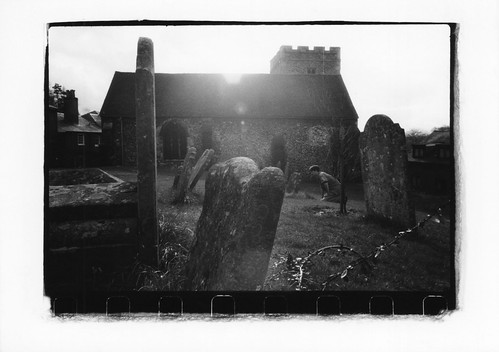
HP5's versatility does lend it to push processing. The Ilford fact sheet for HP5 recommends Ilfotec DDX/HC/RT Rapid or Microphen for push processing, none of which I've used. The two developers I have used with HP5 are ID11 when at college, and Rodinal. For the box speed of 400, I prefer the results using Rodinal diluted 1:25; however when rating the film at 1600, I've used a dilution of 1:100, stand developing the film for 2 hours or more. It may seem counter-intuitive, but push processing works best with plenty of light: low-light or night time scenes are often high contrast, with highly localised sources of light, and achieving shadow detail can be a problem.

Zinnowitzer Straße, HP5, push processed to EI 800 in Rodinal
Shepherd's Lane, HP5 push processed to 1600, stand developed in Rodinal 1:100, 2 hours 20 minutes
Liverpool Street Decorative Stonework, HP5 rated at 3200, developed in ID11 stock solution, 18m at 20ºC.
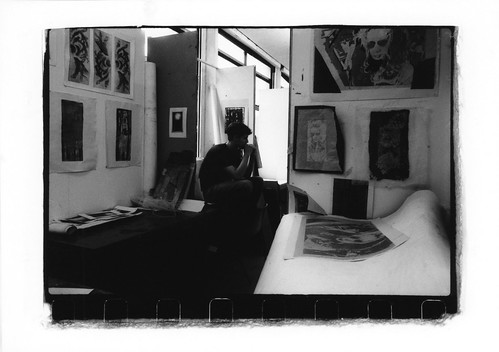
I rarely pull-process films of any kind, but I have shot HP5 at 64 ISO by accident. I thought my camera was loaded with outdated FP4 and exposed it at half of FP4's normal speed. I only realised my mistake when I took the film out of the camera. To compensate for the accidental over-exposure, I developed it at 100 ISO (the slowest rating on the Massive Dev Chart; the film could easily take a little more exposure, giving a slightly thicker negative). Incidentally, I shot the film in my Kodak Retina IIa, and didn't meter it in any way, relying on the 'sunny 16' rule (something I often do with manual cameras, partly out of laziness). Apart from accidents, I have occasionally used HP5 at EI 200 to reduce contrast. This can useful on bright sunny days with deep shadows, in spring or autumn, when the sun can be as bright as summer but the angle of the sun casts longer shadows; this isn't the case with the second image below, but the metal roof of the fire escape and the rendered wall are bright in comparison with the brick wall facing the street, and as such the subject benefits from a lower level of contrast.

Ceramic studio, HP5, rated 64, developed (as 100 ISO) in Rodinal 1:50 for 9mins at 20ºC.
Gate & Buddleia, HP5 (medium format, 6x9) pull processed to 200, developed in Rodinal 1:50
Through years of use and experimentation, I've come to appreciate all the qualities of HP5 which were those that appealed to the photojournalists the film was originally developed to cater for, without being aware of this. In film photography there's no one ideal film that covers all subjects, all lighting situations; even with the contraction of the market, there are still many different films available. This is, incidentally, one benefit of film photography: the ability to tailor film, and its development to the effects one wants to achieve. However, in the hypothetical position of only being able to choose one film to have with me for all eventualities, it would be HP5 Plus.

Gare de l'Est, HP5 (medium format), developed in Rodinal 1:25, 8 minutes
Klosterstraße, HP5 (medium format), developed in Rodinal 1:25, 8 minutes
Bocca Dell Verita, HP5 (medium format) developed in Rodinal
Sources
http://www.ilfordphoto.com/products/product.asp?n=7
http://www.photomemorabilia.co.uk/Ilford/Chronology.html
http://www.photomemorabilia.co.uk/Ilford/Chronology/HP5+_Photopro_Winter1989-90.pdf