Showing posts with label Tessar. Show all posts

Monday, 5 March 2018

Glunz Model 0

Glunz Model 0
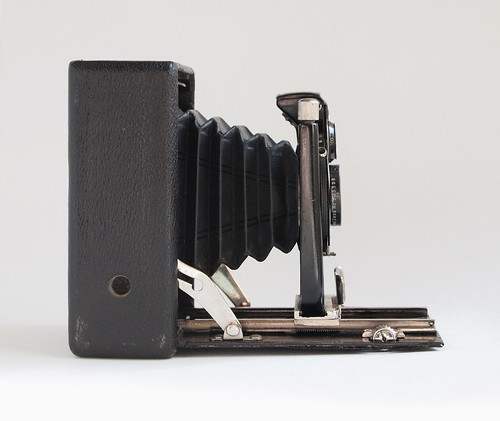
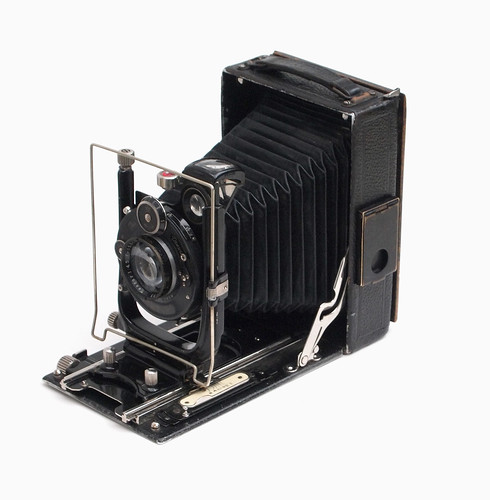
When this small wooden-bodied folding camera arrived in the post, a speculative purchase, there was almost nothing on the camera to identify it, save a small badge inside the body. This has a monogram reading G&S Kamerawerk Hannover-List. This was enough information to turn up some references to Glunz & Sohn Kamerawerk, but there is very little online about the company - the Glunz page on Camera-Wiki is very sparse for example (and I created the Glunz Mod. 0 page on Camera-Wiki myself, and it has only had three minor edits in the five years since). On Collection-Appareils I found a Glunz & Sohn Model 0 camera which looked very much like my version, although not identical - but also more recent, from the 1930s. The serial numbers on the lens and shutter belonging to my camera date them to c.1919. The Model 0 name appears to be a back formation from Glunz's 9x12cm Model 1, presumably produced first, and possibly not named Model 1 when first produced - or it could indicate Glunz's most basic model camera.

Glunz Model 0
The camera is very simply constructed with very few extraneous features. There's no handle on the body, as most folding plate cameras of this type would ordinarily possess. The bellows are single extension only, and there's only a rotating brilliant finder for framing - many other cameras would also have a frame finder; the brilliant finder doesn't have a spirit level attached either. It does however have rise and cross front movements: these seem pretty standard on these pre-war cameras, the movements seen as essential - perhaps converging verticals were distressing to the photographers of the day. The front cross movement is just by friction, while the rise has a standard worm screw. Focus is by ground glass screen, using rack and pinion, with a lock by pushing in the focus knob. The camera also has a scale on the folding bed, which also has an infinity lock, a small lever which pushes in to release the lens standard to advance it further on its rails. There are tripod sockets for vertical and horizontal images.

Glunz Model 0
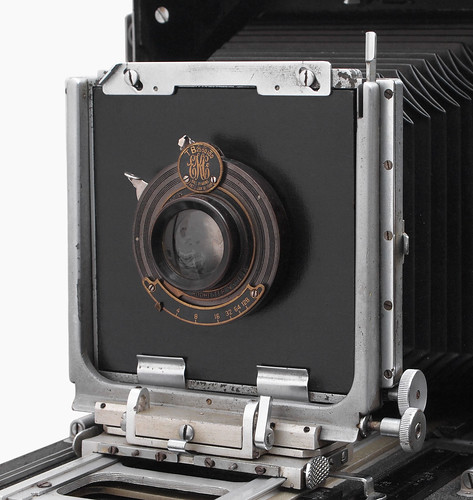
The Mod. 0's body is made from wood with the drop bed (and lens standard) in aluminium. The oddity of the camera is that despite being made very simply, cheaply, and with very few features, it has what would have been a top of the range lens and shutter combination: a 10.5cm f4.5 Tessar lens (fast for its time) in a dial-set Compur shutter. These were of course bought-in stock items, but for a camera this simple, one might expect a cheaper triplet lens in a Gauthier or other shutter - such as seen on the catalogue pages reproduced on Collection-Appareils. That the shutter function dial has ZDM (Zeit, Dauer, Moment) strongly suggests that this particular model of the camera was destined for the German home market, rather than using TBI (Time, Bulb, Instant) for export. The presence of the Tessar lens in the Compur shutter may mean that the camera's model number may in fact not be the Model 0; it's possible that with the same body, the Glunz's model numbers may actually indicate the lens/shutter options. However, there isn't enough information online to be sure that this may in fact be the case.

6.5x9cm plateholders from A.P. Paris
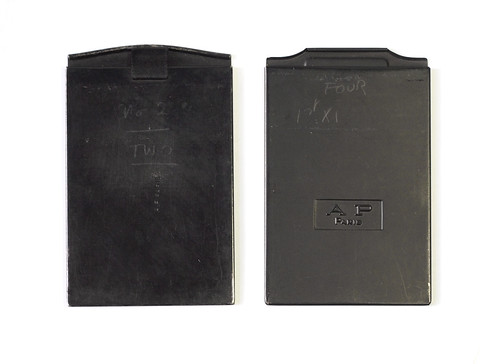
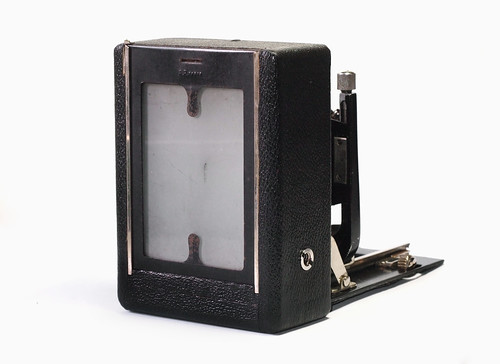
The Model 0 takes very different plateholders from other 6.5x9cm plate cameras I've used. The camera came with six plateholders, all stamped with A.P. Paris, but of two different designs - three have fabric tabs which appear to be there to make removing the plateholders from the camera easier (other plateholders sometimes have a small indent at the bottom for this). The plate holders are of a block-edge type, without the single or double lip around the holders that seems to be far more common. This means that none of the many other plateholders I have can be used with the camera, nor can I use the Rada rollfilm back with the Model 0. The ground glass screen itself is made from a plateholder; whether this was original is open to question, but the conversion was done very skillfully, unlike some I have seen. This is of the same design as the holders with the fabric tabs, although the tab here is cut off level with the metal (the stamp A.P. Paris is in a different place, compared to the proper plateholders though). The body has a small locking lever to secure the plateholder once inserted for removing the darkslide.

Glunz Model 0 ground glass screen
The ground glass screen does not have a hood attached (and doesn't look like it ever had one); I generally don't use a dark cloth when shooting old plate cameras hand-held, and the lack of a hood does make it difficult to see an image of any clarity on the screen. Apart from a few longer exposures, I shot most of the plates shown on this post hand-held. I shot a few plates when I first acquired the camera, but then didn't really use the camera until more recently - partly due to the lack of plateholders.

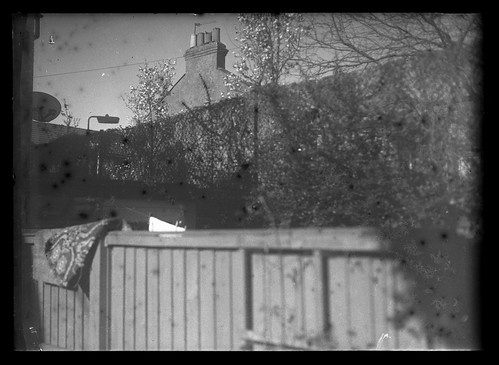
Glunz Mod. 0 with Ilford HP3 plate - test exposure
Having just six of these has been limiting in terms of taking the camera out to shoot - unless one is prepared to take a dark bag and spare plates. I've also used paper and sheet film with the camera, but in an equally limiting fashion, having just one 6.5x9cm film sheath.

Glunz Mod. 0 with Harman Direct Positive Paper
Glunz Mod. 0 with Ilford HPS glass plate 
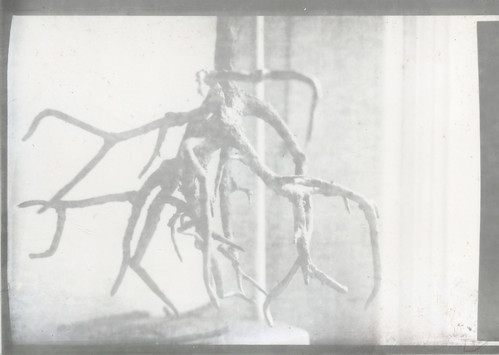
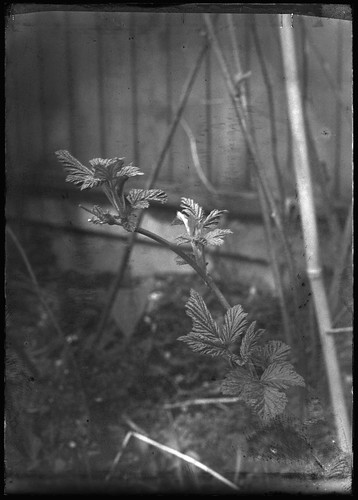
In practice, the Glunz Model 0's construction makes for a light plate camera, partly thanks to its lack of features, which would all add weight, and only having six holders to carry around with it does not add much. The camera doesn't look like it was used very much during its earlier life. The dial-set Compur shutter is in excellent condition, and fires pretty accurately at all speeds, even the slower ones. The Tessar lens is what one would expect, as a pre-war lens, it's not coated but the results are perfectly acceptable. One problem with the camera is that the two arms holding the folding bed do not securely lock out once the camera is opened- these aren't sprung like they are on other cameras I have, and it's very easy to knock the folding bed back, putting the lens standard out of true with the film plane. Although the camera has single extension bellows, in practice its possible to rack the lens standard out to the very edge of the lens board, enabling close focus to around 40cm - as with the HP3 plate shot of the raspberry canes below.

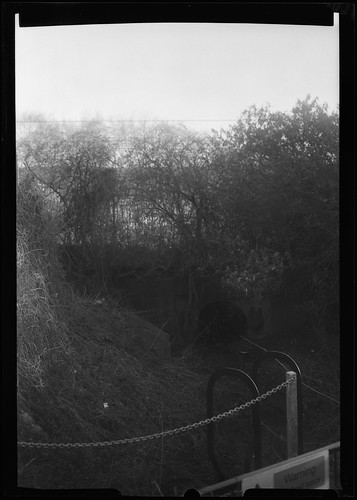
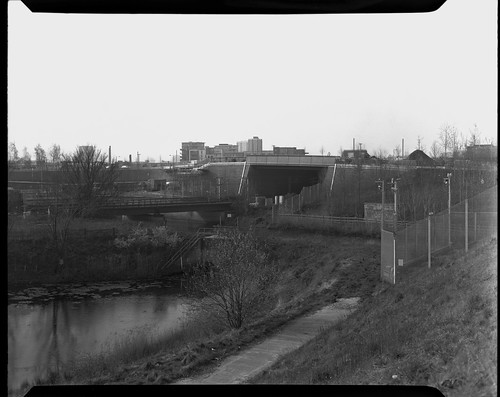
Apart from the shot on Agfapan APX 100 and that on Harman Direct Positive Paper, the rest of the photographs on this post shot with the Glunz Model 0 are on glass plates from the 1950s and 1960s. Most of the Ilford plates have aged fairly well (some of the Kodak plates less so); the Special Lantern plates would have been very slow originally, but weren't intended for 'pictorial contrast', instead these were designed for making lantern slides by contact - or just conceivably via and enlarger - so have a very slow blue-sensitive emulsion (generally, the slower the emulsion speed, the less it is affected by age). However, I also shot some Ilford HPS plates, which came from a box with a leaflet dated to 1952; HPS was the fastest emulsion available at the time - 400 ASA (pre-1960, so 800 by today's standards) and these plates came out well, rating them well below box speed to compensate for age.

Glunz Model 0 with Ilford Special Lantern Plate
Glunz Model 0 with Kodak P1600 Panchro-Royal glass plate
Glunz Model 0 with Ilford Special Lantern Plate
Glunz Model 0 with Ilford HP3 glass plate
Glunz Model 0 with Ilford HPS glass plate
Glunz Model 0 with Agfapan APX100 sheet film
Sources/further reading:
Glunz & Sohn on Camera-Wiki
Glunz Model 0 on Camera-Wiki
On Collection Appareils (French)

Monday, 14 November 2016

Zeiss Ikon Cocarette 519/15

Zeiss Ikon Cocarette 519/15
Many months ago, I shot a handful of test rolls with the Zeiss Ikon Cocarette, but then put this to one side as a consequence of initial results which were disappointing. Earlier this year, after acquiring a No.2A Brownie in a job lot of cameras, my interest was reawakened: both cameras use the obsolete 116 rollfilm format and I wanted to shoot with both on 11/6 this year for a '116 Day'; following this, last week I used the Cocarette again on 6th November as another calendrical 116 Day. When I'd made my first tests with the camera, I had begun to write up my experiences, of which it now seems like an opportune time to revisit, revise and post.

Zeiss Ikon Cocarette 519/15
Having some years ago written a post about the Icarette L, before writing about the Cocarette, I also wanted to pass comment about the popularity of camera names ending in "-ette" during the first half of the 20th century. Nettel's Piccolette was the first example I could find; both the Icarette and Cocarette were later but contemporaneous to each other and a little research has also thrown up the Gewirette, Makinette, the Pearlette, a Japanese copy of Piccolette, itself inspiring copies called the Dianette and Pionette, and the Nifcarette and Rollette. With the Piccolette and other 127 format vest-pocket cameras, the "-ette" suggests a small, compact camera, which my Cocarette certainly is not, being 20cm tall - partly due to being the 116 version. Like the Icarette with Ica, the Cocarette name was given to a new prestige line of folding cameras produced when Contessa-Nettel was formed by a merger in 1919, it came in a number of formats, and, also like the Icarette, this camera was continued by Zeiss Ikon once Contessa-Nettel had been combined into the new company, although it was discontinued earlier, around 1930 (the Cocarette does not appear in Zeiss Ikon's 1931 catalogue).

Carl Zeiss Jena Tessar lens in Compur shutter
My example ot the Cocarette dates from after the formation of Zeiss Ikon, and is badged as such around the lens, on the folding bed, and imprinted on the leather at the top of the body; the name Cocarette likewise appears in three places, while the model number does not, but possibly this may have been on the handle, missing on my camera (it does, however, still have the folding stand on the drop bed's front that appears to be missing on most extant examples of the Cocarette). Provided with a reputed 64 combinations of lens and shutter variants, my camera has the top-of-the-range Carl Zeiss Jena Tessar f4.5 120mm lens and Compur rim-set shutter. Both lens and shutter serial numbers can be dated to 1929, being relatively late in the production run. The focal length of the lens is a giveaway for the film type that the Cocarette uses: had the lens been 105mm, this would denote 6x9 on 120 film; that the lens is 120mm indicates that the Cocarette takes a 6.5x11cm frame size on 116 film - although not true for all cameras, this is a very good indication. Zeiss Ikon were systematic in assigning catalogue numbers to all their cameras (all Zeiss Ikon products in fact), although many cameras in certain markets were also referred to by a letter suffix to indicate different specifications; my Cocarette is a 519/15: the first number denotes the camera model, the second number the film format and frame size. All Zeiss camera models /15 would therefore shoot 6.5x11cm frames on 116 film.
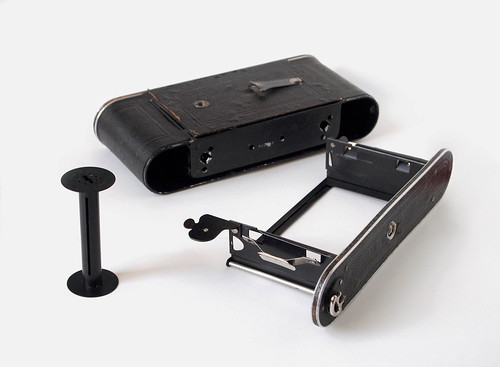
Zeiss Ikon Cocarette opened for loading
The Cocarette has an unusual system for loading film: the top or side, depending on which way the camera is held, has a sliding latch, which when unlocked allows the user to remove a frame into which film is loaded (this is described as the camera's 'film race' in this US advertisement). There are two hinged flaps which hold the film spools either side, and the film needs to be threaded between inner and outer rails; this design appears to have been developed from Contessa-Nettel's earlier Piccolette, which was an improvement on the drop-in loading of the Vest Pocket Kodak that inspired it. It also appears that this design was promoted to reassure customers used to glass plates about film flatness - this advert describes it as entirely eliminating "buckling of the film".

Apart from the 'film race', the Cocarette functions as a fairly typical folder of its day. The camera is non-self-erecting: the lens is pulled out to the infinty stop of the folding bed's rails by hand. Frame advance is by red window and backing number, focus by estimation using a lever with markings for infinity, 30, 15, 10 and 6 feet (indicating this as an export model for US/UK markets); the focus lever does advance the lens further forward than 6 feet, but without distance markings, possibly as the margin for error when focussing may have been felt to be too great beyond this point. The rim-set Compur shutter has the full range of speeds from 1 second to 1/250th, as well as T and B settings; the f4.5 Tessar lens stops down to f32. For framing there is a brilliant finder with spirit level that rotates through 90ยบ for horizontal shots and a wire frame finder: to use this, on the body is a small peep-sight that can be raised into position from a circular door on the back of the camera. This allows access to the lens for cleaning and removal (a feature that the Vest Pocket Kodak also possesses); either completely raised or lowered, this sight locks the rear door, but in an intermediate position the door can be rotated to remove it. Additonally, the lens is also provided with rise and fall in the vertical position.
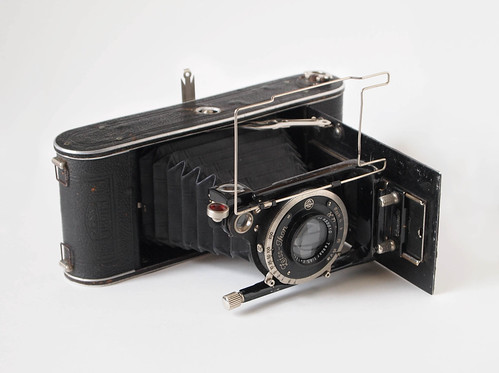
Zeiss Ikon Cocarette in horizontal format with wire frame finder and sight raised
My approach to converting the Cocarette to use 120 film was to do this in a non-destructive way, such that the camera could potentially use 70mm film in future - or, as on the Summer 116 Day, I used some original, expired 116 Kodacolor film. Research online shows two aspects to this conversion - firstly, some method of securing 120 spools into the slightly larger gap for the taller 116 spools - which needs to include the ability to wind on the advance key, and secondly, masking the frame itself down to the width of 120 film. With access to laser cutting facilities at the time I bought the Cocarette, I had adaptors made that would fit the top and bottom ends of spools from acrylic. Initially I thought that this would be enough, but when attempting to load camera with 120 backing paper as a test, there was too much of a curl to the paper at both top and bottom - as the 11cm wide frame doesn't hold the smaller format taut across it. Perhaps in a more conventional folding camera, this could be used without masking, although cupping of the film would potentiallt affect the focus on the film plane. I made a mask simply by cutting runners from thin black plastic sheet, which I taped to the top and bottom of the frame, but the camera also needed another pair of small runners inside the slots themselves to ensure that 120 film runs straight down the middle of the 'film race'.
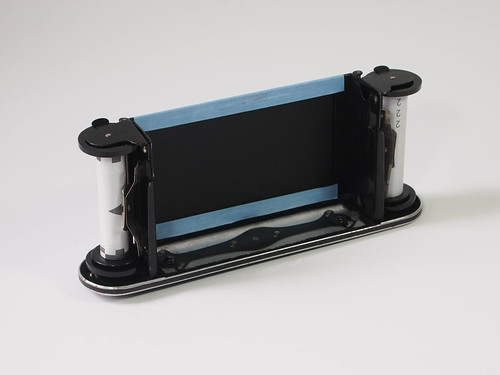
Zeiss Ikon Cocarette conversion - runners taped in place
I didn't make any changes to the viewfinder of my camera. Some examples of 116 conversion show the wire frame finders adapted to take into account the narrower frame. However, as using the wire frame finder - or brilliant finder for that matter - isn't exactly precise for the frame edges, and with 120 film only a small fraction is lost from the top and bottom of this image, I felt this to be unnecessary.

To test the frame spacing, I ran a roll of 120 backing paper through the Cocarette. The numbers which align with the red window are those for 6x4.5 exposures. As this exposure size isn't neatly divisible with the 11cm-long 116 frame, I counted turns of the wind on key to determine how far to advance the film between exposures. My first calculations were that I would need to make the first exposure starting with the number 2 on the backing paper to provide enough film to cover the frame; I estimated that 2 and 1/3 turns of the winding on key for each subsequent exposure was sufficient. To make this easy, there are three screws around the winding key to mark its position when turning. For the first test roll I simply discounted the problem of the circumference of the take up spool increasing as more film and backing paper is wound on. The first two images on the roll overlapped, but I then found an increasing distance between the frames. When I developed the first test roll, as well as the uneven spacing, this was marred by obvious light leaks (I discounted this being from the red window, as this should be light tight anyway - even with modern emulsions, the film's backing paper should be perfectly impervious, despite some comments that occasionally crop up in discussions online). Looking at the light leaks' position relative to the camera, it was clearly caused by a missing screw on the side which removes for loading. As I couldn't find a screw of the right dimensions to replace it, I simply used black tape to cover the hole from the inside.
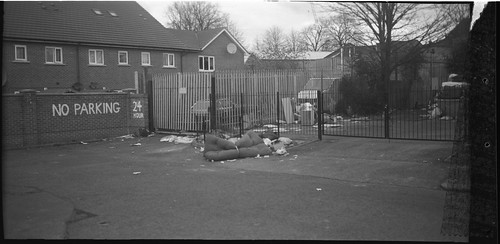
Second test roll, Fomapan 400, first frame showing tape mark at start of film
For a second test roll, I took the first two shots with a gap of 2 and 2/3 turns, then 2 1/3, finally just 2 turns between the exposures. This showed I'd solved the light leak, but, although none of the frames overlapped, the spacing was too generous, which resulted in five shots from the roll of film rather than a possible six. The first frame was also right on the very beginning of the film, overlapping the tape, as in the image above. It seemed safer to begin with the number 3 aligned in the red window, instead of 2, given that this initial length of film might vary between manufacturers.

Rather than counting turns of the winding key, I decided for the frame spacing, I would try using the numbers on the backing paper. Had I only wanted just five shots, it would have been easy to use the numbers 3, 6, 9, 12, 15, but there's clearly enough film on a roll of 120 to get six exposures. Running backing paper through the camera again, I noted down where I thought each frame should fall, using the marks that precede the frame numbers as well as the numbers themselves. For a third test, using the red window, I aligned the first mark before the number 3, then 5, first mark before number 8, third mark before 10, first mark before 13, 15. However, this isn't necessarily always possible, as different manufacturers have different backing paper designs: Foma, and some other films have three marks before the frame number; Ilford films have four circular marks increasing in size before the frame number; unhelpfully, Kodak just has the word 'Kodak' and the film name before the frame number. When using the camera, I taped a note with these estimations written down so as not to forget where I was in the sequence when shooting; I have yet to try taking 120 film and taping it to the 116 backing paper that I now have from shooting the expired film earlier in the year, which could be an alternative approach.
Zeiss Ikon Cocarette focus lever
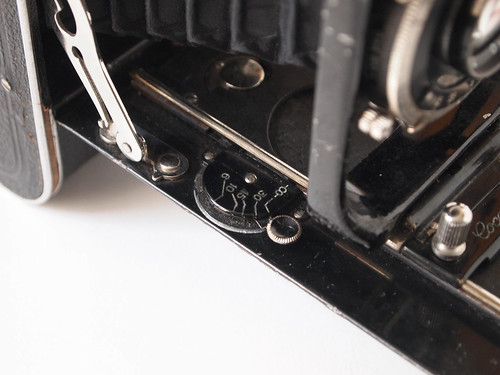
From my earlier tests, and using the camera during the summer, I realised that the focus scale was not accurate, and attempting to find out exactly why, I removed the panel at the back of the camera and using a loupe with some tape across the focal plane (I used some 120 backing paper with a hole in for the tape to best place this on the focal plane itself), it was clear that, when set to infinity on the scale, the lens was not extended far enough; at the 30ft mark, infinity seemed to be achieved. I then made the assumption, which I didn't measure, that I could simply shift each focus mark to the next nearest, so if 30ft is really infinity, then 15ft becomes 30ft, and so on. This worked well enough for the shots I'd taken on the last 116 Day, although a more permanent solution might be better, but the only practical way to do this would be to remove the infinity stop, which takes the form of a small peg screw, drill a small hole in the folding bed slightly forward of its original position, and replace it there.

As I wrote on my post for the summer's 116 Day, using 120 film in a 116 camera does make for an attractively proportioned image, especially suited to landscape photography, and, like the Zeiss Ikon Cocarette (despite my camera's focus issues which may yet require more attention), there are many of these cameras still around which can be used with currently available film with a little extra work.
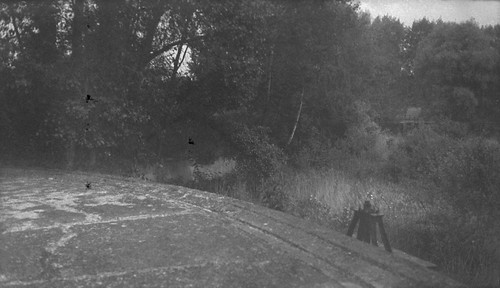
Zeiss Ikon Cocarette with expired Kodacolor film
Zeiss Ikon Cocarette with Agfa Superpan 200
Zeiss Ikon Cocarette with Fomapan 400
Zeiss Ikon Cocarette with Ilford HP5 Plus
Sources/further reading:
The Cocarette series on Camera-Wiki
Cocarette models on Early Photography
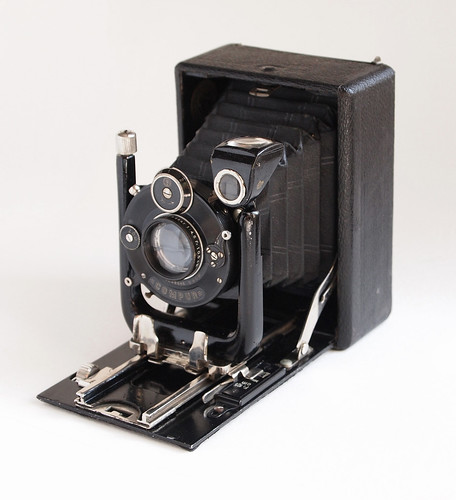
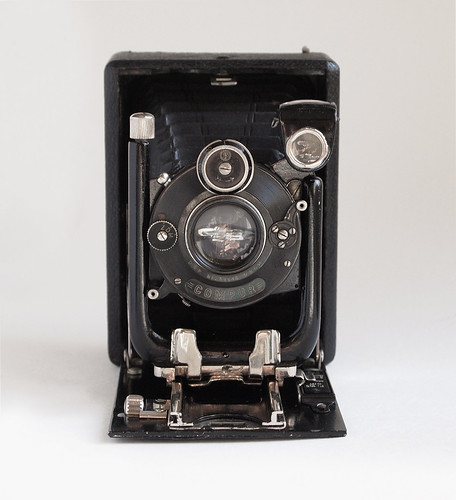
Tuesday, 2 December 2014

Old Lenses

"Now, of course, the most important parts of cameras are lenses."
"Ooh no, you can't say that, old boy, you can't say that."
"Why not?"
"That's not grammatical. You should say lends. Lends. I lends, he lends, or he borrows, or he scrounges, that's you. You can't say lendses." 
"Yes you can, you don't understand me, the lens, the lens is in front of the camera and it is through this that the light gets to the plate or film."
"Sounds like a little dental outfit, doesn't it?"

Clapham & Dwyer, 'On Photography'

Not to be confused with Susan Sontag, the above exchange from a 1930s 78rpm record of a variety act works better aloud than being read on the screen, and, in titling this post 'Old Lenses', for some reason, I thought of them. In the post I wrote about the MPP Micro-Technical camera, I didn't put enough emphasis on one attraction of large format cameras: the ability to use a very great variety of lenses. As long as the lens can actually be mounted on the camera, which in practice means fitting to a lens board, the only considerations as to suitability are, firstly, bellows draw, whether the bellows can be extended (or retracted) enough to focus the lens and, secondly, the image circle the lens projects, whether this is wide enough to cover the film format and if it is large enough to also allow movements (a chief attraction in most large format camera designs itself).

When I bought my MPP Micro-Technical Mk VI camera, it came with a 150mm Schneider Kreuznach f4.5 Xenar lens. On the 4x5 inch format, a 'normal' angle of view, based on the diagonal measurement of the image sizes would be 150mm. However, the angle of view for a normal lens is not directly comparable with a 50mm lens on a 35mm camera (for example), as 4x5 has different, squarer, frame proportions and the 150mm lens sometimes felt a little wide for many shots (I also bought a wide angle 90mm Schneider Kreuznach Angulon lens, although I've rarely used it). Although I've been shooting large format for around four years, it does feel like I still have much to learn (more so than with other formats), and still making mistakes. Considering the options for longer focal length lenses, these can be very expensive, and while it would be ideal to use the best equipment available, an initial outlay of hundred of pounds in lenses that might not be used very often, although an investment, may not be the best way to start shooting large format. Close to the Xenar's 150mm focal length, I found a very cheap (under £40) f5.3 Zeiss Tessar 16.5cm lens in a dial-set Compur shutter, which I've used for many of the large format glass plate night shots (I've written elsewhere about my preference for dial-set shutters over the rim-set versions).

Carl Zeiss Tessar 16.5cm f5.3 lens
There isn't much to add about the Tessar lens here, except perhaps that it may be slightly lower in contrast to the Xenar due to being a pre-war uncoated lens. This may work better for situations such as in the image above, shot with Kodagraph Ortho Negative film, a high-contrast repro film (the Xenar, not a recent lens by any means, is a Tessar-type design, but my lens, from the 1950s, is at least coated, and perhaps better suited to colour work than an uncoated lens). Given the age of the Tessar lens (the serial numbers on the lens and shutter date it to 1926) and the focal length, it possibly came from a camera such as the Ica Lloyd or Nixe, a camera using 'postcard' format 122 rollfilm with an optional plate back.

Bausch & Lomb Rapid Rectilinear lens in Kodak Ball Bearing shutter
Kodak's 122 format was made for their No 3A Folding Pocket Kodak. The 122 rollfilm gave negatives of 3¼×5½ inches (8.25x14cm), a sufficient size when most photographic prints were made by contact printing. The No 3A Folding Pocket Kodak was provided with a number of lens/shutter combinations: I had one with a Bausch & Lomb Rapid Rectilinear lens in a Kodak Ball Bearing shutter, and had intended to convert the camera for (cropped) panoramic shots on medium format film. However, having languished in a drawer for a number of years, I decide to mount the lens and try it with the MPP camera. The Rapid Rectilinear lens design dates back to 1866; this one has a patent date of 'Jan 18 1910' on the shutter. The lens itself doesn't provide very much information: there's no serial number and no indication of focal length. The apertures are marked in U.S. stops: 4, 8, 16, 32, 64, 128. These equate to the standard f-stop system of f8, f11, and so on; the U.S. stop of 16 is the same as f16, which is useful to work out how the two systems match up (although U.S. stands for Universal System, it was not widely adopted, and went out of use around 1920). The ball bearing shutter has speeds of 1/25th, 1/50th, 1/100th and T and B settings. I tested the shutter speeds by making an audio recording and found that all speeds were the same, around 1/40th. Mounted on the MPP camera, the focal length of the lens appears to be around 180mm, although this would probably have been expressed in inches originally. As the Rapid Rectilinear lens is made from two sets of cemented symmetrical elements, I'd read somewhere that it should be convertible: both front and rear sets of lens elements are sufficiently well corrected to form an image alone, and this aspect of the lens I wanted to try for myself.

Bausch & Lomb Rapid Rectilinear lens with yellow filter
Bausch & Lomb Rapid Rectilinear lens - rear lens elements only
When shooting with the Rapid Rectilinear, there were a number of calculations to work out the exposures required. To begin with, I used an exposure index of 250 with the Fomapan 400 film and factored in a deep yellow filter for the first of the two images above; the US stops had to be converted; and with only the rear elements in the lower image, I also had to calculate the bellows factor, which I've written about in my last post on Distars and Proxars.

I also shot the same scene with the Xenar lens for comparison: the Xenar clearly is much better for edge to edge sharpness, and it is in the out of focus areas where the difference between the two lenses is clearest: the Rapid Rectilinear's characteristics are most noticeable in the long grass in the foreground. In both shots it's possible to discern the astigmatism in these out-of-focus parts, which the Rapid Rectilinear is not corrected for, especially in the second photograph, which was shot with just the rear lens elements at the widest aperture, which would have been equivalent to f16 at a focal length of around 360mm. This was also shot without the deep yellow filter, which reduces the contrast further. However, the Rapid Rectilinear is still good stopped down and large format is very forgiving at a relatively small scale of reproduction; in a large print it may be a different matter.

Left: Xenar; right: Rapid Rectilinear (rear elements only)
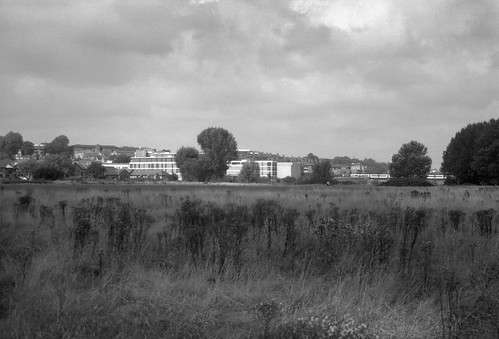
The images below, starting with a photograph using the 16.5cm Tessar, were all shot at smaller apertures. These were also shot on Fomapan 400, this time rated 320. I also used the deep yellow filter on the shot without the front lens elements, as the shutter's screw mount protrudes enough for the push-fit filter. With the ball bearing shutter only firing at around 1/40th, by necessity the exposure with just the rear elements of the Rapid Rectilinear was two seconds on the 'T' setting, allowing me to stop the aperture down to the equivalent of f64. As the clouds were moving away from the lens, rather than across the field of view, the length of exposure did not result in blurred clouds, but movement shows up in some of the trees.

Carl Zeiss Tessar 16.5cm lens with yellow filter
Bausch & Lomb Rapid Rectilinear lens with yellow filter
Bausch & Lomb Rapid Rectilinear lens - rear lens elements only with yellow filter
As the results show, these lenses do have their own character and quirks, and although many better lenses have been designed since the Rapid Rectilinear (and, indeed, the Tessar), and the results will not be as good, older lenses represent a possibility, if also a compromise, of cheaply expanding a range of focal lengths available (especially with convertible lenses) for view and large format cameras. 

Sources/further reading:
Through A Vintage Lens on the Rapid Rectilinear
Rapid Rectilinear on Camera-Wiki

Wednesday, 15 October 2014

Ica Trona 210

Ica Trona 210
For some time I have been thinking about writing a post on 'small large format', to discuss my 9x12cm folding plate 'hand and stand' cameras, the Kodak Recomar 33 and Voigtlรคnder Avus, but there always seemed too much information to convey in such a post and I hadn't used either camera enough, for a number of reasons. However, having begun developing films at home over the summer, rather than the darkroom I usually use (which is being refurbished), and having bought an Ica Trona 210, the ease and speed of turnover for developing sheet film (or glass plates) has meant, in a short space of time, I've used the camera quite a bit. One reason I was going to call the post on 9x12cm cameras 'small large format' was firstly that, although it is open to debate, and opinions differ, 9x12cm is considered the smallest sheet film format to be sufficiently large to be labelled such - if it's considered at all, that is. Many would use 4x5 inches as a starting point, but as 9x12cm is less common in the UK and US, it's hardly thought about as a format (the Wikipedia entry begins "Large format refers to any imaging format of 4×5 inches (102×127 mm) or larger..." then adds "Less common formats include [...] metric formats, including 9×12 cm"). Indeed, when I bought the Voigtlรคnder Avus some years ago, I was not aware of it, yet in continental Europe it is not uncommon as a sheet film size (Ilford also manufactures film in 9x12cm, although possibly only during its annual ULF production run). I saw the Ica Trona in an online auction with a prominent warning that "it is NOT possible to obtain film which will work in this camera. It is sold for DISPLAY ONLY." At the time I had a mostly full box of Fomapan 100 and three boxes of HP3 glass plates in the size, the buyer's warning was a goad for me to place a bid on the camera, and the auction went for its starting price.

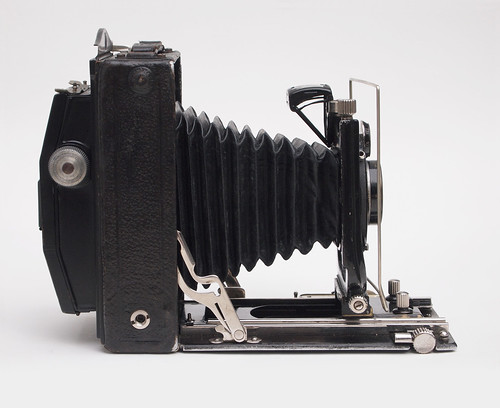
A second reason I was going to call the post 'small large format' was also the size of the cameras. By no means small in themselves, compared to most 4x5 inch cameras, these 9x12cm cameras are compact, being around the size of a thick paperback book (a doorstep airport novel, say): the Trona is 16 x 11.7 x 5cm when folded. One notable reason for these cameras' compactness is that most do not possess rotating backs, a feature which would make the cameras square to the longest dimension of the plate or film holders. My Ica Trona dates to the early 1920s, but the design of these folding plate cameras was remarkably similar across various manufacturers from the early years of the century until the later 1930s, when most of these cameras seem to have been discontinued, their functions being replaced by professional view and press cameras, while for amateur photography all kinds of rollfilm cameras had made the 'hand and stand' camera seem awkward and obsolete (a quick glance at the folding hand page of Early Photography shows how similar many of the cameras are).

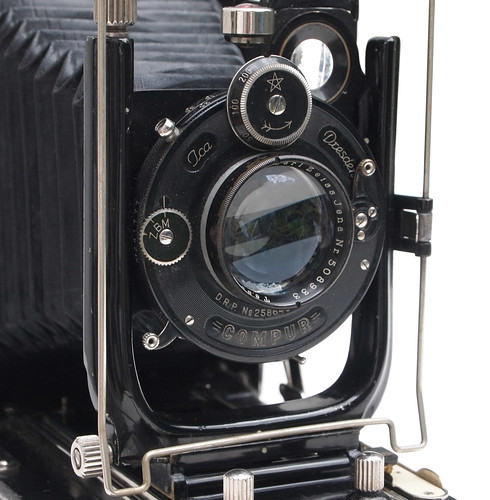
I briefly wrote about Ica's history in my post about the Icarette; unlike the Icarette, the Trona was one of the cameras that Ica continued to manufacture from one of its founding companies, and, when Ica became combined into the new Zeiss Ikon, the Trona was continued (alongside many other similar models - Zeiss Ikon's range of cameras in the early 1930s contained numerous near-identical but different models, many of which had come from the once-rival companies which came together to  make up Zeiss Ikon). The '210' after the Trona name is the code for the camera's image size - the 210 is 9x12cm, while there was a 6.5x9cm model, the 110 (there was also a quarterplate model, apparently sold in the US and UK markets only). Zeiss Ikon continued these model codes, with variations. The 1925 Ica catalogue reproduced on Camera Eccentric lists the Trona 210 with a f4.5 Tessar at 218 marks, making it one of the more expensive models, after the Niklas and the Ideal.

Conceived in the age of photographic plates, focus is by removable ground glass screen (the spring back appears to have been a later innovation), with each photographic plate loaded into individual plate holders. The Trona has features common to many 9x12cm folding plate cameras of a similar age: double extension bellows for a near 1:1 scale image when extended, front rise and cross movements, a rotating brilliant finder with spirit level, and a wire frame viewfinder. As with many pre-war cameras, the Trona was provided with a number of different lens and shutter combinations. My model has what would have been the top-of-the-range f4.5 13.5cm Tessar in a dial-set Compur shutter (later Zeiss Ikon Tronas were provided with a faster f3.5 Tessar). The shutter's rotating selector is marked 'ZBM', which seems an unusual variant, standing for Zeit, Bulb, Moment. Other Compur shutters I have of a similar age have 'D' for the German 'Dauer', rather than B, or 'TBI', standing for Time, Bulb, Instant - and some shutters have both. It appears that later Compur shutters were standardised with the letters representing the English terms.

Ica Trona lens and shutter detail
Although the ground glass screen has a wooden frame, the camera body and drop bed are both metal as are all the 9x12cm plate holders I've picked up over the past few years. Most of these work in all three of my cameras in this size, with the exception of two Kodak holders, which, oddly enough, do not fit the Kodak Recomar. The inter-war period appears to mark the transition from glass plate negatives to film, although in the 1940s Ilford were still producing many more different types of emulsions as glass plates rather than film. However the folding plate cameras of this era were provided with all the accessories needed to shoot film as well as glass. Firstly, film sheathes or septums were produced for film holders: to ensure flatness and the correct focal-plane distance, the sheathes hold sheet film in the place of a rigid glass plate. Secondly, film packs were made which held several sheets of film in an arrangement of light tight backing or covering paper (the special backs or holders for film packs often show up with the cameras themselves, not infrequently in the place of the ground glass screen). Thirdly, roll film backs were made to use medium format film.

Ica Trona with rollfilm back
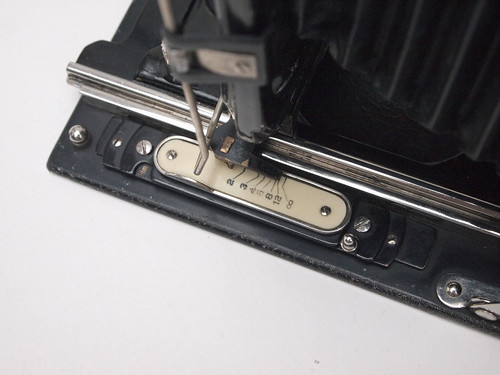
On the 9x12cm size, the rollfilm back does mean the image is cropped to 6x9cm, essentially a 'half-frame' size (one of my rollfilm holders also included masks for 6x6cm and 6x4.5cm frames, but this would mean sacrificing a large amount of the camera's size for a narrow angle of view to get more shots on a roll of film). The Ica Trona has a lever by the focus scale to switch this from Plate to Film, which moves the focus scale/infinity stop back by a very small amount. This only affects focus when using the scale itself, as it does not move the lens standard - unless this is locked into the infinity stop. Like most folding cameras from this era, the lens is not self-erecting, the lens needs to be pulled out by hand along the rails as far as the infinity stop, which then needs to be disengaged to use the rack and pinion focus. This is done by pulling out the sliding lever next to the focus knob which is connected to the focus scale on the other side of the drop bed. It can also be used to lock the focus knob at any point by pushing it back inwards.

Ica Trona focus scale
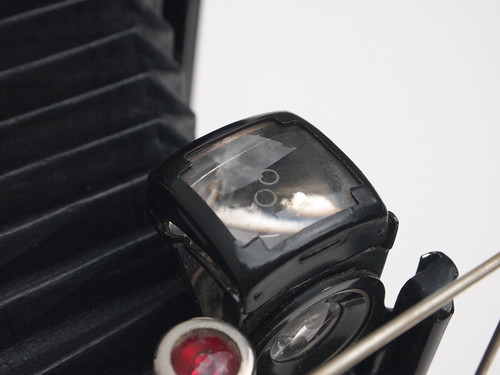
A reason to use such cameras today is their relative compactness for the large negative size, and the ease of hand held use - although historically large format press-type cameras were generally used hand held, I would not want to risk camera shake from trying to use my MPP Micro-Technical camera in the same way (by no means light, the Ica Trona is 1.2kg and the MPP 2.9kg). When shooting hand held, I have been using the ground glass screen to focus, then removing and replacing the screen with either a plateholder or the rollfim back, and framing the shot with the wire frame finder, or for a few shots, using the brilliant finder, holding the camera against my body for stability. The brilliant finder has a feature that I have seen on other cameras, but none of my other cameras with such finders possess: the glass is etched with two small circles which should be aligned to ensure that the framing of the finder is accurate and not at an oblique angle.

Brilliant finder with etched circles
Some shots, notably the still life and studio photographs below, required a tripod for stability, but, more importantly, for accurate framing and focus. The Trona has one tripod screw fitting for landscape orientation, and two for portrait - one of these is placed towards the front of the drop bed to balance the camera when the lens is fully extended. The Tessar lens, although uncoated, is still capable of great definition and character. For initial tests with the camera, I shot a few Ilford HP3 glass plates from the early 1970s, which I was able to use hand held, rating them at 50 to compensate for age (most of the other plates I've been using are much slower), and Fomapan 100 sheet film and some rolls of Rollei RPX 100 in the rollfilm back. The dial-set Compur shutter has one advantage over the later rim-set designs in that it's useful to be able to switch between Z and M functions when focussing with the ground glass without having to change the shutter speeds on the dial.

Ica Trona with Fomapan 100
Ica Trona with HP3 glass plate
Ica Trona with Rollei RPX100 in rollfilm back
I was fortunate to have bright sunny weather for the photographs above, taken hand held with the Trona, which meant I was able to use relatively small apertures and faster shutter speeds. On a subsequent occasion, with lighting conditions less favourable, I rated the Fomapan 100 at 200. Developing with Ilfotec LC29, I couldn't find any times for a one stop push online, neither from Foma nor the Massive Dev Chart, so with a dilution of 1:19, I estimated a time of 12 minutes at 18ยบC. The image below suffers from a lack of detail in the sky which a yellow filter may have helped to a degree, although the sky itself may have just been flat and overcast. The front lens standard is also not as rigid as it could be, and some of the photographs appear to show that, with wide apertures at least, if the lens isn't quite parallel to the film plain, the image isn't in focus across the whole surface of the negative, as the second image below demonstrates, as it becomes out of focus towards the left hand edge (some of my other old folding cameras seem to suffer from the same problem). This may in part be due to inadvertently pulling the lens with a backward motion while tripping the shutter, and being aware of this, with care can be avoided.

Ica Trona with Fomapan 100, push processed at 200
Although in the past I've used my Kodak Recomar 33 as a more portable large format camera, the Recomar has a more limited four-speed Telma shutter and a slower lens and, although most of the time the lens is stopped down for shooting, a faster lens is useful to focus and compose using the ground glass screen. The Avus had no ground glass screen when I bought it, having an empty film pack back in its place, which I did eventually convert into a ground glass screen, but the Avus also has a very stiff shutter dial, and, although trivial, the small clip which secures the plateholders, ground glass screen or rollfilm backs to the camera is very difficult to move in and out. In comparison, the spring clip on the Trona is designed to allow a plateholder to be inserted without pulling it aside as a separate action. The differences between all three cameras are small, but nonetheless, the Trona feels more sympathetic in use.

Ica Trona with Fomapan 100, push processed at 200
Ica Trona with HP3 glass plate
Ica Trona with Rollei RPX 100 in rollfilm adaptor
Sources/further reading:
Ica Trona on Early Photography
1925 Ica Catalogue

Saturday, 2 February 2013
Ica Icarette II/L

Ica Icarette II/L
Ica was a relatively short-lived Dresden-based camera manufacturer, formed in 1909 by the merger of four companies: Hรผttig AG; Kamerawerk Dr. Krรผgener; Wรผnsche AG; and Carl Zeiss Palmos AG. Its name is derived from Internationale Camera A.-G. and it's often written ICA, however as written on the cameras themselves, in advertisements and other documentation, the company's name appears as Ica. Ica was one of the 'name-giving' partners when it merged with Ernemann, Goerz and Contessa-Nettel to create Zeiss-Ikon in 1926.

Ica continued many camera models from its constituent companies, but the Icarette line of elegant folding cameras was an entirely new range, using a number of different rollfilm formats, from 127 to 116. The Ica Icarette II (named the Icarette L in US Ica/Zeiss Ikon catalogues) takes 6x9cm size images on 120 film, but it's a dual format camera (as are some of the other Icarette models), meaning that it also takes plates. This makes it a model 500/2: there is an Icarette II which takes rollfilm only, with a model number of 500/1; the Icarette I was a horizontal folding camera in the 6x6 negative format. The Icarette II 500/2 has a section of the camera back with the orange window–and a separate pressure plate–that can be removed and replaced with a ground glass screen and plateholders for 6.5x9cm (or 2 1/2x3 1/2 inch) glass plates (my first post on glass plates discusses the differences between metric and imperial sizes). When loading rollfilm, the camera back removes entirely, and the spool holders on each side are hinged to swing out for ease of loading. The focus scale has to be adjusted to either 'P' for plates or 'F' for film as the focal plane changes depending on which format used. This has a notch for infinity, which the lensboard pulls out to, the Icarette being non-self-erecting, as self-erecting designs for folding cameras only became common in the 1930s. There's also a handwritten focus scale on the other side of the bed for the Distar lens attachment.

Ground-glass back removed, and plateholder inserted.
The first Icarettes were produced in 1919, with the II/L model appearing c.1925. My camera is from early in the Icarette II's production. The serial number on its lens dates it to 1924; interestingly the shutter's serial number appears to be from before 1920. As was common with many folding cameras, the Icarette was offered with a range of lenses depending on price. My example has the top-of-the-range Carl Zeiss Jena f4.5 105mm Tessar lens.

Icarette L lens detail
The above detail shows the Tessar lens in a dial-set Compur shutter; the shutter settings of T for 'Time', B for 'Bulb' and 'I' for 'Instant' suggest the camera was produced for export; I have a contemporaneous Voigtlรคnder Avus with a Compur shutter with 'Z' 'D' 'M' marked on it, for 'Zeit', 'Moment', and 'Dauer' (duration). Unlike the later rim-set Compur shutters, the exposure mode is selected on the small wheel to the left of the lens in the picture above and the shutter speeds are set independently on the dial at the top.

The camera also features double extension bellows, and a rising front. I have found the double extension bellows can cause a problem when focused from infinity to any moderate distance, as most of the length of the bellows remain in the camera's body unless drawn out manually, otherwise they tend to occlude the edges of the frame widthways, blurring them. For a viewfinder, there's the brilliant finder adjacent to the lens, a wire frame sportsfinder, which has an unusual profile to fit around the shutter and permit access to its controls, and the ground glass screen when using plates.

One of the curious features of my Icarette is it has "The Westminster" impressed into the leather on the back of the ground glass screen hood, the rollfilm back and inscribed between the knobs of the lensboard base. This could be The Westminster Photographic Exchange: much like my Baldalux camera rebadged by Wallace Heaton, presumably the Icarette was sold in the UK by The Westminster Photographic Exchange. There's a camera very like the Icarette II in one of the company's advertisments, 'The Westminster' can be discerned on leather on the camera, although on closer inspection, I believe the camera depicted in the illustrations is actually a Contessa Nettel Cocarette (identifiable by the shape of the wireframe finder, catch on the camera body, and the vertical stand).

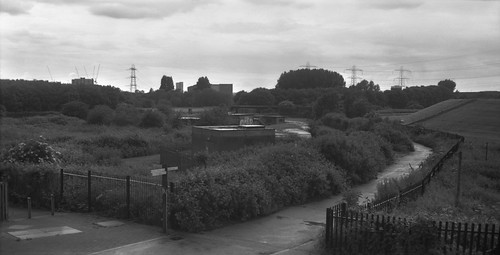
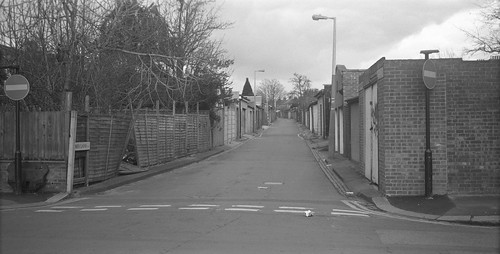
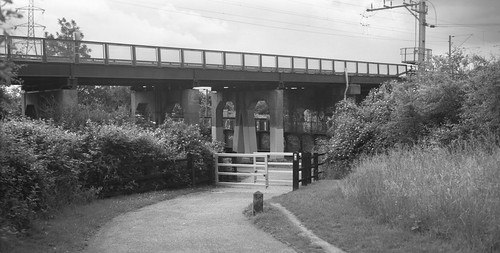
Although I also have a Wallace Heaton plate camera in 6.5x9cm size, I've only used the Icarette II to shoot my glass plates in this size. Fortunately, my Icarette still had both the ground glass screen and the rollfilm back and pressure plate, as well as a leather wallet with four Ica plate holders and a case. As well as plates, I've also shot a few rolls of film; the Icarette II is not the most convenient of my medium format folding cameras - but possibly has the best lens. The Tessar lens, nearly ninety years old, performs very well. In the examples below, the photograph of the London 2012 Olympic Village in particular shows the good edge-to-edge sharpness of the lens.

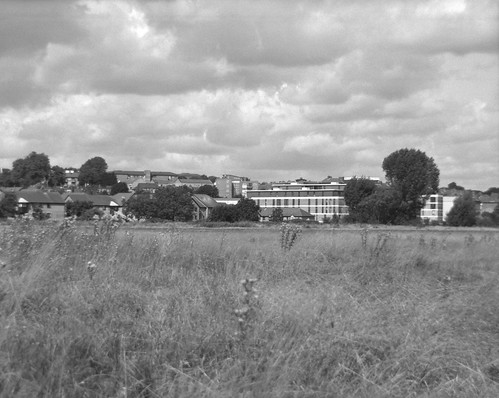
Hackney Downs, Rollei RPX 400 developed in R09 One Shot (Rodinal) 1+25 for 11m15s at 18˚C
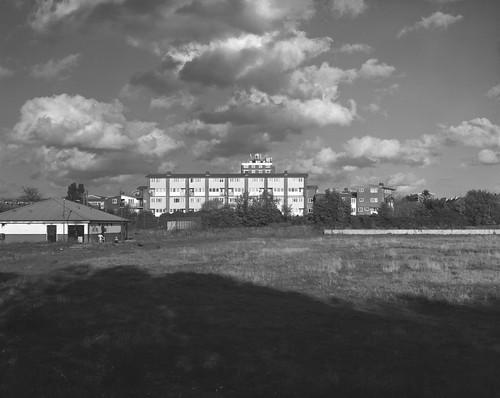
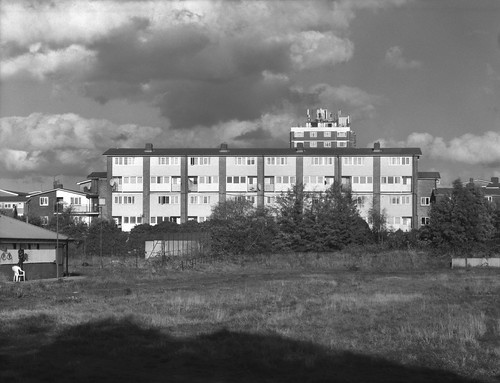
London 2012 Olympic Village,  Fomapan 200, developed in Rodinal 1+50; 8mins at 20 degrees C.
Ilford R10 glass plate, stand developed in Rodinal 1+100
Kodak O.250 glass plate, stand developed in Rodinal 1+100
The Icarette II was continued by Zeiss Ikon long after Ica's merger into the new conglomerate. This advert shows that it was produced until at least 1937, while none of the other Icarette models appear: perhaps as a dual format camera, the Icarette II filled a unique niche in Zeiss Ikon's range.

Sources/further reading
Icarette models & Ica pages on Camera-Wiki
Ica chronology (in French)
Ica pages on Early Photography