Showing posts with label Ica. Show all posts

Friday, 23 September 2016

Butcher's "Cameo"

The "Cameo"
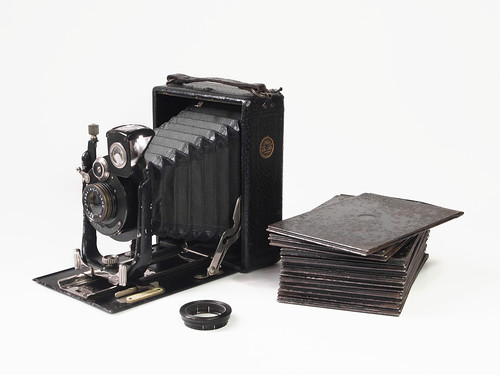
Sometimes I acquire cameras almost by accident. After using the Ensign Folding Klito earlier in the year, I bought another quarter-plate format folding camera as it came with a full complement of a dozen plate holders, and probably would have paid around the same amount for the plate holders on their own. However, these metal holders were not compatible with the Klito: the Klito holders have a single 'lip' on the left and right edges and none at the bottom. These particular holders in comparison have a double lip at both sides with a single lip at the bottom edge which meant that they were not interchangeable. It's an issue not uncommon for early plate cameras, as many manufacturers had their own propriety designs, especially it seems around the turn of the century; only later was there a degree of standardisation amongst different camera makers.

Cameo with plate holders and supplementary lens
The camera that these holders came with was a Butcher and Sons Cameo (on the camera itself is a small brass name badge with The "Cameo").  I've already written about Butcher and Sons in discussing the Midg: their cameras were made in Germany and then badged and sold by Butchers - with most likely some other elements of finishing by Butchers, notably that the Cameo has a British-made lens in a German shutter. The camera itself was almost certainly made by Hüttig, or Ica - of which Hüttig was a constituent when Ica was formed in 1909: the 'Cameo' is listed as a plate camera under the Hüttig page on Camera-Wiki, but does not appear as a 'continued model' on the Ica page, although this may just be an omission (however, the Cameo also does not appear under the comprehensive Ica cameras list on From the Focal Plane to Infinity).

Research online turned up scans of a Butcher and Sons catalogue from 1914, which was invaluable for precisely identifying the model. There are four versions of the Cameo listed: my camera corresponds to the Model O, surely a back-formed name: the others are named with Roman numerals I, II and III (the 'Uno-Cameo'); the O is a simpler, cheaper version. It does appear to be named with a capital 'O' rather than a zero, although whether anyone referred to it as a "Model-Oh" seems unlikely. To add a small amount of confusion, the Model O is divided into five variants based on lens and shutter combinations: my example is the middle of the range Model 03 (the other Cameos, although having a wider variety of sizes, lenses and shutters are not burdened with a further model name in the catalogue). The catalogue states that "The Model O "Cameo" has for fourteen years held the lead as the most serviceable, most practical, and most valuable Guinea Folding Pocket Camera on the market, and for this reason has become famous the wide world over. The 1914 pattern has been entirely remodelled, and is now as perfect as is possible to make it." As an importer of cameras from Germany, the outbreak of war that year was significant: it resulted in Butchers forming a partnership, and then an eventual merger, with Houghtons in order to stay in business.

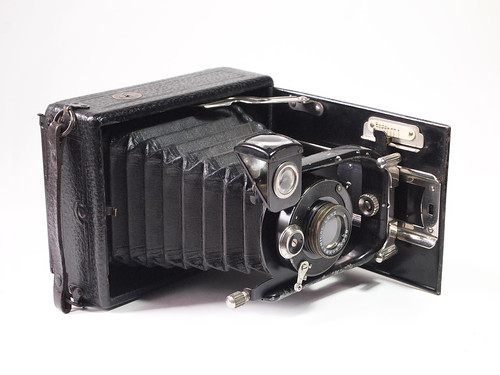
Cameo in landscape orientation
The Cameo itself is a fairly well-constructed example of a typical plate camera of its time: leather-covered wooden body, with a metal drop bed, removable wooden back for the ground glass screen, originally with a hood, missing on my version. It has a large brilliant finder, without a spirit level. It also lacks a wire frame finder, which I prefer for shooting handheld. The bellows are single extension only, and focus eschews a rack and pinion device for the simpler expedient of using the spring clamps, as the catalogue names them, to advance the front standard along the runners. There is a focus scale with an infinity lock, but for precise focusing, this is rather more difficult as I found my hand partly occluding lens as I attempted to move the standard into place. As well as a hood, my camera was also missing the ground glass screen itself, so I made a replacement, although I used too coarse a grade of grit to see the projected images very clearly (incidentally, to make the replacement screen I had to cut down a glass plate for this, as the screen is smaller than quarter plate size). Camera movements are limited to front rise/fall and cross, like most folding plate cameras of this age. The body also has standard tripod sockets for vertical and horizontal orientation.

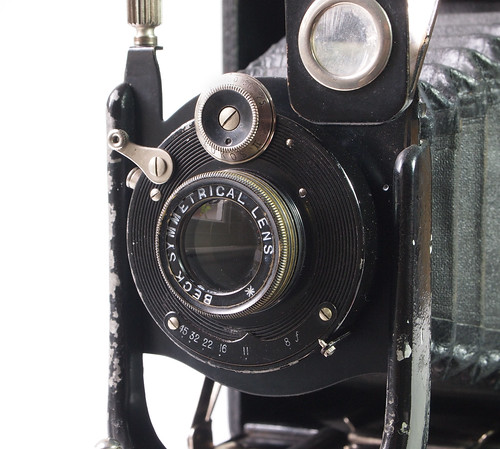
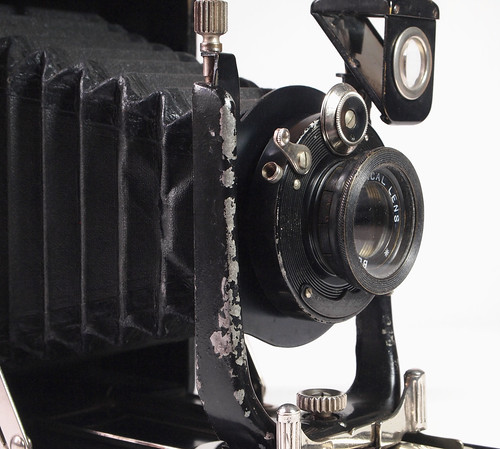
Beck Symmetrical lens in Lukos II shutter
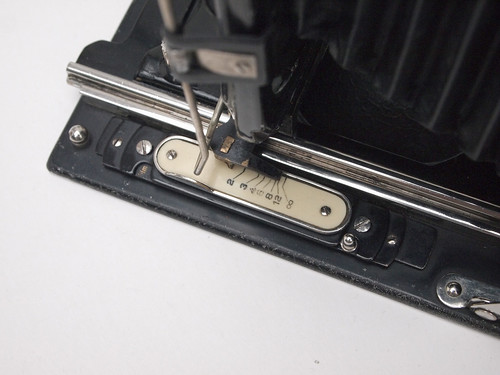
The Beck Symmetrical lens has a mark for f8 as its widest opening on the scale, but the aperture opens a little wider, as shown by the pointer's position in the image above, possibly just to f7.7. It does have a chip or crack at the very edge of the front element, but this probably has a marginal effect on image quality. The lens is set in a Lukos II three-speed shutter, with 1/25, 1/50, 1/100, with T and B. The Lukos is an 'Everset' shutter, meaning that it doesn't need a separate lever to cock the shutter before firing, but the tensioning of the mechanism can be felt in initially pressing down on the release lever before it reaches the firing position. According to the 1914 catalogue, Lukos shutters were specially made for Butchers - although not specified, no doubt by Ica.

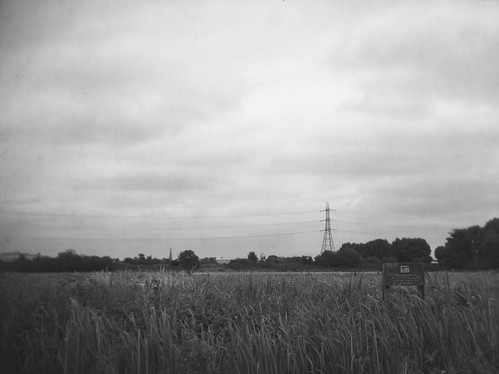
Having made a new ground glass screen and submitted the camera to some general cleaning and renovation, an excuse for shooting with the Cameo came with the announcement on Emulsive of the first #FP4Party. In one of my job lots of old film and plates, I'd acquired two boxes of 8.2x10.8cm FP4 from the 1970s: with 50 sheets to a box I was happy to sacrifice a few sheets to test the camera, and having used some 4x5 inch FP4 from the same source successfully, without testing the film itself. I shot half a dozen sheets at half box speed and used developing times for modern FP4 Plus - the sheet film being the previous iteration of Ilford's FP emulsion before the 'Plus' version.

Cameo with expired Ilford FP4
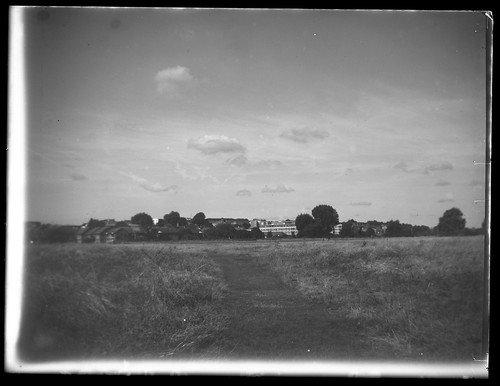
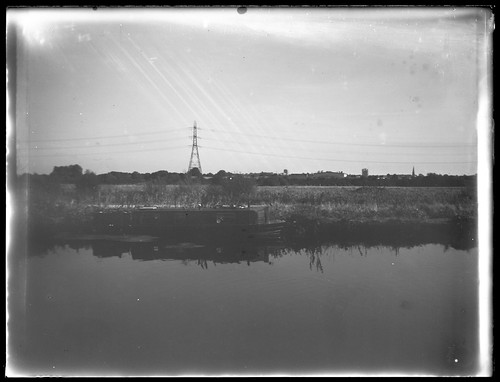
As well as the FP4 film, I also shot some glass plates at the same time. Thirty years older than the FP4, I shot some Ilford Soft Gradation Panchromatic plates, dated to 1946, hand held, with the result that most were underexposed given the Cameo's slow lens. The plates would have been better for an extra stop or two, but the results are still good for a seventy-year old emulsion.

Cameo with Ilford Soft Gradation Panchromatic glass plate
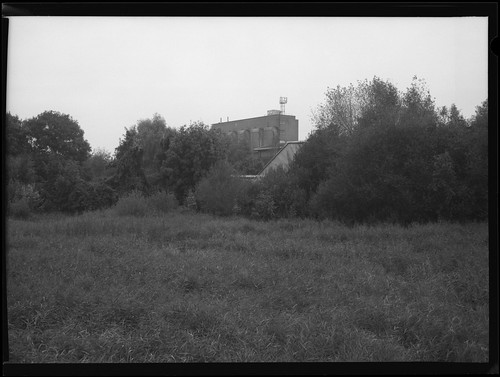
Without a spirit level or a wire frame finder, I had trouble keeping the camera level when shooting, and as a result, I have cropped some of the FP4 images, although with the glass plates the qualities of their distinctive edges would be lost, so I kept the scan of the whole plate, as above, despite the slanting horizons.

Cameo with No.6 supplementary lens fitted
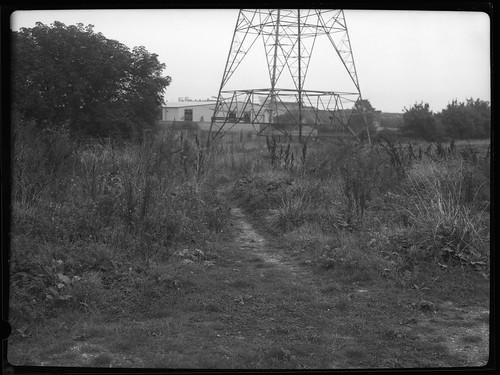
Included with the Cameo camera was a push-on supplementary lens, with little information to identify it, marked simply 'No.6'. Fitting it to the camera showed it to be for close up and wide angle use, the former mitigating the camera's limited, single bellows extension to get closer to a subject, the latter simply facilitated by placing the front standard a little closer to the camera body. With the supplementary lens it's critical to use the ground glass screen to focus, as the focus scale on the body no longer applies; for wide-angle work, the brilliant finder shows a slightly smaller angle of view, but using the finder itself isn't especially exact, so this matters little. The two images below show the difference with and without the supplementary lens, which isn't especially dramatic.

Cameo with No.6 supplementary lens and expired Ilford FP4
Cameo with Soft Gradation Panchromatic glass plate
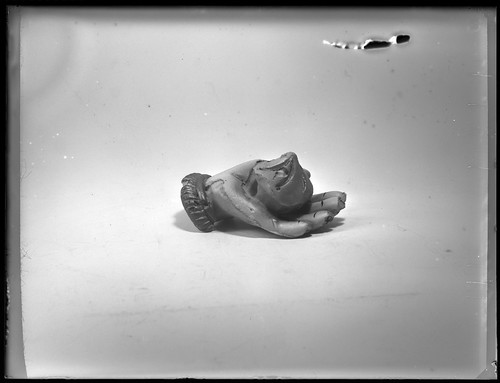
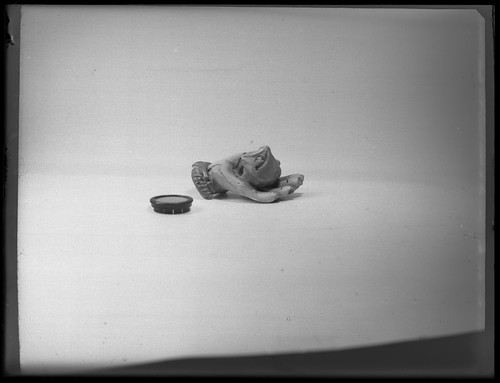
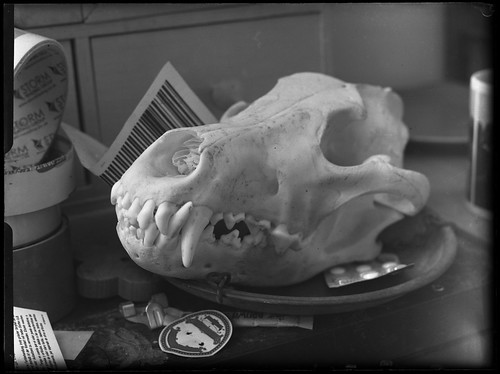
The difference when used for close up photographs appears more marked, with the two examples below both shot on Ilford G.30 Chromatic glass plates. In each case, the front standard of the camera was advanced as far as possible on the runners, right at the very edge of the folding bed.

Cameo with Ilford G.30 Chromatic glass plate and No.6 supplementary lens
Cameo with Ilford G.30 Chromatic glass plate
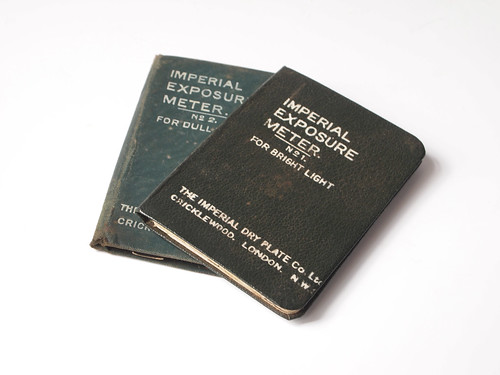
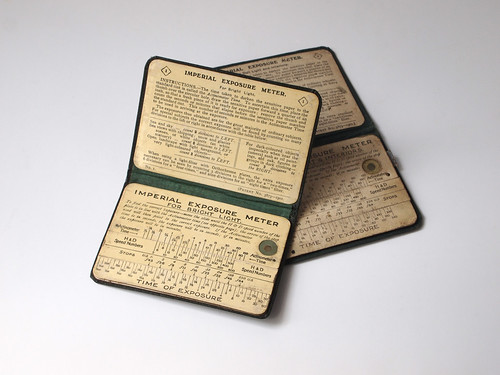
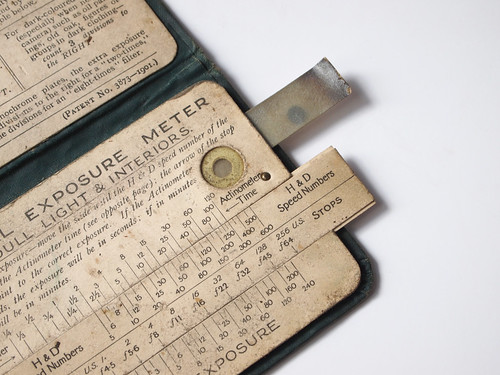
Although not used for any of the photographs in this post, the Cameo also came with two exposure meters of a very specific kind. The two wallet-like items are actinometers and work by timing how long a piece of sensitised paper takes to darken to a specific tint; that time is then applied to the calculator, which is calibrated to emulsion speed in Hurter and Driffield numbers. Possibly around a hundred years old, I found that the sensitised paper still darkened when exposed to light; some of my old glass plates are rated in H&D numbers, but most of the photographs in this post were shot with the 'sunny 16' rule rather than metered (I used an SLR to meter the close up shots and overexposed most of them).


Imperial Exposure Meter showing sensitised paper strip and sliding calculator
A century ago, the Cameo would have given quite adequate results on glass negatives for photographs that would have mostly been printed by contact. The Beck Symmetrical lens is sharp in the middle, but definition falls off towards the edges at wider apertures, and for some of the reasons I've mentioned, the Cameo isn't the easiest plate camera I've used: contemporary to my camera, more expensive models in the range with better, faster lenses, double extension bellows and rack and pinion focussing would be more desirable - if one were to make an informed purchase.

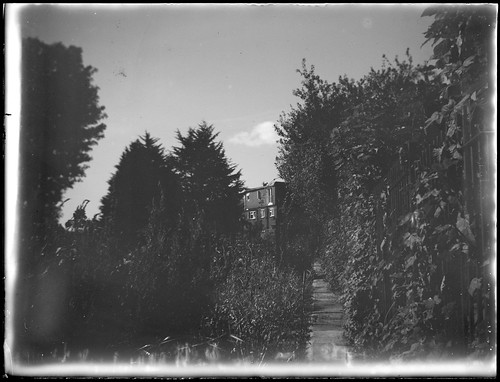
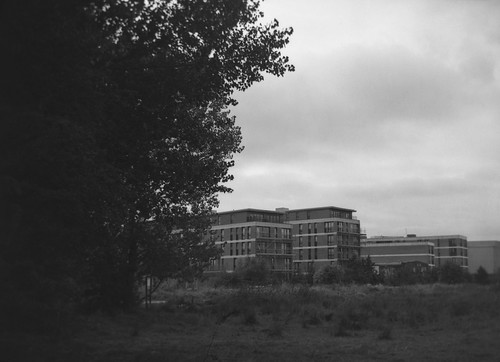
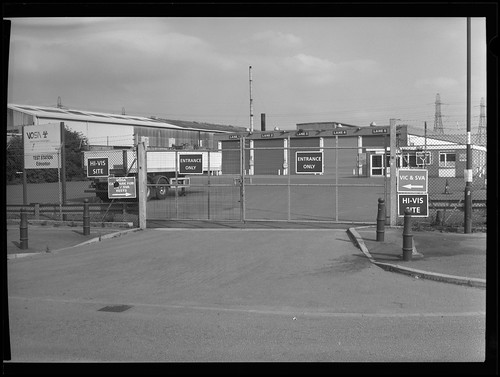
Butcher's Cameo sample image with Ilford FP4
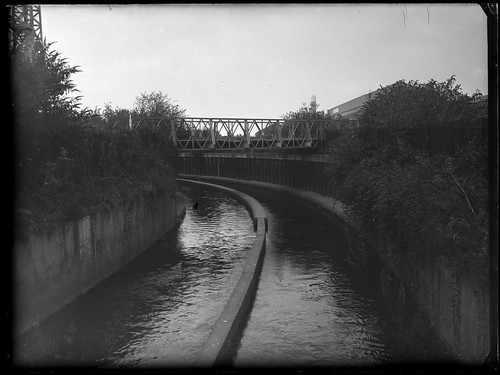
Butcher's Cameo sample image with Soft Gradation Panchromatic glass plate
Butcher's Cameo sample image with supplementary lens and Soft Gradation Panchromatic glass plate

Sources/further reading:
There's perhaps surprisingly little in depth information about the Cameo online, although presumably sold in tens or hundreds of thousands, this may be simply that it's not considered sufficiently interesting in any way.
1914 Butcher Catalogue
'Pocket' Cameos on Historic Camera
Early Cameo model on The Living Image

Wednesday, 19 November 2014

Distars and Proxars

Ica Trona with Distar supplementary lens
Having achieved some good results recently with the Ica Trona, use of the camera's full 9x12cm frame size is limited by the number of plateholders with films sheathes I possess, and also limited to the few films manufactured in the 9x12cm size. Using a rollfilm back with the camera is convenient and means being able to shoot with any medium format film available. However, this leads to cropping the image, or, to put it another way, using the rollfilm back provides an image with a narrower angle of view. For most of the cameras I habitually use, I'm almost always happy shooting everything with the 'normal' focal length lens for the format and most of my cameras have fixed, non-interchangeable lenses. For cameras of a similar age or design to the Ica Trona, if the photographer wanted to use different focal length lenses, there were three approaches to achieve this: more expensive cameras did have interchangeable lenses, often with a bayonet mount, like the Voigtländer Bergheil (although this did require each lens to also have its own shutter); certain lenses were designed to be convertible or combinable, where front and rear lens elements were each sufficiently well corrected to be used individually either behind or in front of the shutter; and there were also supplementary lenses, to be used like filters, which change the focal length of the lens they are attached to. The Ica Trona has a Tessar lens, the design of which does not lend itself to being used as a convertible lens. When writing the blog post for the Trona, the Zeiss catalogues on Camera Eccentric were an invaluable resource; the 1933 catalogue includes a detailed section on Zeiss's supplementary lenses. Zeiss introduced the Distar first (seen in the 1927 catalogue, page 18), which increases the focal length of a lens; this was then added to by the Proxar, decreasing the focal length. The Proxar proved to be the more useful of the two, and was produced to fit many cameras for a number of decades. Other manufacturers also produced supplementary lenses.
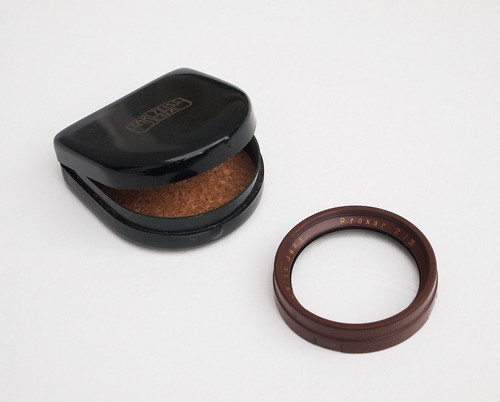
Zeiss Proxar supplementary lens with case
The Distars and Proxars were initially made as push-fit accessories to fit onto a camera lens in the same manner as a filter, in a variety of sizes and different powers of magnification. Both have gold lettering inscribed around the mounts and the pre-war Proxars are brown, perhaps to be easily identifiable at a glance. On the Camera Eccentric website, the reproduced Zeiss lens catalogue from 1933 has both Distars and Proxars listed with a full description and tables for use (the 1929 catalogue also lists both, but the 1933 one has better illustrated examples). To quote from the catalogue:
The Distars are single lens components of small diverging power [...]. When placed in front of the camera lens they increase its focal length with corresponding increase of the camera extension. They thus add to the scope of camera lenses, especially those of an unsymmetrical type, since these, from their very nature, are only adapted for use on cameras with single extension in that their components are not corrected independently for use as long-focus lenses. In conjunction with the Tessars the Distars form wide-range sets of convertible lenses.
[...]
PROXARS are lenses of small converging power [...]. When attached in front of the camera lens, they produce an effect opposite to that of the Distars in that they shorten the focal length. Thus, Tessar F/4.5, f=13.5cm has its focal length reduced to about 13cm, 12.5cm, 12cm, or 11.5cm according to the converging effect of the Proxar selected. The range of uses of the Tessar is thereby widely extended in a twofold direction, viz:

For obtaining large figures of near objects [i.e. close focus images]
[...]
For taking wide-angle photographs at greater distances
Use of the Distar depends on the camera having sufficient bellows extension to achieve infinity focus, the greater the power of the Distar, the longer this distance needs to be, while the Proxars, to focus on infinity, need less bellows extension than the lens would normally require. This last fact is the reason for the Proxar's greater usefulness: on rigid-body cameras, it is usually impossible to reduce the lens-to-film plane distance, meaning that a Proxar could not be used for wide angle photographs ("at greater distances") as the lens would not focus on infinity, but it would still work as a close-up accessory, which Proxars were sold as, post war, no longer brown, as either push-fit accessories or with screw threads for mounting.
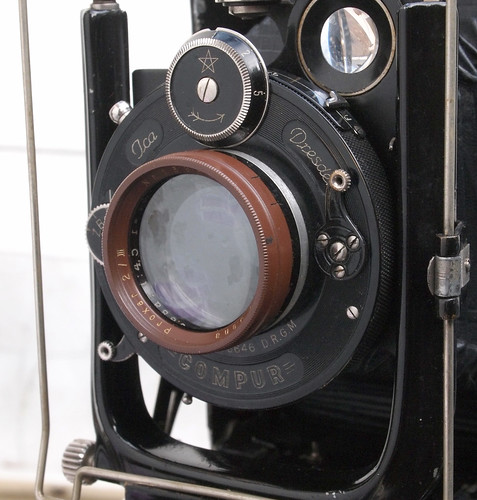

Ica Trona 210 with Proxar supplementary lens
I recently bought one of each: a Distar 3/III and a Proxar 2/III. According to the table in the Zeiss 1933 catalogue, the Distar 3 increases the equivalent focal length of the 13.5cm Tessar lens to 22.5cm, needing a bellows extension of 23cm to focus on infinity; the Proxar 2 reduces the equivalent focal length of the lens to 11cm, with infinity focus at 10.5cm. Reiterating what I've written earlier in this post, one reason I wanted the Proxar was to be able to use the rollfilm back with a 'normal' angle of view: a standard lens for the 6x9cm frame size is 105mm, so 11cm is very close.

The first set of test photographs I made with the Proxar were all out of focus, initially confusing as I'd used the ground glass screen to focus the images. When I shot a second set of test images, I realised where the problem arose: once the image was focussed, I discovered the tendency of the lens to slide forward on its runners when removing the back and replacing it with a plateholder, especially when pointing the camera downwards. On the Trona, the lens is designed to be pulled forwards to the infinity stop at 13.5cm, the focus knob is then used for closer focus and partly as a result of use, the lens moves with relative ease to the infinity stop itself (there is some friction, but perhaps the additional weight of the Proxar helps overcome the inertia). The Distar attachment provided different concerns: what's known as bellows effect, not mentioned in the Zeiss catalogue, which, for purposes of exposure and using the ground glass screen, results in a dimmer image. As the bellows are extended, moving the lens further away from the film plane, the relationship between aperture size and lens to film plane distance are changed significantly. To simplify the numbers for the purposes of giving an example, an aperture of f4 on a lens of 100mm focal length has a diameter of 25mm. If that lens is extended to a distance of 200mm from the film plane, that 25mm diameter of the f4 aperture is now one-eighth rather than one quarter, giving an effective aperture of f8, two stops difference in terms of exposure. Returning to the Distar 3 on my Tessar lens, as the focal length wasn't doubled, being nearer to an increase of half the focal length, for ease of calculation, I increased exposure by one stop (the same effect in reverse would be the case with the Proxar at infinity focus, but a decrease in focal length from 13.5cm to 11cm is not as dramatic, and although logically the image should be brighter, it is not different enough to compensate for in exposure).

The images below were all shot hand held: although for testing the qualities of the Distar and Proxar themselves it would have been better to use a tripod, I wanted to use the supplementary lenses in conditions that I have been using the Ica Trona camera. I push processed the 9x12cm Fomapan 100 to 200 in order to provide an extra stop in exposure, to use a smaller aperture at a faster shutter speed. The images are arranged from shortest focal length to longest.
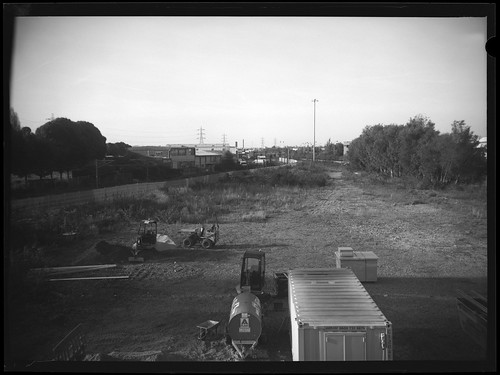
Ica Trona 210 with Proxar supplementary lens, Fomapan 100 rated 200 EI
Ica Trona 210, Fomapan 100 rated 200 EI
Ica Trona 210 with Distar supplementary lens, Fomapan 100 rated 200 EI
When shooting the tests, I focused with the ground glass screen, then used the wire frame finder (the 'Iconometer') for framing once the screen had been replaced with a plateholder. The wire frame finder continues to give a fairly accurate framing as the angle of view changes relative to how near or far the finder is to the eye piece (this is also true with the front rise and cross movements). The top image of the three, taken with the Proxar shows some vignetting and also has a shadow at the left had edge due to the bellows on my camera being slightly deformed. In addition, the bellows on my Trona do not have the clips that many double extension folding plate cameras often possess to gather the bellows when the lens is closer to the film plane, i.e. at or near to infinity focus.

I also shot a sequence of images with the rollfilm back. Using Rollei RPX 400, I gained an extra stop in exposure from the push-processed Fomapan 100 sheet film. On the frames with and without the Proxar, I stopped the lens down further; with the increased focal length using the Distar, I chose a faster shutter speed to guard against camera shake. These provide a better example of the change in angle of view than the sheet film shots above as the framing is more consistent across all three photographs.
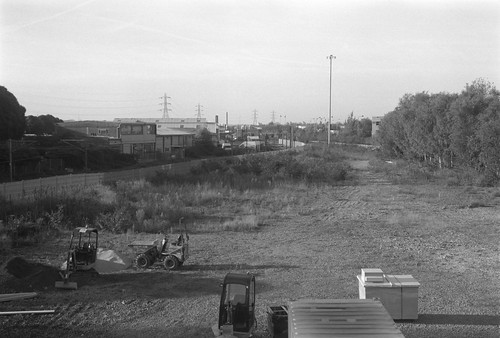
Ica Trona 210 with Proxar supplementary lens, Rollei RPX 400 in rollfilm back
Ica Trona 210, Rollei RPX 400 in rollfilm back
Ica Trona 210 with Distar supplementary lens, Rollei RPX 400 in rollfilm back
For comparison with the images from the rollfilm back, I also shot the same scene with the Zodel Baldalux: the 6x9cm frame size is the same and the focal length with the Proxar and the rollfilm back is close to the 105mm lens on the Baldalux - the reason for my interest in the supplementary lenses. Using the Proxar as a close up attachment rather than for wide angle, with the double extension bellows on the Trona, it is possible to focus very close to a subject. Bellows effect also applies, as with the Distar, and I also found focus difficult: even with the lens fully opened the image on the ground glass was still dim, and depth of field was extremely shallow. The photograph below was stopped down to f25 and by necessity, this was shot with a tripod (exposure was around 30 seconds). Although the shallow depth of field limits the use of such extreme close up photography, the scale of the mouse on the negative is actually larger than life size.
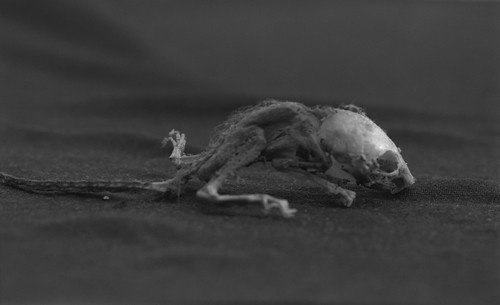
Ica Trona 210 with Proxar supplementary lens, Rollei RPX 400 in rollfilm back
The 1933 Zeiss catalogue contains an illustration (p30) showing six different views achievable from the same standpoint with a 15cm Tessar and Distars and Proxars of different powers with the caption, "Convert your ZEISS TESSAR at small cost into an objective of wide utility." Most of the remarks about the use of Distars and Proxars in the Zeiss catalogues relate directly to their use with the Tessar lens. The other designs listed under 'Universal Lenses' are Dagors and Protars, the first being symmetrical and the second composed of components of different focal lengths, but both can be used as convertible lenses. The introduction of the Distars and Proxars was intended to add this flexibility to the Tessar;
The Tessar is [...] pre-eminently the lens for hand cameras with single extension. In the course of recent years it has more and more taken the place of symmetrical and semi-symmetrical lenses in cameras with double extension, thanks to the introduction of our Distars and Proxars. These are single attachable front lenses whose curvatures are so computed as to increase or decrease the focal length of the objective within certain limits. They form, therefore, with the Tessar a very comprehensive convertible set, so that it can be used on hand cameras with single extension, and to a still greater extent on cameras with double extension, with a new range of applications. 
Zeiss lens catalogue, 1933
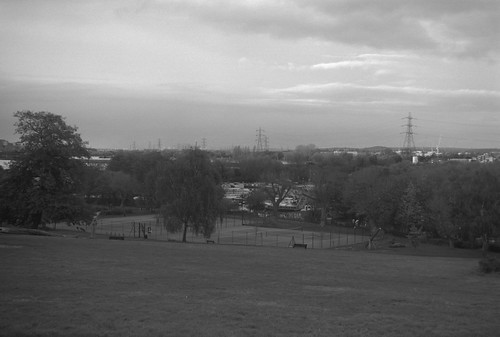
Ica Trona 210 with Proxar supplementary lens, Rollei RPX 400 in rollfilm back

Sources/further reading:
Zeiss Lenses Catalogue 1933
Supplementary lenses on Early Photography
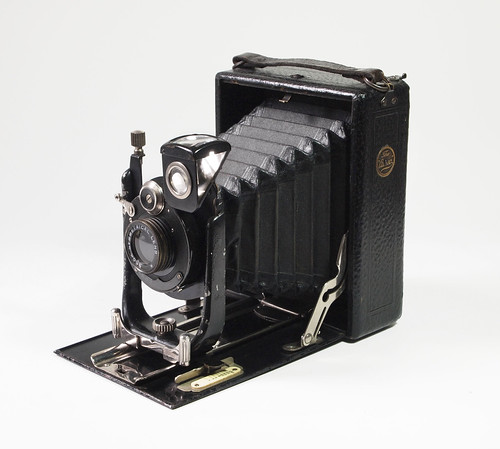
Wednesday, 15 October 2014

Ica Trona 210

Ica Trona 210
For some time I have been thinking about writing a post on 'small large format', to discuss my 9x12cm folding plate 'hand and stand' cameras, the Kodak Recomar 33 and Voigtländer Avus, but there always seemed too much information to convey in such a post and I hadn't used either camera enough, for a number of reasons. However, having begun developing films at home over the summer, rather than the darkroom I usually use (which is being refurbished), and having bought an Ica Trona 210, the ease and speed of turnover for developing sheet film (or glass plates) has meant, in a short space of time, I've used the camera quite a bit. One reason I was going to call the post on 9x12cm cameras 'small large format' was firstly that, although it is open to debate, and opinions differ, 9x12cm is considered the smallest sheet film format to be sufficiently large to be labelled such - if it's considered at all, that is. Many would use 4x5 inches as a starting point, but as 9x12cm is less common in the UK and US, it's hardly thought about as a format (the Wikipedia entry begins "Large format refers to any imaging format of 4×5 inches (102×127 mm) or larger..." then adds "Less common formats include [...] metric formats, including 9×12 cm"). Indeed, when I bought the Voigtländer Avus some years ago, I was not aware of it, yet in continental Europe it is not uncommon as a sheet film size (Ilford also manufactures film in 9x12cm, although possibly only during its annual ULF production run). I saw the Ica Trona in an online auction with a prominent warning that "it is NOT possible to obtain film which will work in this camera. It is sold for DISPLAY ONLY." At the time I had a mostly full box of Fomapan 100 and three boxes of HP3 glass plates in the size, the buyer's warning was a goad for me to place a bid on the camera, and the auction went for its starting price.

A second reason I was going to call the post 'small large format' was also the size of the cameras. By no means small in themselves, compared to most 4x5 inch cameras, these 9x12cm cameras are compact, being around the size of a thick paperback book (a doorstep airport novel, say): the Trona is 16 x 11.7 x 5cm when folded. One notable reason for these cameras' compactness is that most do not possess rotating backs, a feature which would make the cameras square to the longest dimension of the plate or film holders. My Ica Trona dates to the early 1920s, but the design of these folding plate cameras was remarkably similar across various manufacturers from the early years of the century until the later 1930s, when most of these cameras seem to have been discontinued, their functions being replaced by professional view and press cameras, while for amateur photography all kinds of rollfilm cameras had made the 'hand and stand' camera seem awkward and obsolete (a quick glance at the folding hand page of Early Photography shows how similar many of the cameras are).

I briefly wrote about Ica's history in my post about the Icarette; unlike the Icarette, the Trona was one of the cameras that Ica continued to manufacture from one of its founding companies, and, when Ica became combined into the new Zeiss Ikon, the Trona was continued (alongside many other similar models - Zeiss Ikon's range of cameras in the early 1930s contained numerous near-identical but different models, many of which had come from the once-rival companies which came together to  make up Zeiss Ikon). The '210' after the Trona name is the code for the camera's image size - the 210 is 9x12cm, while there was a 6.5x9cm model, the 110 (there was also a quarterplate model, apparently sold in the US and UK markets only). Zeiss Ikon continued these model codes, with variations. The 1925 Ica catalogue reproduced on Camera Eccentric lists the Trona 210 with a f4.5 Tessar at 218 marks, making it one of the more expensive models, after the Niklas and the Ideal.

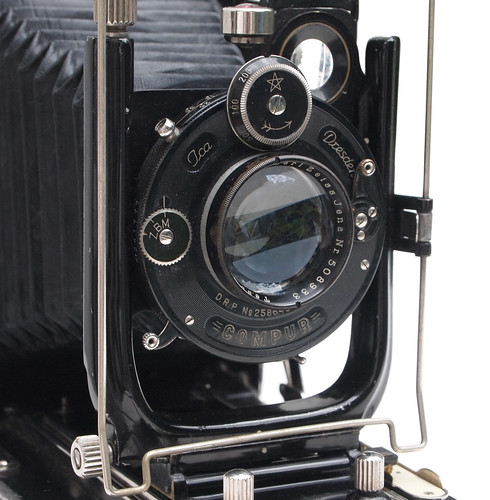
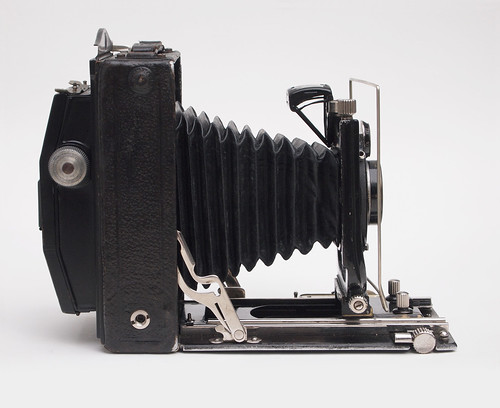
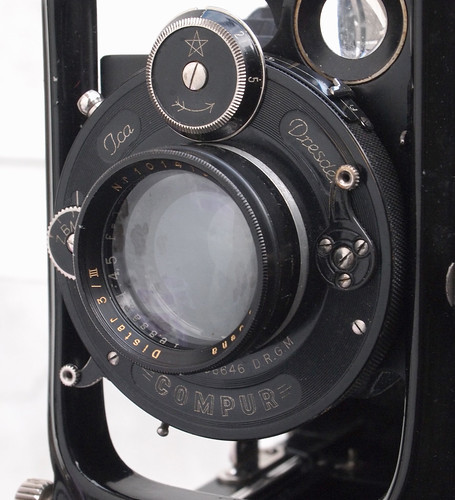
Conceived in the age of photographic plates, focus is by removable ground glass screen (the spring back appears to have been a later innovation), with each photographic plate loaded into individual plate holders. The Trona has features common to many 9x12cm folding plate cameras of a similar age: double extension bellows for a near 1:1 scale image when extended, front rise and cross movements, a rotating brilliant finder with spirit level, and a wire frame viewfinder. As with many pre-war cameras, the Trona was provided with a number of different lens and shutter combinations. My model has what would have been the top-of-the-range f4.5 13.5cm Tessar in a dial-set Compur shutter (later Zeiss Ikon Tronas were provided with a faster f3.5 Tessar). The shutter's rotating selector is marked 'ZBM', which seems an unusual variant, standing for Zeit, Bulb, Moment. Other Compur shutters I have of a similar age have 'D' for the German 'Dauer', rather than B, or 'TBI', standing for Time, Bulb, Instant - and some shutters have both. It appears that later Compur shutters were standardised with the letters representing the English terms.

Ica Trona lens and shutter detail
Although the ground glass screen has a wooden frame, the camera body and drop bed are both metal as are all the 9x12cm plate holders I've picked up over the past few years. Most of these work in all three of my cameras in this size, with the exception of two Kodak holders, which, oddly enough, do not fit the Kodak Recomar. The inter-war period appears to mark the transition from glass plate negatives to film, although in the 1940s Ilford were still producing many more different types of emulsions as glass plates rather than film. However the folding plate cameras of this era were provided with all the accessories needed to shoot film as well as glass. Firstly, film sheathes or septums were produced for film holders: to ensure flatness and the correct focal-plane distance, the sheathes hold sheet film in the place of a rigid glass plate. Secondly, film packs were made which held several sheets of film in an arrangement of light tight backing or covering paper (the special backs or holders for film packs often show up with the cameras themselves, not infrequently in the place of the ground glass screen). Thirdly, roll film backs were made to use medium format film.

Ica Trona with rollfilm back
On the 9x12cm size, the rollfilm back does mean the image is cropped to 6x9cm, essentially a 'half-frame' size (one of my rollfilm holders also included masks for 6x6cm and 6x4.5cm frames, but this would mean sacrificing a large amount of the camera's size for a narrow angle of view to get more shots on a roll of film). The Ica Trona has a lever by the focus scale to switch this from Plate to Film, which moves the focus scale/infinity stop back by a very small amount. This only affects focus when using the scale itself, as it does not move the lens standard - unless this is locked into the infinity stop. Like most folding cameras from this era, the lens is not self-erecting, the lens needs to be pulled out by hand along the rails as far as the infinity stop, which then needs to be disengaged to use the rack and pinion focus. This is done by pulling out the sliding lever next to the focus knob which is connected to the focus scale on the other side of the drop bed. It can also be used to lock the focus knob at any point by pushing it back inwards.

Ica Trona focus scale
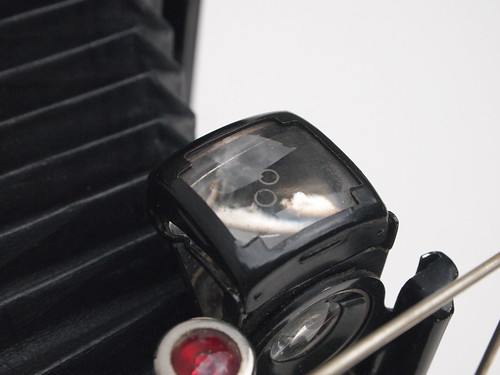
A reason to use such cameras today is their relative compactness for the large negative size, and the ease of hand held use - although historically large format press-type cameras were generally used hand held, I would not want to risk camera shake from trying to use my MPP Micro-Technical camera in the same way (by no means light, the Ica Trona is 1.2kg and the MPP 2.9kg). When shooting hand held, I have been using the ground glass screen to focus, then removing and replacing the screen with either a plateholder or the rollfim back, and framing the shot with the wire frame finder, or for a few shots, using the brilliant finder, holding the camera against my body for stability. The brilliant finder has a feature that I have seen on other cameras, but none of my other cameras with such finders possess: the glass is etched with two small circles which should be aligned to ensure that the framing of the finder is accurate and not at an oblique angle.

Brilliant finder with etched circles
Some shots, notably the still life and studio photographs below, required a tripod for stability, but, more importantly, for accurate framing and focus. The Trona has one tripod screw fitting for landscape orientation, and two for portrait - one of these is placed towards the front of the drop bed to balance the camera when the lens is fully extended. The Tessar lens, although uncoated, is still capable of great definition and character. For initial tests with the camera, I shot a few Ilford HP3 glass plates from the early 1970s, which I was able to use hand held, rating them at 50 to compensate for age (most of the other plates I've been using are much slower), and Fomapan 100 sheet film and some rolls of Rollei RPX 100 in the rollfilm back. The dial-set Compur shutter has one advantage over the later rim-set designs in that it's useful to be able to switch between Z and M functions when focussing with the ground glass without having to change the shutter speeds on the dial.

Ica Trona with Fomapan 100
Ica Trona with HP3 glass plate
Ica Trona with Rollei RPX100 in rollfilm back
I was fortunate to have bright sunny weather for the photographs above, taken hand held with the Trona, which meant I was able to use relatively small apertures and faster shutter speeds. On a subsequent occasion, with lighting conditions less favourable, I rated the Fomapan 100 at 200. Developing with Ilfotec LC29, I couldn't find any times for a one stop push online, neither from Foma nor the Massive Dev Chart, so with a dilution of 1:19, I estimated a time of 12 minutes at 18ºC. The image below suffers from a lack of detail in the sky which a yellow filter may have helped to a degree, although the sky itself may have just been flat and overcast. The front lens standard is also not as rigid as it could be, and some of the photographs appear to show that, with wide apertures at least, if the lens isn't quite parallel to the film plain, the image isn't in focus across the whole surface of the negative, as the second image below demonstrates, as it becomes out of focus towards the left hand edge (some of my other old folding cameras seem to suffer from the same problem). This may in part be due to inadvertently pulling the lens with a backward motion while tripping the shutter, and being aware of this, with care can be avoided.

Ica Trona with Fomapan 100, push processed at 200
Although in the past I've used my Kodak Recomar 33 as a more portable large format camera, the Recomar has a more limited four-speed Telma shutter and a slower lens and, although most of the time the lens is stopped down for shooting, a faster lens is useful to focus and compose using the ground glass screen. The Avus had no ground glass screen when I bought it, having an empty film pack back in its place, which I did eventually convert into a ground glass screen, but the Avus also has a very stiff shutter dial, and, although trivial, the small clip which secures the plateholders, ground glass screen or rollfilm backs to the camera is very difficult to move in and out. In comparison, the spring clip on the Trona is designed to allow a plateholder to be inserted without pulling it aside as a separate action. The differences between all three cameras are small, but nonetheless, the Trona feels more sympathetic in use.

Ica Trona with Fomapan 100, push processed at 200
Ica Trona with HP3 glass plate
Ica Trona with Rollei RPX 100 in rollfilm adaptor
Sources/further reading:
Ica Trona on Early Photography
1925 Ica Catalogue

Saturday, 2 February 2013

Ica Icarette II/L

Ica Icarette II/L
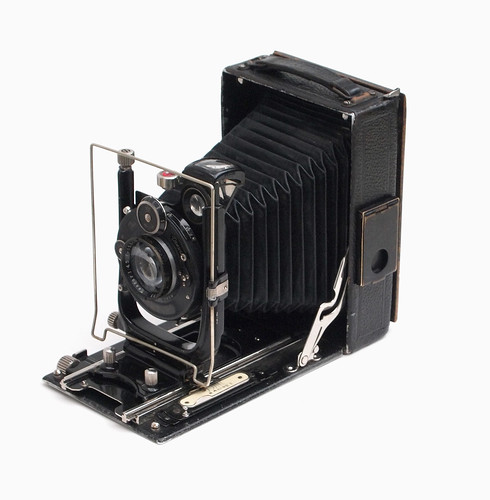
Ica was a relatively short-lived Dresden-based camera manufacturer, formed in 1909 by the merger of four companies: Hüttig AG; Kamerawerk Dr. Krügener; Wünsche AG; and Carl Zeiss Palmos AG. Its name is derived from Internationale Camera A.-G. and it's often written ICA, however as written on the cameras themselves, in advertisements and other documentation, the company's name appears as Ica. Ica was one of the 'name-giving' partners when it merged with Ernemann, Goerz and Contessa-Nettel to create Zeiss-Ikon in 1926.

Ica continued many camera models from its constituent companies, but the Icarette line of elegant folding cameras was an entirely new range, using a number of different rollfilm formats, from 127 to 116. The Ica Icarette II (named the Icarette L in US Ica/Zeiss Ikon catalogues) takes 6x9cm size images on 120 film, but it's a dual format camera (as are some of the other Icarette models), meaning that it also takes plates. This makes it a model 500/2: there is an Icarette II which takes rollfilm only, with a model number of 500/1; the Icarette I was a horizontal folding camera in the 6x6 negative format. The Icarette II 500/2 has a section of the camera back with the orange window–and a separate pressure plate–that can be removed and replaced with a ground glass screen and plateholders for 6.5x9cm (or 2 1/2x3 1/2 inch) glass plates (my first post on glass plates discusses the differences between metric and imperial sizes). When loading rollfilm, the camera back removes entirely, and the spool holders on each side are hinged to swing out for ease of loading. The focus scale has to be adjusted to either 'P' for plates or 'F' for film as the focal plane changes depending on which format used. This has a notch for infinity, which the lensboard pulls out to, the Icarette being non-self-erecting, as self-erecting designs for folding cameras only became common in the 1930s. There's also a handwritten focus scale on the other side of the bed for the Distar lens attachment.

Ground-glass back removed, and plateholder inserted.
The first Icarettes were produced in 1919, with the II/L model appearing c.1925. My camera is from early in the Icarette II's production. The serial number on its lens dates it to 1924; interestingly the shutter's serial number appears to be from before 1920. As was common with many folding cameras, the Icarette was offered with a range of lenses depending on price. My example has the top-of-the-range Carl Zeiss Jena f4.5 105mm Tessar lens.

Icarette L lens detail
The above detail shows the Tessar lens in a dial-set Compur shutter; the shutter settings of T for 'Time', B for 'Bulb' and 'I' for 'Instant' suggest the camera was produced for export; I have a contemporaneous Voigtländer Avus with a Compur shutter with 'Z' 'D' 'M' marked on it, for 'Zeit', 'Moment', and 'Dauer' (duration). Unlike the later rim-set Compur shutters, the exposure mode is selected on the small wheel to the left of the lens in the picture above and the shutter speeds are set independently on the dial at the top.

The camera also features double extension bellows, and a rising front. I have found the double extension bellows can cause a problem when focused from infinity to any moderate distance, as most of the length of the bellows remain in the camera's body unless drawn out manually, otherwise they tend to occlude the edges of the frame widthways, blurring them. For a viewfinder, there's the brilliant finder adjacent to the lens, a wire frame sportsfinder, which has an unusual profile to fit around the shutter and permit access to its controls, and the ground glass screen when using plates.

One of the curious features of my Icarette is it has "The Westminster" impressed into the leather on the back of the ground glass screen hood, the rollfilm back and inscribed between the knobs of the lensboard base. This could be The Westminster Photographic Exchange: much like my Baldalux camera rebadged by Wallace Heaton, presumably the Icarette was sold in the UK by The Westminster Photographic Exchange. There's a camera very like the Icarette II in one of the company's advertisments, 'The Westminster' can be discerned on leather on the camera, although on closer inspection, I believe the camera depicted in the illustrations is actually a Contessa Nettel Cocarette (identifiable by the shape of the wireframe finder, catch on the camera body, and the vertical stand).

Although I also have a Wallace Heaton plate camera in 6.5x9cm size, I've only used the Icarette II to shoot my glass plates in this size. Fortunately, my Icarette still had both the ground glass screen and the rollfilm back and pressure plate, as well as a leather wallet with four Ica plate holders and a case. As well as plates, I've also shot a few rolls of film; the Icarette II is not the most convenient of my medium format folding cameras - but possibly has the best lens. The Tessar lens, nearly ninety years old, performs very well. In the examples below, the photograph of the London 2012 Olympic Village in particular shows the good edge-to-edge sharpness of the lens.

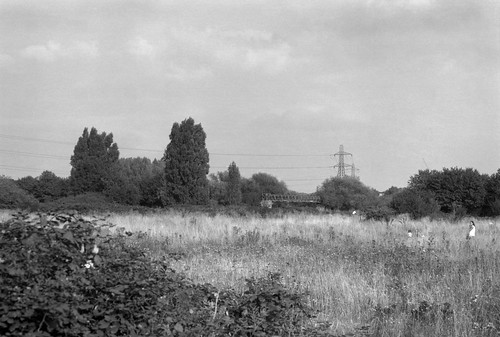
Hackney Downs, Rollei RPX 400 developed in R09 One Shot (Rodinal) 1+25 for 11m15s at 18˚C
London 2012 Olympic Village,  Fomapan 200, developed in Rodinal 1+50; 8mins at 20 degrees C.
Ilford R10 glass plate, stand developed in Rodinal 1+100
Kodak O.250 glass plate, stand developed in Rodinal 1+100
The Icarette II was continued by Zeiss Ikon long after Ica's merger into the new conglomerate. This advert shows that it was produced until at least 1937, while none of the other Icarette models appear: perhaps as a dual format camera, the Icarette II filled a unique niche in Zeiss Ikon's range.

Sources/further reading
Icarette models & Ica pages on Camera-Wiki
Ica chronology (in French)
Ica pages on Early Photography