Tuesday, 21 August 2012

Ilford HP5 Plus

Ilford HP5 Plus in 35mm, medium format and sheet film
HP5 Plus is Ilford's best selling black and white film. The first Ilford film designated HP (for Hypersensitive Panchromatic) was introduced in 1935 and had a speed of 160 ISO (by revised, post-1960 ASA standards). By the 1950s the HP emulsion had its speed increased to 400 ISO. Its current iteration, HP5 Plus, remaining at 400 ISO, was introduced in 1989. HP5 Plus was developed to compete with Kodak Tri-X, the photojournalists' film of choice: in the field of press photography, high-speed, good latitude, 'pushability' and ease of development were all desirable qualities over fineness of grain in the final image. HP5+ is currently available in 35mm, 120, and numerous sheet film sizes.

For many years when choosing a black and white film, HP5 Plus was simply the 'default' film for me. In my post about Delta 3200, I described how, when I began developing my own films at college, I was frequently taking hand-held shots in low-light conditions, and speed was more important to me than fineness of grain. Using ID11 as a developer, I was able to take advantage of being able to push the film, and rate it up to EI 3200. However, since I've returned to developing my own films and use Rodinal instead of ID11, I've become more discerning about the combination of film and developer, and I've explored a wider range of films than I used as a student. As a consequence I don't shoot HP5 as often in 35mm as the grain can be obtrusive, but this does depend on the subject matter (the images on this post are from 35mm negatives, unless indicated otherwise). Of course, 35mm film tends to stay in a camera longer than medium format, so while I might load a camera for taking low light shots, often the film is used up on other subjects entirely. However, I still use HP5 regularly in medium format, and being a traditional cubic-type emulsion, HP5 does has a particular look (which is difficult to define in words) and a great tonality I really like, especially when combined with a yellow filter for landscape work. By comparison, I've found Ilford's Delta films have a slightly 'harder' look to them (at least the 100 and 400 speed versions), and are more finickety in terms of exposure to get good results. I've only tried a couple of rolls of Kodak Tri-X, which I know lots of photographers love, but I prefer HP5.

Berlin from the Teufelsberg, HP5 (medium format, 6x9, with yellow filter) developed in Rodinal 1:25
Apart from the look of HP5, the main reason to use the film is its versatility: Ilford state it can be used at meter settings from 400 to 3200, and give a range from 250-3200 on their developing chart; I have inadvertently used it as low as 64. Ilford also mention its wide exposure latitude; it's described as 'bullet-proof' by Ag Photographic (the comparison to other 400 ISO films on Digital Truth appears to confirm this). I've personally found that the film takes overexposure well while retaining highlight detail. For example, a couple of long-exposure night shots from Paris appeared nearly white on the contact sheet compared to other frames on the roll, yet when scanned revealed much more detail than the contact promised.

Carreau du Temple, Paris, HP5 developed in Rodinal 1:50, 13m45s at 18ºC.
HP5's versatility does lend it to push processing. The Ilford fact sheet for HP5 recommends Ilfotec DDX/HC/RT Rapid or Microphen for push processing, none of which I've used. The two developers I have used with HP5 are ID11 when at college, and Rodinal. For the box speed of 400, I prefer the results using Rodinal diluted 1:25; however when rating the film at 1600, I've used a dilution of 1:100, stand developing the film for 2 hours or more. It may seem counter-intuitive, but push processing works best with plenty of light: low-light or night time scenes are often high contrast, with highly localised sources of light, and achieving shadow detail can be a problem.

Zinnowitzer Straße, HP5, push processed to EI 800 in Rodinal
Shepherd's Lane, HP5 push processed to 1600, stand developed in Rodinal 1:100, 2 hours 20 minutes
Liverpool Street Decorative Stonework, HP5 rated at 3200, developed in ID11 stock solution, 18m at 20ºC.
I rarely pull-process films of any kind, but I have shot HP5 at 64 ISO by accident. I thought my camera was loaded with outdated FP4 and exposed it at half of FP4's normal speed. I only realised my mistake when I took the film out of the camera. To compensate for the accidental over-exposure, I developed it at 100 ISO (the slowest rating on the Massive Dev Chart; the film could easily take a little more exposure, giving a slightly thicker negative). Incidentally, I shot the film in my Kodak Retina IIa, and didn't meter it in any way, relying on the 'sunny 16' rule (something I often do with manual cameras, partly out of laziness). Apart from accidents, I have occasionally used HP5 at EI 200 to reduce contrast. This can useful on bright sunny days with deep shadows, in spring or autumn, when the sun can be as bright as summer but the angle of the sun casts longer shadows; this isn't the case with the second image below, but the metal roof of the fire escape and the rendered wall are bright in comparison with the brick wall facing the street, and as such the subject benefits from a lower level of contrast.

Ceramic studio, HP5, rated 64, developed (as 100 ISO) in Rodinal 1:50 for 9mins at 20ºC.
Gate & Buddleia, HP5 (medium format, 6x9) pull processed to 200, developed in Rodinal 1:50
Through years of use and experimentation, I've come to appreciate all the qualities of HP5 which were those that appealed to the photojournalists the film was originally developed to cater for, without being aware of this. In film photography there's no one ideal film that covers all subjects, all lighting situations; even with the contraction of the market, there are still many different films available. This is, incidentally, one benefit of film photography: the ability to tailor film, and its development to the effects one wants to achieve. However, in the hypothetical position of only being able to choose one film to have with me for all eventualities, it would be HP5 Plus.

Gare de l'Est, HP5 (medium format), developed in Rodinal 1:25, 8 minutes
Klosterstraße, HP5 (medium format), developed in Rodinal 1:25, 8 minutes
Bocca Dell Verita, HP5 (medium format) developed in Rodinal
Sources
http://www.ilfordphoto.com/products/product.asp?n=7
http://www.photomemorabilia.co.uk/Ilford/Chronology.html
http://www.photomemorabilia.co.uk/Ilford/Chronology/HP5+_Photopro_Winter1989-90.pdf

Friday, 13 July 2012

127 Day - 12th July 2012

Flooded Underpass, Baby Ikonta, Agfa Retro 80S
Having had a couple of months away from the darkroom, yesterday's 127 Day was the perfect excuse to shoot and develop some film. Unlike previous 127 Days, I wasn't at work in one form or another, so I wasn't constrained by that (in some respects constraints like this can help give shape to the day); with all the recent rain, the morning was bright and sunny, so I went out to shoot some film.

I took my Baby Ikonta, already loaded with out of date Efke R21 (now branded R100, the '21' relates to the film's DIN number, 100 being the equivalent ISO). I had a roll of Agfa Retro 80S, and a roll of Kodak Verichrome Pan, with an expiry date of 12/81. I also shot a second roll of Verichrome Pan with an expiry date of 1968 in the Foth Derby. All films were developed with Rodinal, the expired films were stand developed for 1 hour, at a dilution of 1:100 (the expired films were also rated at half their nominal speed).

Previously, I've had mixed results with expired Verichrome Pan. The roll of Verichrome Pan with the more recent expiry date wasn't stuck to the backing paper, unlike the older roll, a problem I've encountered before. The more recent film was packaged differently, with a sealed foil-backed wrapper: the older films were simply packaged in twisted foil paper, which may have let the film get damp at some point, although I have no knowledge of how either of the films had been stored through the years. The expired R21 had a similar problem, with a mottled texture on the negatives, possibly transferred from the backing paper.

Lea Bridge Road Station, Baby Ikonta, expired Efke R21
Argall Road Industrial Estate, Foth Derby, expired Verichrome Pan
Graffiti, Shadows, Baby Ikonta, expired Verichrome Pan
Forest Road, Baby Ikonta, Agfa Retro 80S
See more photographs from 127 Day in the Flickr 127 Format Group Pool

Thursday, 5 July 2012

Summer 127 Day

Having been engaged with other projects and not posted for some time, I am planning to shoot some film for next week's 127 Day - 12th July. Sadly, I don't have any more out-of-date FP4 in 127 format, but I do have a couple of rolls of 80S to shoot.


127 Format Group on Flickr

Friday, 4 May 2012

Stereocrafters Videon

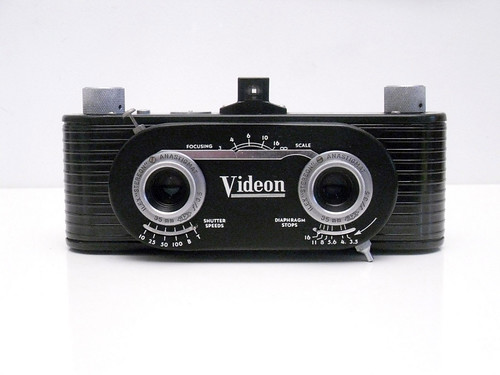
Sterocrafters Videon 35mm stereo camera
I first became interested in stereo photography about ten years ago when I bought a couple of stereo cameras, the fairly well known Sputnik, a medium format camera, and this, the Videon, a 35mm camera. I don't have the camera any more, but I thought it might be worth writing it up in a blog post as there is relatively little about the Videon on the net (and much that is on the net isn't necessarily in English). I bought the camera, with a case, from a secondhand camera shop, before these were effectively wiped out by auction sites.

Stereo or stereoscopic photography is simply the means of taking pictures that replicate binocular vision, that is the impression of three dimensions achieved by combining the vision from two eyes which see from slightly different viewpoints (it is sometimes, inaccurately, referred to as '3D photography'). The easiest way to replicate this in photography is to have a camera with two lenses, roughly the same distance apart as human eyes, which take two photographs simultaneously. The two photographs then have to be viewed in such a way that the right eye only sees the right side image, and the left eye the left one. Stereo photography was invented just a few years after photography itself, and has experienced periods of popularity since. There was a post-war boom in 35mm stereo photography, from which the Videon dates (1953, according to Massimo Bertacchi's Innovative Camera site). It was made by Stereocrafters of Wisconsin; apart from a Videon II, it appears the company made no other models.

The Videon is simply and cheaply constructed. The body is moulded in two halves from bakelite, with pressed or stamped metal top and bottom plates, and the lenses and shutters housed in a metal surround. The lenses are Ilex "Stereon" f3.5 35mm anastigmats; the shutters are un-named, but perhaps also by Ilex, with a limited range of speeds, 1/100, 1/50, 1/25, 1/10 sec., and 'B' and 'T' settings. These are set by rotating a pin, one under each lens. Framing is by a simple viewfinder on the top plate, equidistant between the two lenses. Focus is manual by turning one or the other of the lenses, with a metal arm joining the two, and a V-shaped notch that indicates the focus on the scale.

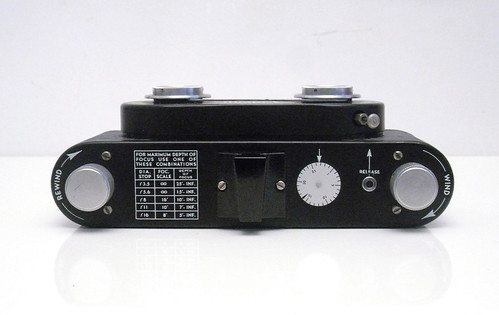
The Videon takes 35mm film, loaded by sliding off the back and bottom plate. However, the image format, like most 35mm stereo cameras, is a non-standard size, c.24x25mm. After loading the frame counter is set manually; this goes up to 25, which are stereo pairs, i.e. 25 pairs of photographs. The counter is a simple rotating disc directly on the top plate, with nothing to stop it being accidentally turned, meaning it's very easy to lose one's place on the film. There is a release button next to the frame counter, which needs to be pushed forwards before the film is wound on - and also when rewinding the film.

Videon top plate, showing from left: rewind knob; depth of focus scale; viewfinder;
frame counter; wind release (shutter release above this); wind on knob.
As the scan below shows, the Videon frame advance winds the film after each exposure to take three pairs in a row, then has to wind on past the second set of three frames so as not to double expose them, and then take another three pairs of exposures. The image below also shows how narrow the image circles of the lenses are, leading to heavy (and uneven) vignetting in the corners. The exposures also overlap a little on the film at the edges. I imagine in practice the stereo pairs would be cropped down to avoid these flaws showing in the final prints. In practice, the brass sprockets in the camera easily tore the sprocket holes on the film, leading the film to frequently slip, and part-double exposures were not uncommon. Damage to the sprocket holes can be seen to the right hand side of the strip.

The stereo pair are the two outermost frames of the four pictures.
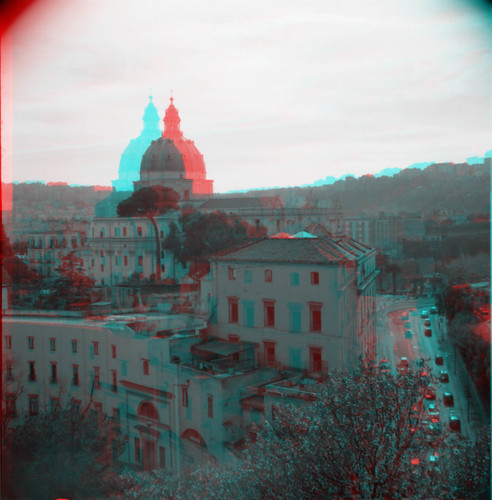
When I bought the Videon, I didn't have access to a darkroom, so generally used chromogenic black and white film, and had it developed and a contact sheet made, which I then scanned. I have recently scanned some of the negatives directly, which makes for better image quality. To view the images I convert the stereo pairs into anaglyphs, requiring red-green glasses for viewing.

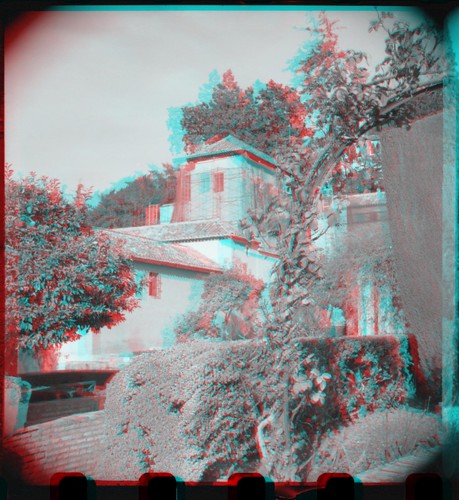
Generalife, Alhambra, Spain - anaglyph from the pair on the strip above.
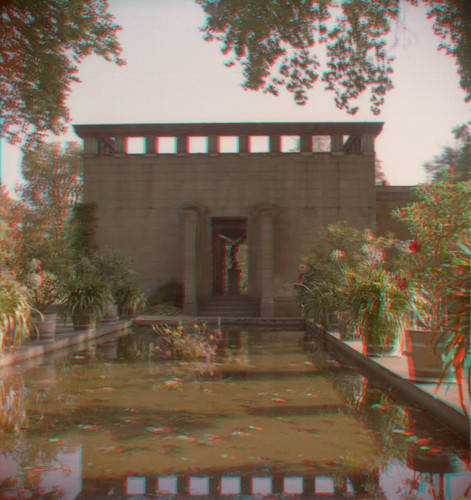
The anaglyphs are created in Photoshop, by selecting the red channel in the Channels palette (in RGB mode), then selecting the right hand of the stereo pair and moving it until it sits over the left hand image, and then cropping the whole. This does create a red-cyan image rather than red-green, but it works sufficiently well. This technique can also be used with colour images, but with less success perhaps.

Botanical Garden, Potsdam
Overall, I found the Videon to be less than reliable as a camera, mostly due to the winding on mechanism: when relying on taking two pictures at a time, frequently one half of a stereo pair would be partly obscured by a double exposure occurring, thus rendering the pair unusable for stereo purposes. However, compared to the Sputnik camera I've still got, it had certain advantages. Using 35mm film rather than medium format has its convenient aspects, which also meant the camera was more compact, and the Videon had an ever ready case with strap lugs (for some reason the designers of the Sputnik didn't conceive that users might want to put a strap on it to make it easier to carry around).

View in Naples
A Street in Naples
Potsdam

Sources/further reading:
http://camera-wiki.org/wiki/Stereo
http://corsopolaris.net/supercameras/Stereo135/stereocameras135.html

Sunday, 22 April 2012

More Glass Plates

Kodak O.250 Rapid Ortho Metallographic Glass Plates
Following the successful results exposing and developing old Ilford R.10 glass plates, I wanted to test another box, again previously opened. These are Kodak O.250 Rapid Ortho Metallographic Glass Plates and, according to the Early Photography website, Kodak's Rapid Ortho emulsion was only available in plates. These are 6.5x9cm plates, slightly larger than the imperial size of the Ilford plates (the small handwritten label on the box states: "Do not fit 3 1/2x2 1/2 single slides"). The box is also inscribed with a marker pen '28/6/62'. The plates in this box, unlike the Ilford plates, are wrapped in fours, with the central pair held together by paper runners. It wasn't clear which way around the plates were facing: whether the central pair were facing, and the other two facing outwards, which was the choice I made when loading the plate holders. This turned out to be the wrong decision, as the emulsion on the central pair faces outwards, the outer plates facing inwards. As a result, in the plate holders, the anti-halation backing faced the lens. I shot these plates at the same rating as the Ilford plates, roughly 12 ISO. The plates do not have a speed rating other than the name O.250, but looking at the information on Early Photography, it looks as though these plates may have been as slow as 16 ISO originally.

Kodak O.250 Rapid Ortho Plate, loaded back to front, shot in Icarette L
When I took the plates out of the holders in the darkroom under the safelights (these plates being orthographic) I realised my mistake. However, I went on to develop the plates, using the same method as the Ilford R.10 plates, using Rodinal diluted 1:100, stand developing for an hour. The results show that the anti-halation backing transmits enough light to give a fairly good image on the emulsion, but the backing wasn't a smooth, even layer (which I could see before developing), with the effect of creating mottled patches which also diffuse the focus in these areas. The negatives are quite thin but the plates are clearly usable, and perhaps shot the right way around the negatives would be sufficiently dense to use at 12 ISO.

Kodak O.250 Rapid Ortho Plate, loaded back to front, shot in Icarette L
Edit: 28/04/13

I recently bought another box of Kodak O.250 plates, and this had an information leaflet inside. It gives the speed of the plates as 8 ASA for daylight, and just 3 for tungsten, but it isn't clear whether the plates are from before or after the black & white speed rating change of 1960: if from before, then the original rating of the plates would have been 16 ISO. Either way, the plates have lost very little sensitivity despite being fifty years old. It provides filter factors and developing times for D61a and D76 (Ilford's ID11). The leaflet describes O.250 plates as being:
recommended for photographing biological sections, metallurgical and mineralogical work, spectography and macrography and clinical photography where neither red sensitivity nor high speed is necessary. It is also suitable for commercial, landscape and architectural photography and for studio portraiture by daylight.
Kodak O.250 Plate leaflet (front)
Kodak O.250 Plate leaflet (back)

Saturday, 21 April 2012

Kodagraph Ortho Negative Film

Most photographic films still in use today are panchromatic, that is, sensitive to the spectrum of all visible light. However, the earliest photographic emulsions were only sensitive to blue light; the sensitivity of emulsions was first extended to be orthochromatic (sensitive to all but red light), before becoming panchromatic. Some manufacturers still produce orthochromatic films (such as Adox Ortho, the film I first used with my large format camera) but for many years the primary use of orthochromatic film was for graphic arts applications as a result of being high contrast and fine grained, applications such as preparing black and white artwork for printing: these processes have been entirely superseded by digitisation.

Kodagraph Ortho Negative ON4 Reproduction Film
I bought this box of Kodagraph Ortho Negative Film ON4 in a batch of orthochromatic films and plates (which also included boxes of Kodalith Ortho Film Type 3 and Kodak Orthochromatic plates). The ON4 box was already opened and the only one of the three that was in a size that would fit any of my cameras without modification. Searching on the internet for information about the Kodagraph ON4 film, I found a Kodak data sheet for the Type 3 film, and plenty of references to Type 3 on forum posts and so forth, but there seemed to be nothing about ON4. The label on the box calls it 'Reproduction Film'; it has a catalogue number 326 2680 and a 'develop before' date of 9/1982, as well as instructions to open under Kodak Safelight No.1/No.1A, i.e. a red or light red safelight.

Opening the box under a red safelight, two things were immediately apparent. The film does not have notches to identify which is the emulsion side, like most sheet film; examining it under the safelights, one side looked a lighter grey which I thought could be the emulsion side. There is also the possibility that the film doesn't have an anti-halation layer (no colour came out during pre-soaking) meaning that it wouldn't matter which side is used. Loading it into the film holders, the film base is much thinner than other sheet films I've used, and I initially picked up two sheets together before I realised that how much thinner it is.

London 2012 Olympic Site, shot on Kodagraph ON4 rated at 6 ISO, developed in Rodinal 1:120
I shot the film using my MPP Micro Technical camera. I rated some sheets at 12 ISO and some at 6 (the box does not list a speed rating, the data sheet for the Kodalith Type 3 film gave 12 ISO with 'pulsed xenon' and 8 ISO for tungsten; I assumed that the ON4 film would be similar, given it was designed for similar applications). Those shot at 6 ISO were better but perhaps a little underexposed. I tray developed the film by inspection under safelights in the darkroom, using Rodinal, diluted to 1:120 with the intention of controlling the contrast. Once developed, the clear areas of the negative are remarkably transparent, with almost no discernible base fog, perhaps surprising for film 30 years out of date, but slower film tends to take longer to lose sensitivity.

For a second test shoot, I pre-exposed some of the film in the darkroom using an enlarger. Ansel Adams in The Negative describes using pre-exposure to improve shadow detail in high contrast scenes; I wondered if this would work for high contrast films. This can be done either in camera, or in the darkroom when loading the film. I exposed a sheet of film under an enlarger as a test, to find the shortest exposure which gave a discernible density on the film. I shot a number of sheets of the same subject, both with and without pre-exposure. However, the negatives from this second shoot I took out of the developer far too soon, with the result that they were all extremely thin, and as a result I haven't attempted to scan any of these. Part of the difficulty of tray developing film under a safelight is the fact that despite being able to see the image appear on the film as it develops, the film is still opaque until it is fixed, by which time it's too late to decide it needs longer in the developer, and this opacity can make the image appear denser than it is.

London 2012 Olympic Site, shot on Kodagraph ON4 rated at 5 ISO, developed in Rodinal 1:100
For the third test shoot I rated the film at 5 ISO, and again I pre-exposed some sheets. I also shot some Fomapan 400 at the same time, for a meaningful comparison of the Kodagraph ON4 with a panchromatic film. When these were developed I couldn't discern a difference between those with and those without pre-exposure, but having tray developed the film, I hadn't used consistent times so the testing regime wasn't really rigorous enough to tell. I diluted the Rodinal to 1:100 this time, which may have made the results a little higher in contrast than my first tests, but the lighting conditions were different too. The negatives are noticeably a little uneven, which can been seen in the sky, an issue due to not agitating the film sufficiently while developing.

London 2012 Olympic Site, shot on Fomapan 400, developed in Rodinal 1:50
The two films have very different looks, although the lighting conditions changed as I shot the Fomapan (which was shot with a yellow filter with to add some contrast in the sky, as well as pulling up tones in the foliage; I haven't tried ON4 with a yellow filter). The ON4 has a colder, harder look, which might suit architectural subjects for example. It also has extremely fine grain, and the slow speed is not necessarily an issue with large format film, large format cameras usually being used with a tripod.

Kodagraph ON4 rated 5 ISO, developed in Ilford Multigrade 1:30
I also developed some sheets in Ilford Multigrade paper developer, which I had used for developing the test to establish a minimum density for the pre-exposure. I diluted the Multigrade initially at 1:14, but, seeing the first sheet develop very quickly, I diluted the developer further, to roughly 1:30. The resulting negatives are very high contrast, losing detail in both highlights and shadows. This was to be expected, and, I imagine, closer to the results the film was designed to achieve.

References:
Ansel Adams, The Negative, 1981 ISBN 0-8212-1131-5

Thursday, 5 April 2012

Ilford R.10 Glass Plates - First Test

Ilford R.10 Soft Gradation Panchromatic Glass Plates
The first old films I had developed, or used and developed, I'd come across by accident, usually finding them in or with cameras I'd bought, found or been given. Having achieved results of varying success, I began to seek out expired films on occasion, when able to find them cheaply, and this then extended to glass plates. I have a few cameras which take plate holders, which I had previously used with film or paper.
 
Having accumulated a few boxes of glass plates, recent sunny weather provided me with the excuse to try some. A couple of the boxes had already been opened, and it made sense to use plates from one of these first. I chose Ilford R.10 Soft Gradation Panchromatic plates, which I'd bought in a lot with a box of unopened FP4 plates, not knowing whether the plates in the open box had been exposed to light or not. Both boxes have writing in pencil with the date 2/9/65 and 'Photo Centre'; the box of R.10 has "6 8 [crossed out] left". According to the Ilford chronology on the Photomemorabilia website, glass plate production by Ilford finished in 1975 (Ilford do still make photographic glass plates for specialised applications in the nuclear and particle physics industry; some other manufacturers still make plates for general photography, but these are very expensive and a number of photographers coat their own glass plates).

The box originally held 12 plates, 2 1/2x3 1/2 inch size. There are a number of standard plate sizes, both metric and imperial, and a confusion sometimes arises between the closeness of the different sizes: metric and imperial standards are sometimes treated as being interchangeable. There is a metric 6.5x9cm plate size, which is very close to the 2 1/2x3 1/2 imperial size (being 6.4x8.9cm; I have a box of 6.5x9cm plates which has a handwritten label "Do not fit 3 1/2x2 1/2 single slides"). I used 6.5x9cm plate holders, which the imperial size plates will fit, while metric plates of that size wouldn't fit into similarly sized imperial holders.

The camera I shot the plates in is an Ica Icarette L, a dual format camera from the 1920s that takes either 120 film, or 6.5x9cm plates. When I bought this, it came with a plate holder wallet containing four single plate holders, and the following leaflet:-

Ilford Plates leaflet - outside
Ilford Plates leaflet - inside
There's a code on the back of the leaflet, 'G57/D' - possibly referring to its date i.e. 1957. Under 'Packing' it explicitly states that "plates are packed in pairs with the emulsion sides face to face," something I had previously read on a forum, which was good to have confirmed. The pairs of plates are wrapped in black paper, with a thin paper 'runner' holding these together along the short edges. The glass is very thin, less than 2mm and the cut edges of the glass are still sharp.

The R.10 plates were originally rated 100 ISO (the label around the box gives 'Meter settings for minimum exposure ASA 100 DIN 21'). With my previous experience of using out of date film (see the posts about Verichrome and 127 Day), and knowing that the sensitivity would have decreased with time, I shot two plates, the first at 25 ISO, and a second at 12. Exposure was 1/50th at f5.6 and f4.5 respectively. I stand developed the plates in a Combi Plan tank using Rodinal diluted 1:100 for one hour, with 2 minutes pre-soak, and 3 inversions at the half hour mark. The first plate came out black - this one would have been at the top of the box, possibly this had been exposed to light with the box opened at some point, although I'm not ruling out making an error myself. The second plate has a small amount fogging at the left and bottom sides. Once fixed and washed I did not squeegee the plates, but even so the plates took a long time to dry. (Incidentally, I've been reading Ansel Adams' The Negative recently, and in a section on water bath development, Adams compares older thick emulsions favourably to modern thin ones, perhaps the emulsion on the R.10 plates is thicker, and so absorbs more water). The second plate came out well:-

Ilford R.10 glass plate, shot with Ica Icarette L
Aspects of framing and focus of the plate not withstanding, there is something precious and unique about holding a glass negative in one's hand: there's probably a longer essay to be written about how the ease of taking thousands of digital images, compared to dozens on a roll of film, or single sheets, plates and Polaroids, has devalued the photographic image; it may be something to do with the physicality of the image and its physical link (perhaps misconstrued) to authenticity.

Edit: 29/04/13

As a result of my research into Ilford, I discovered the Ilford Technical Information Book, which contains a sheet on the R.10 Soft Gradation Panchromatic plates, dated to 1967. This provides additional information for the plates from the leaflet shown above. It gives the ASA setting for tungsten lighting as 64, against the daylight setting of 100. The table of development times gives further dilutions and times for both continuous and intermittent agitation.

Ilford R.10 development times
Ilford R.10 Curves