Wednesday, 29 February 2012

'Take Your Box Camera To Work Day'

Lumiere Scout Box Camera
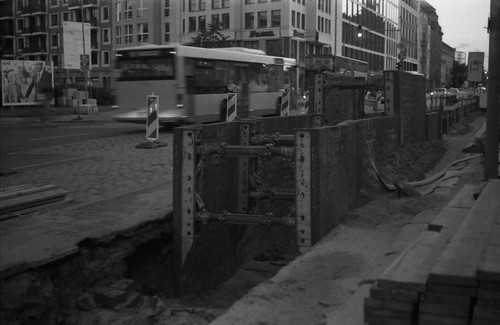
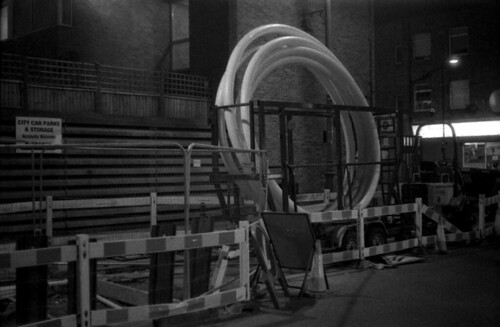
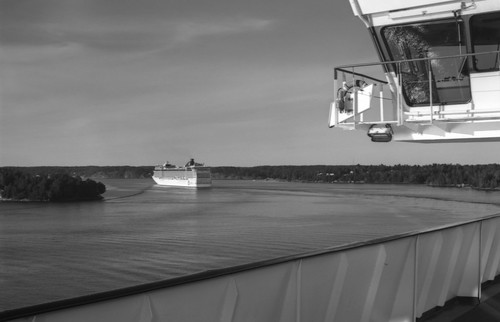
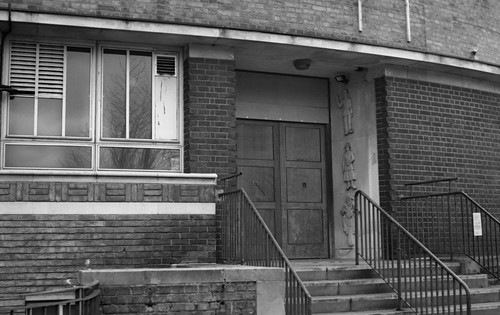
For today's 'Take Your Box Camera To Work Day' (see previous post), I took my Lumière Scout Box to work. The Lumière Scout Box is quite compact for a box camera, smaller than the No.2 Brownie that I used to have. The camera has a single aperture, and the shutter has two settings, 'I' for 'Instant' and 'P' for 'Pneumatique' (or bulb). The lens is a meniscus type, a 'Lumiere Objectif Rapide'. The camera has a single viewfinder which, unusually, rotates through 90 degrees for landscape format shots. Inside the camera is a label instructing the use of 'Lumière 49' film, and the spool which came with the camera looks identical to a 620 spool, though fortunately the camera will also accept 120 spools without the modifications that 620 cameras often require.

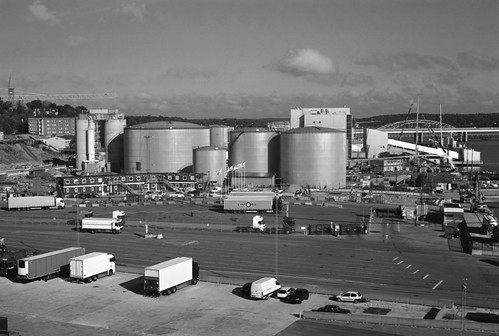
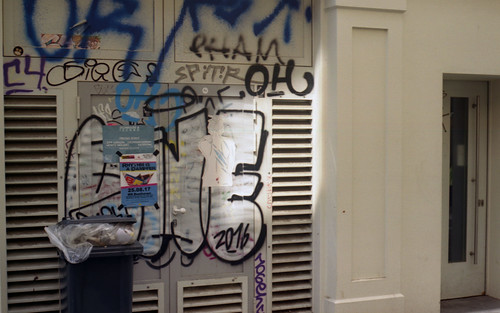
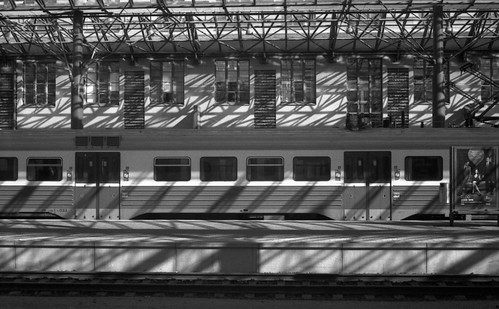
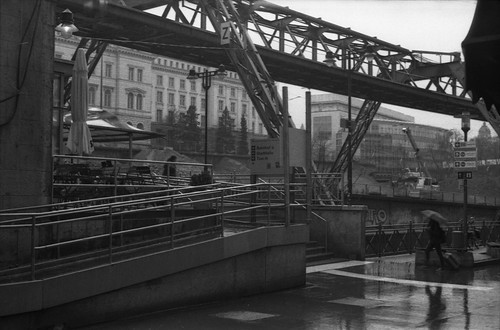
I managed to shoot just one roll of film. As it wasn't a sunny day, and I thought I might be able to shoot inside, I wanted to use a 400 ISO film, but the only film I had in stock was Ilford Delta 400 (the roll I used had an expiry date of January 2009). I would have much preferred HP5, but I'd been given a few rolls of expired Delta 400 and wanted to use it up. The film was developed in Rodinal 1:25, 11 minutes 15 seconds at 18 degrees C. The results are perhaps rather unprepossessing, but I did get a shot of Ben Spiers, one of the other painting tutors at college.

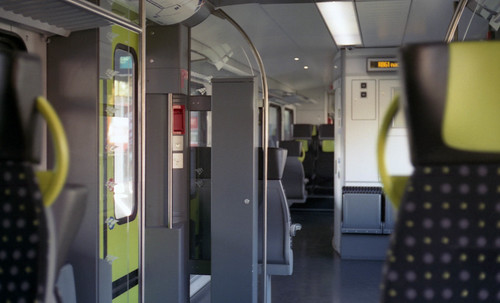
Kennington Rooftops

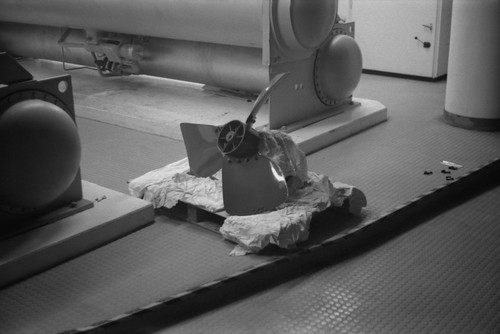
Bin Yard

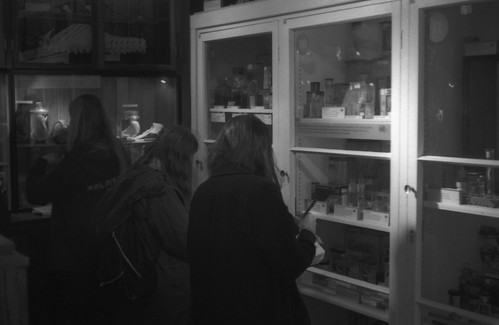
Painting Studio

Wednesday, 22 February 2012

29th February is 'Take Your Box Camera To Work Day'

The Box Camera Revolution group on Flickr has announced that Wednesday 29th February is to be 'Take Your Box Camera To Work Day'. Like the 127 Days, it's an excuse to get people using box cameras. These were the snapshot cameras for much of the 20th century, only being supplanted by the Instamatic in the early 1960s; box cameras were produced in many millions, and unsurprisingly they are very easy to find today. Unless in exceptional condition or a rare model, they really should be dirt cheap.

The image below was taken with a Kodak No.2 Brownie, the camera first manufactured in 1901, for which the 120 roll film format was created. Despite very limited user controls (the No.2 Brownie had a single shutter speed and three apertures) and simple glass meniscus lenses, the size of the 6x9cm negatives, along with modern film emulsions, actually produces very credible results.

Southampton Central, shot with a Kodak No.2 Brownie on HP5 film

Thursday, 19 January 2012

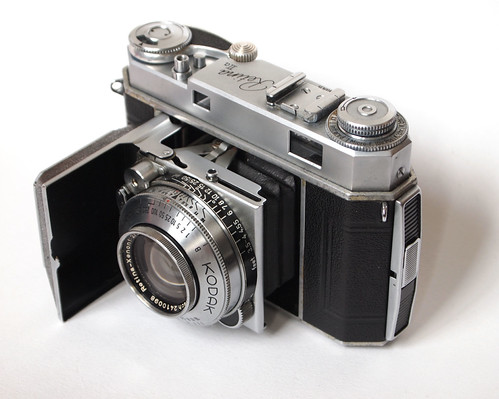
Kodak Retina IIa

Kodak Retina IIa
It seems rather apposite to be posting about Kodak's finest camera on the day that news is announced the company is filing for bankruptcy protection. If Kodak could be said to have had a philosophy, it would be that their goal was to democratise photography. This meant developing and nurturing a mass market for photography that hadn't existed before - and this was primarily done through cheap mass-produced cameras.  Karen Nakamura comments on her blog about hating Kodak cameras (a view I have sympathy with), but makes an exception for the Kodak Retina. She identifies the reason for this being that the Retina camera was designed and built in Germany by the Nagel cameraworks in Stuttgart, acquired by Kodak in 1931. The original Retina of 1934 was the first camera designed to use a daylight loading 35mm film canister, perhaps to capitalise on the success of the early Leicas (which did use 35mm film, but required the user to load film cassettes themselves from bulk film).

The Retina series comprised a number of different models of folding cameras produced by Kodak AG both before and after the Second World War. There are three main model numbers to differentiate the Retinas: Model I is a viewfinder camera; Model II has a coupled rangefinder; Model III has a rangefinder and a selenium cell lightmeter. Different specifications of the basic models are designated by lower-case letters after the Roman numerals, and to avoid confusion Retinas are often referred to by a factory number.
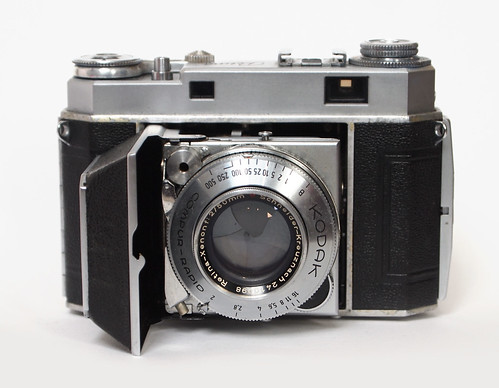
Kodak Retina IIa
My Kodak Retina is a Type 016 model IIa, which was produced from 1951-54. I bought it to replace a Balda Rigona 35mm folding camera, which had a slower lens, a shutter with less speeds, and also lacked a rangefinder. However, what I liked about the Balda camera was that it was a full frame 35mm camera with a 50mm lens, but it would easily fit into a pocket when folded. As a result of using this camera, I was on the look out for another folding 35mm camera with better specifications to replace it, and research led me to the Kodak Retina. The Retina is bigger than the Rigona, but not by much, and is still compact when folded. It is heavy for its size, a testament perhaps to how solidly built the camera is. In fact, everything about the way this camera is made exudes confidence in its precision engineering, from the moment the button is pressed to fold open the camera and the lens slides into place.
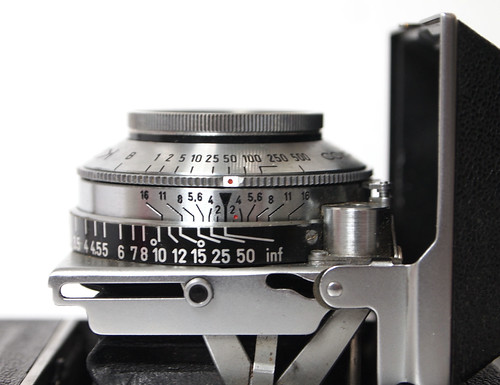
Detail of shutter speeds/depth of field scale/focus ring-
The Retina IIa has a fast Schneider-Kreuznach Retina-Xenon f.2 50mm lens in a Compur-Rapid shutter (which marks it out as an early Type 016, later in the production run this was changed to a Synchro-Compur shutter). A red delta symbol indicates lens coating. The focus lever sits neatly on the bottom corner of the front plate of the camera, and is coupled to the rangefinder, which is super-imposed as a rectangle inside the viewfinder. The lens focuses down to 3.5 feet, but must be set to infinity to close the camera.

The Retina IIa has a couple of quirks I've not encountered in other cameras. There is a second release button tucked behind the shutter release. Cameraquest states it is for unjamming the shutter - which it could well be, but equally perhaps this is for advancing the film without tripping the shutter, for example after loading, for which the camera doesn't need to be opened. The frame counter is set manually with a diamond mark to position it for the correct number of frames. This counts down as the camera is wound on, and stops at 0, preventing further photographs to be taken. Of course, it can be manually reset in order to take more photos (to get say 37, 38 frames from a roll of 36 - or if not set correctly when the camera was loaded).
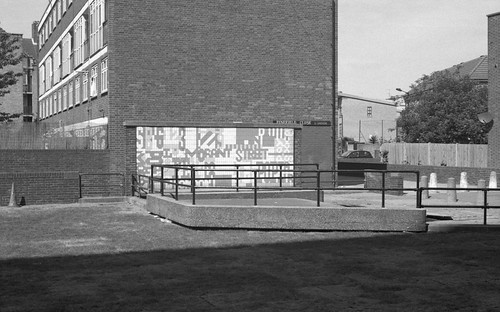
Sample image from Kodak Retina IIa, shot on Rollei Retro 100
Sample image from Kodak Retina IIa, shot on HP5
Kodak Retina IIa sample image, shot on Delta 3200
Edit 30/11/17 - Further examples

Kodak Retina IIa with Ilford Ilfodata HS23
Kodak Retina IIa with Rollei RPX25
Kodak Retina IIa with Kodak Technical Pan
Kodak Retina IIa with Kodak Ektar 100
Kodak Retina IIa with Ilford FP4 Plus
Kodak Retina IIa with Rollei RPX400
Kodak Retina IIa with Agfa Vista 400
Kodak Retina IIa with Ilford HP5 Plus at EI 800
Kodak Retina IIa with Rollei RPX400 at EI 1600

Sources/further reading:
http://camera-wiki.org/wiki/Kodak_Retina_IIa
http://www.cameraquest.com/retIIa.htm
http://dantestella.com/technical/retina.html
http://www.photoethnography.com/ClassicCameras/KodakRetina.html
http://www.kodak.com/global/en/consumer/products/techInfo/aa13/aa13pg2.shtml
http://homepages.ihug.co.nz/~Srawhiti/index.html

Thursday, 29 December 2011

Verichrome Pan

Kodak Verichrome Pan 120 film, expiry date July 1964

Verichrome Pan was a black and white panchromatic film produced by Kodak from 1956 to c.2002. The film had a speed rating of 125 ISO, which would have been considered fast at the time it was introduced and replaced Verichrome, which was its orthochromatic predecessor. This advert for the original Verichrome lists its various unique qualities, including the fact that it was double coated, with two layers of photographic emulsion, both fast and slow, and also that it had enormous latitude, claiming an exposure range of 1 to 2,400. I haven't found any information as to whether Verichrome Pan kept these characteristics, but I doubt manufacturers would now claim such latitude for modern film emulsions (although I have used HP5 from 64 to 3200 ISO).

Verichrome Pan in 127 format, showing instructions for use on the paper backing

I shot a couple of rolls of out-of-date Verichrome Pan on the Summer 127 day in July. One of these had come from the box of a Kodak Brownie Starmite, with an expiry date of September 1975; the other was one of three films I bought from a certain auction site. The results from both sets of films were disappointing: the rolls bought online had evidently got damp at some point and the backing paper was stuck to the film: soaked and removed, the paper took some of the emulsion with it; the roll from the Starmite box came away cleanly from the backing paper, but nonetheless this seems to have left behind a textured pattern on the emulsion.

Sceaux Gardens, Bethnal Green: the black areas on the image are where the emulsion stuck to the backing paper


After the results with the 127 format film, I hadn't expected much from a roll in 120 format that had been inside the case of a Kinax folding camera that I bought. This roll of Verichrome Pan had an expiry date of July 1964. The box also contained a leaflet on Kodak films. I shot the roll in my Zodel Baldalux camera in Berlin during the summer, then stand processed it. Unlike the recent out-of-date FP4, I didn't take into account the loss of sensitivity with age, and exposed it at the box speed of 125 ISO. The resulting negatives are very thin, and while they have held the highlights well, the rendering of shadow detail is patchy, although the results are much better than the 127 format films. (All films were stand-developed in Rodinal, diluted 1:100, for 1 hour).

Pergamon Museum, Berlin, shot on Verichrome Pan, expiry date July 1964
Oranienburger Straße, Berlin, shot on Verichrome Pan, expiry date July 1964

Friday, 9 December 2011

127 Day - 7th December 2011

Cleaver Square Rooftops
127 Day is a calendrical encouragement to use 127 format cameras, on both 12th July (written 12/7 in little endian format) and 7th December (12/7 middle endian). Shooting with my Baby Ikonta, on the day I used a roll of FP4 with an expiry date of June 1976. Ilford no longer produce film in 127 format; my film was from a batch of three I bought online. I had used one of these rolls in my Foth Derby for the Summer 127 Day, and had been very pleased with the results from such an old film.  I rated the film at 64 ISO, half FP4's box speed of 125, to compensate for the loss of sensitivity with age, and stand developed the film in Rodinal at a dilution of 1:100 for one hour, with 30 seconds agitation at the start, and a couple of inversions at the half hour mark.

As I had been in July, I was working all day. With the limited amount of time I had to take photographs, especially given the short daylight hours, I took a number of night shots on my journey home from work to use the whole roll during the day. The daylight shots were metered with a Weston Master II; the night photographs were estimated.

London 2012 Olympic Site
Sutton Street, Stepney
A106 Eastway

See more photographs from 127 Day in the Flickr 127 Format Group Pool

Tuesday, 1 November 2011

Werra 1

Werra with 50mm Novonar f3.5 lens
The Werra is a unique 35mm compact camera produced by Carl Zeiss Jena. The version I bought at the Mauerpark flea market is the original olive green model with a 50mm Novonar f3.5 lens. This model is generally referred to as the Werra 1 to distinguish it from the subsequent versions, but at the time was simply called 'Werra'. Not knowing much about the Werra when I bought it, I had assumed that it dated from the 1960s, due to its streamlined design. However production began in 1954, and the serial number on my camera's lens dates it to 1955. Compare the look of the Werra with, for example, the Kodak Signet or the Baldessa, both 35mm viewfinder cameras contemporary to the Werra and it's easy to see how advanced its design was for the mid-1950s. One might speculate for the reason for this is that the Werra was made by Carl Zeiss Jena, principally a lens manufacturer, which made very few cameras. Perhaps it's a camera built around a lens, without being derived from any precedents. In keeping with the minimalist design, the camera is marked with just the name 'WERRA' embossed on the lens cap and rear of the body, 'Novonar' on the lens and the manufacturer's name is entirely absent.

Werra with lens cap/shade removed
The two most distinctive aspects of the Werra's design are its unusual film advance, which works by turning the aluminium bezel around the lens, and the combined lens cap and shade. The lens cap can be unscrewed from the shade, the shade removed, reversed and attached. The camera's controls are located around the lens, and, with the frame counter on the underside of the camera, which leaves just the shutter release for the top plate. The original Werra is a completely manual camera, without a meter. However there are figures around the lens picked out in red for optimum exposure and focus: 1/50th of a second on the shutter, f8 for the aperture, and 6m on the focus ring, which at f8 gives a depth of field from just beyond 3m to nearly infinity.

Detail of figures picked out in red around the lens
Obviously this depends on film speed and lighting conditions, but one can assume that these settings were designed to be used in fair daylight conditions with a film of medium speed. I used these settings to finish the film that was in the camera when I bought it. Raul M, in his blog post about the Werra, suggests that the shade can be left on covering the controls, effectively turning the Werra into a point and shoot camera. The entire back and bottom plate slides off to load the film, which travels from right to left, opposite to the direction 35mm film normally travels in a camera (although this is also true of the Agfa Optima Sensor), meaning that the frames on the developed film appear to be upside down, and also read in sequence right to left.

Sample image from the Werra, FP4 stand developed in Rodinal 1:100

ORWO NP 20: Mauerpark Flea Market & Found Images

ORWO NP 20 35mm film
Inside the Werra camera I bought at the Mauerpark flea market in Berlin there was a partly used roll of film, which I inadvertently exposed when opening the camera to check the shutter. On buying the camera, it felt appropriate to use the rest of the film taking photographs in the flea market itself. Being a manual camera, and not knowing what the film's speed was, I used the settings marked out in red on the Werra to shoot the film.

Flohmarkt am Mauerpark, ORWO NP 20 film
Slot Machine, Flohmarkt am Mauerpark, ORWO NP 20 film
Flohmarkt am Mauerpark, ORWO NP 20 film
Once I'd finished the film, and could safely open the camera again, I discovered that the film was a roll of ORWO NP 20, an East German black and white film, presumably dating back to before reunification. It was also in a reusable plastic film canister, with the minimal label stuck across the join with the canister's screw top. To develop the film, I used Rodinal, diluted 1:100 for 1 hour stand development, with a couple of inversions at the 30 minute mark. I've previously used stand development with unknown or old films (including colour) with some success as it seems to simply reveal what's actually on the film. The frames I shot on the film came out well enough, apart from the inevitable light leaks. More excitingly, the film that had already been exposed in the camera yielded a number of frames, which I had feared would have mostly been lost due to being exposed to light when I opened the camera, yet a dozen frames came out almost unaffected. After an oblique shot of a fence and a greenhouse, the unaffected frames show some sort of parade or procession (oddly enough, as do some of the photographs on the first roll of old film I developed), while some of the frames largely obliterated by light leaks appear to show sheep shearing on a farm.

Found image on a roll of ORWO NP 20
The images already on the film appear to show a couple of aspects of life in rural Germany. Judging from the haircuts and clothes of some of the younger people watching the parade, the pictures were no doubt taken some time in the 1980s.