Tuesday, 29 March 2016

LAPC Bank Holiday Photo Walk

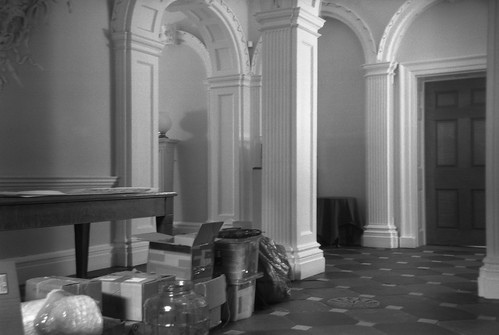
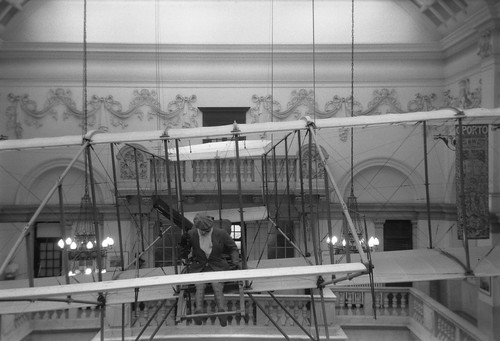
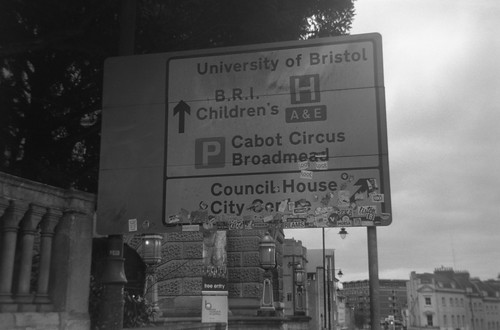
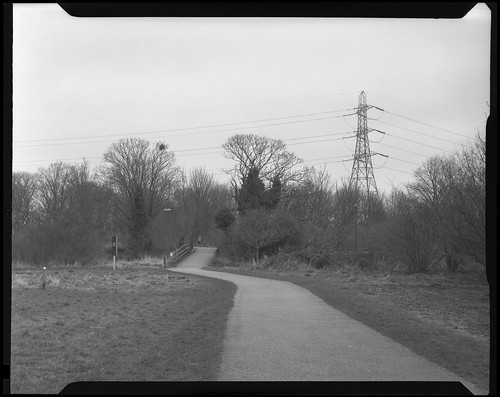
Ensign Folding Klito de Luxe No.9 with Ilford Special Rapid Panchromatic plate
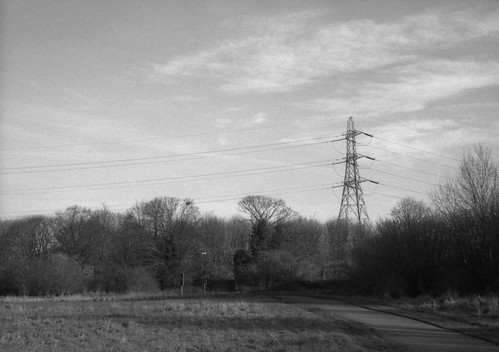
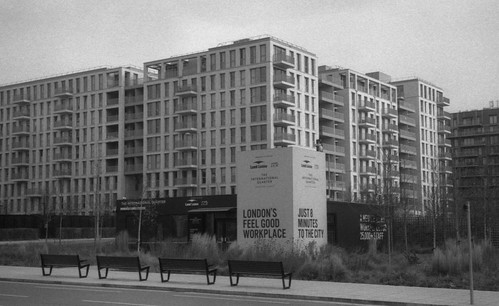
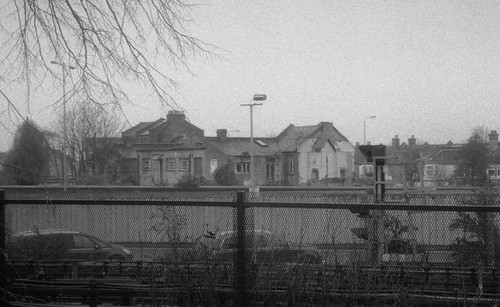
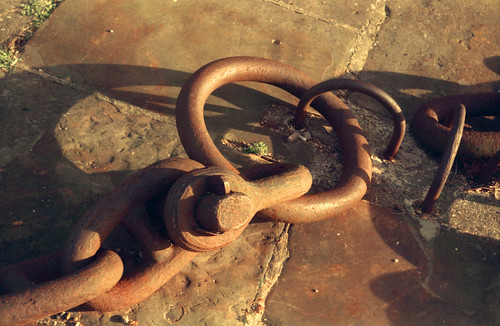
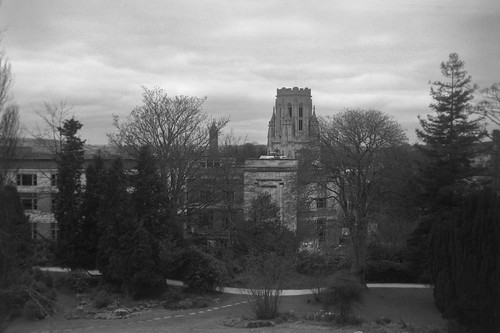
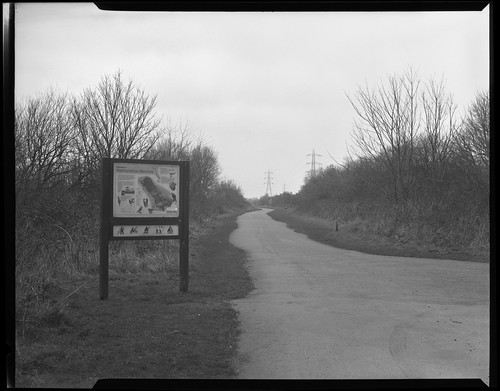
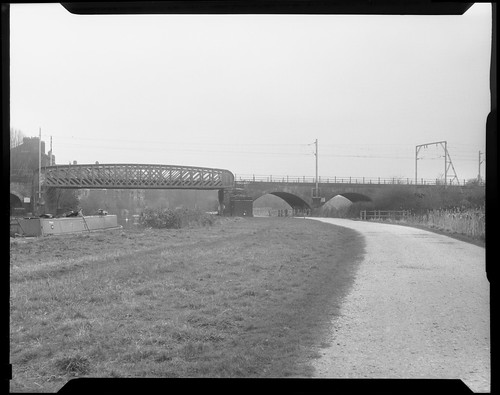
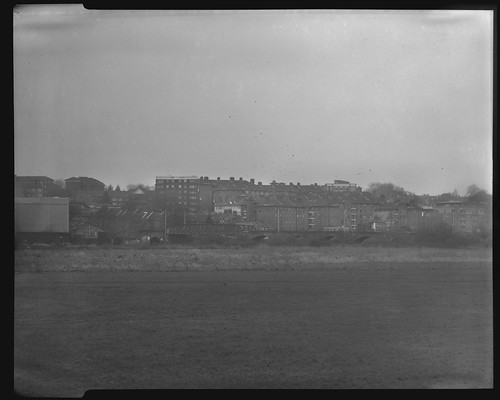
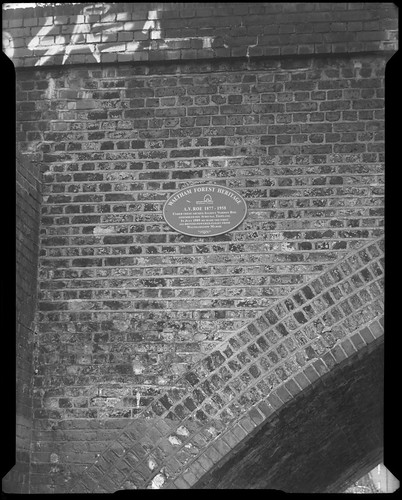
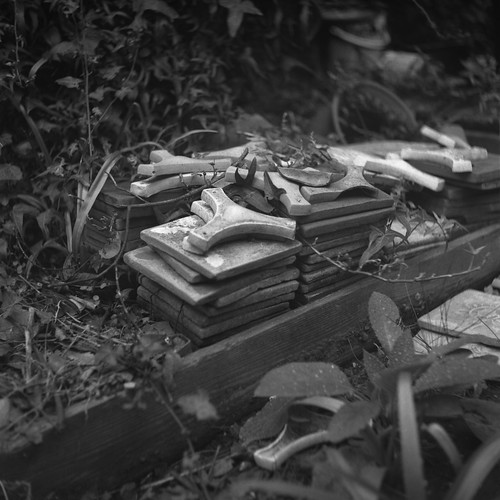
Yesterday I joined the LAPC Bank Holiday Photo Walk along the Parkland Walk from Finsbury Park to Alexandra Palace, led by Melanie King and Daniel Berrange. I took my Ensign Folding Klito with a dozen plateholders with a few different types of plates. Not wanting to carry a tripod on the walk meant that I was constrained to shooting the plate camera on fairly slow shutter speeds - 1/25th and 1/50th - and at wide apertures (for the 12cm Ica Dominar lens), either f4.5 and f5.6. The best results were from a box of Ilford Special Rapid Panchromatic plates, which had a leaflet inside the box dating to July 1946. These glass plates, seventy years old, are relatively free from deterioration and fogging, apart from the edges, which is partly due to the emulsion being thicker where it collects from pouring. Although I rated the plates at an exposure index of just 10, the negatives would have benefitted from at least another stop of exposure; however, there were periods of bright sunshine to facilitate using the plates hand held. Other plates I shot were one Ilford N.40 Process plate from 1958, some Ilford N.50 Thin Film Half Tone plates from 1957, and some Kodak plates: one Kodak P300 Special Rapid Panchromatic plate, and two Kodak P1200 Super Panchro-Press plates from two different boxes. The emulsion lifted entirely from the plates from one box; the other plate (below), from a box with a handwritten date '11/4/61', has 'frilling' where the emulsion is lifting from the edges and some very obtrusive patches which look like they could be due to mould.

Ensign Folding Klito de Luxe No.9 with Kodak P1200 Super Panchro-Press plate
Ensign Folding Klito de Luxe No.9 with Ilford N.40 Process plate
The Ilford N.50 Thin Film Half Tone plates are heavily fogged (with more exposure a usable negative might have been obtained, but this wasn't really possible hand held - the case of the Kodak P300 Special Rapid Panchromatic plate demonstrates this with the shutter at 1/10th sticking open, giving perhaps a couple of seconds exposure); the Ilford N.40 Process plate (above) is much better. The plates I used yesterday had already been loaded into the holders without intending that these would be shot handheld: had I wanted more consistent results I would have chosen carefully which plates to use. (I also shot some Kodak Photo Instrumentation SO-078 film, with a develop before date of 08/2002, in the Kiev-30M.)

Ensign Folding Klito de Luxe No.9 with Kodak P300 Special Rapid Panchromatic plate
Ensign Folding Klito de Luxe No.9 with Ilford N.50 Thin Film Half Tone plate
Ensign Folding Klito de Luxe No.9 with Ilford Special Rapid Panchromatic plate

Sunday, 27 March 2016

Take Your Box Camera To Play Day 2016

Lumière Scout Box with Rollei RPX 400
For last weekend's 'Take Your Box Camera to Play Day', I reverted to using Lumière Scout Box rather than the Kodak No.2 Brownie as I had done last year; the Scout Box seems to give better results, despite there being less controls (the Brownie does have three aperture settings). With the Scout Box being more compact than the Brownie, I used the Brownie's case, as the camera fitted in the case with enough space for three cartons of medium format film, plus room to slip a yellow filter in the side.


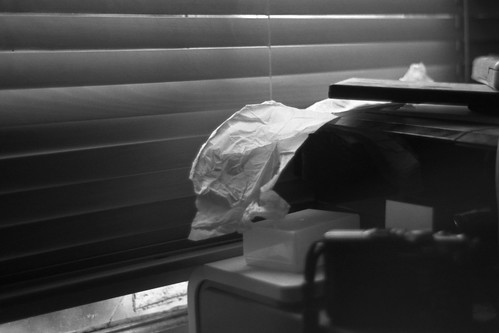
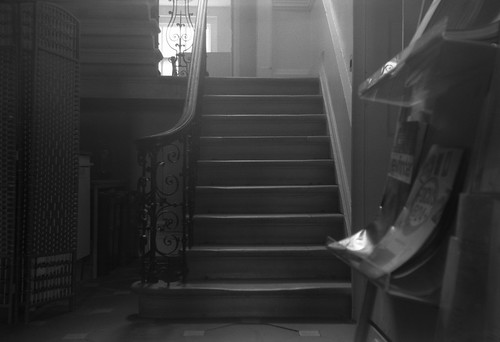
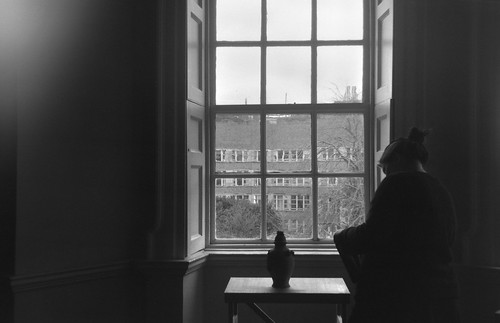
I shot three rolls of Rollei RPX 400 for its good latitude to guard against variations in conditions, and shot most of the interiors using the 'pneumatique' or time setting, balancing the camera on any available flat surface while holding the shutter open for long exposures. All rolls were developed in R09 One Shot diluted 1+25.

Lumière Scout Box with Rollei RPX 400
See the whole set on Flickr here.

Tuesday, 22 March 2016

Zeiss Ikon Ikoflex Ic

Zeiss Ikon Ikoflex Ic
The twin-lens reflex has been eclipsed by the popularity of single-lens reflex cameras. Excellent results are possible with some models of this design, however, and they often represent the least expensive way for a photographer to begin working in medium format.
Ansel Adams, The Camera, 1980
Twin lens focus cameras were around for many years before Franke & Heideke introduced the Rolleiflex, but, like the Leica with 35mm film, it became the archetype - and inspiration - for the many twin lens reflex cameras that followed, as well as establishing the 6x6cm square negative format. TLR cameras were produced by many different manufacturers for decades, the majority were made between the 1930s and 1950s, but the twin-lens reflex design fell out of favour from the early 1960s (notable exceptions such as the Mamiya C series and the Rolleiflex itself, as more fully-featured, prestige cameras, were made until the 1990s and 2010s respectively).

I bought my original Zeiss Ikon Ikoflex Ic in March 1996. It was my entry into medium format as a student, being significantly cheaper than a Rolleiflex or MPP's contemporary Microcord/Microflex cameras, and a fraction of the price of medium format SLR cameras at the time. It cost £99 as a commission sale from a camera shop which meant there was no secondhand guarantee. A tutor at college described it as being "two-and-a-quarter-inch", and, although at that point I knew of medium format, I'd not heard it described as such before.

Zeiss Ikon Ikoflex Ic with HP5 Plus
The above image is from the first roll of black and white film I shot with the camera. It's one of several shots made standing the Ikoflex on the floor for long exposures, easy to do with the typical twin-lens reflex waist level finder. The Ikoflex Ic I'd bought had a 75mm Novar lens, a cheaper triplet lens made by other manufacturers under license for Zeiss Ikon; it was also available with a f3.5 Tessar, but at the time I wouldn't have known to distinguish between a Novar and a Tessar. (Edit 30/11/18: looking through my images with this first Ikoflex - and images of the camera itself - I'm now sure that this was with the Tessar lens - although, again, I wouldn't have known the reputation of the lens at the time).

Zeiss Ikon Ikoflex Ic with HP5 Plus
The immediate difference in image quality with the shift from 35mm to medium format (even with a cheaper lens), and also the changing relationship of depth of field with longer lenses on the format, was clear from the first few prints I made from the negatives from the camera. The photograph above shot in May 1996 after I'd had the camera for a couple of months embodied these qualities almost perfectly - almost, as there appears to be a small amount of either a fall off in definition from the lens to the corners, or possibly a little camera shake in a twisting motion, nonetheless the quality of images like that above suddenly looked more professional. Another student at college had a Lubitel 166B, and it was very clear that the images, with vignetting and light leaks, were poorer quality in comparison to the Ikoflex.

Zeiss Ikon Ikoflex Ic with HP5 Plus
The Ikoflex also served as my introduction to night photography, using the camera on 'B' with a tripod. To calculate exposure times, I set my Praktica SLR to the same aperture and counted how many seconds between the shutter opening and closing, without factoring in reciprocity loss. This method worked well enough with regard to the Ikoflex's selenium meter being unusable at night. While at college I mostly shot Ilford HP5 Plus in the Ikoflex. On my contact sheets from the time I didn't write down developing details (curiously, I did so for most contemporary 35mm contact sheets). The developer at college would have been ID11, and usually used 1+1. Although I didn't write down any information about the developing, I also didn't push process any of the medium format at the time, which I had begun doing in 35mm. Later, once outside college and not having access to a darkroom, I shot a wider variety of films which I had professionally processed, mostly at Jessops. One film that I did use was Delta 3200 (the film itself hadn't been introduced until after I left college) for some handheld night shots, possibly shot on 1/10th. I used the Ikoflex much less when I bought my first Canon A-1: I last used it frequently in 2000, and it was stolen in 2003. Unlike the Canon A-1 or Olympus Pen EE3, I didn't feel the need to replace the camera as soon as I could, (or even, much later, the Brownie). However, a few weeks ago I saw an Ikoflex Ic in an online auction for half the price I paid for it twenty years ago, and bidding it up by a few pounds to nearer two-thirds that price, I won the camera. Ideally, I should have probably waited for a version with a Tessar, or the last Ikoflex model, the Favorit, but in replacing the Ikoflex Ic two decades on from first buying it provided a sense of resolution.

Ikoflex Ic with viewing hood and meter cover open
The Ikoflex Ic was the penultimate model in Zeiss Ikon's TLR series. It has a typical frame size of 6x6cm on 120 medium format film, with a 75mm Novar or Tessar f3.5 lens, stopping down to f16. The viewing lens is a 75mm f3.5 Teronar. The Prontor SVS shutter has a full range of speeds from 1-300, plus B, and a switch marked VXM for self timer (V), electronic flash (X), and flash bulbs (M). The self timer on my camera doesn't work, and in my experience rarely works on Prontor shutters from fifty to sixty years ago. The shutter can appear stuck if the switch is inadvertently knocked on V, easy to do, but switching to X releases the shutter (I have wasted a few frames with my new camera this way). Both lenses are provided with screw threads, but in different diameters. The taking lens has a 35.5mm thread; externally, it will take 37mm push-on filters or hoods. Two windows around the taking lens display aperture and shutter speeds; the aperture settings have a red dot for a hyperfocal distance between f8 and f11.

The focus knob is on the left hand side of the camera when holding it. On my camera it's marked in feet denoting an export model. Close focus runs down to 3.6 feet, with depth of field markings, and a hyperfocal dot on the scale between 48 and 15 feet to correspond with the dot on the aperture scale. On the right hand of the camera is the shutter release - lower on the body than older Ikoflex models - and the cable release socket in the top corner position where the older cameras had the shutter release. The release pivots outwards for shooting, with the shutter locked when it is pushed in. This shutter release is key to the ergonomics of the Ikoflex: the weight of the camera is taken in the right hand while focusing with the left hand, but the thumb of the right hand operates the shutter and also helps steady the camera between both hands. I haven't used older Ikoflex cameras, but I can imagine having a shutter release on the top of the camera makes it less easy to use handheld. The right hand side of the camera also has the frame advance knob, with a film reminder with "PAN/IR/ORTHO COLOR NEG/POS" inscribed on it, the COLOR section doubled, presumably for tungsten or daylight film and the frame counter, with its reset dial, and a PC socket for flash.

The waist level viewfinder hood is nicely sprung to pop open when the catch is released on the body. Rather than just plain ground glass, the viewing screen is actually a fresnel lens (fine concentric lines can just be made out). There's a flip up magnifier lens for fine focusing, and the cover of the viewing hood with the nameplate itself flips up to create an eye-level sports finder. The viewing screen has ruled horizontal and vertical lines to aid composition, and also displays the lightmeter needle. The Ikoflex Ic's built in lightmeter was one of the reasons for buying it (not heard of the 'sunny 16' rule at the time). The cover on the front of the camera flips up, and the needle in the viewfinder has EV markings from 2-16; on the focusing knob there is a calculator on focus knob with ASA settings from 5-320, including -2 -4 adjustments for filter factors, where the EV numbers can be read off against shutter speed and aperture combinations. Exposure times are listed up to 60 seconds; whole seconds are marked in green, and can be seen appearing at the far end of the calculator in fast film settings with a high EV, which the manual warns about. The selenium meters on both cameras I've had worked perfectly well with black and white and colour negative film; there are some references online referring to the Ikoflex Ic having a CDS meter, but I've found nothing conclusive, perhaps some cameras were customised with CDS cells replacing the selenium meter.

The Ikoflex Ic has an automatic frame counter with double exposure prevention. This was initially confusing, and, with no manual available when I bought my first camera, had to be worked out by trial and error. The man in the shop when I bought the camera loaded it for me, and the frame counter reset fooled him initially: he got this to return to 1 after having wound a whole film through the camera. I found the very first film from the camera had only part of one frame exposed. The correct way to load the camera is to ensure the frame counter has passed '12', which will then freely rotate (this may have to be done manually). On loading the camera, the film is advance to the first frame using the red window on the bottom plate, then the frame counter is reset to '1'. Once the shutter has been fired, there is an interlock which prevents the shutter firing again before the film is advanced (it's possible to cock the shutter without advancing the film, but it will not fire).

Zeiss Ikon Ikoflex Ic with Ilford Delta 400
Zeiss Ikon Ikoflex Ic with Ilford XP2
Zeiss Ikon Ikoflex Ic with Kodak Tri-X
Zeiss Ikon Ikoflex Ic with Kodak Portra 160VC 
Zeiss Ikon Ikoflex Ic with Ilford Delta 3200
When I first used the Ikoflex twenty years ago, the square format was a novelty and provoked more care taken over composition. This is partly helped by the lateral reversal of the image in the viewing screen, which does need some experience to become familiar. Although typically twin lens reflex images were often cropped when used professionally, composing to a full, square format is more challenging; picking up the camera again after many years brought this back with a distant sense memory of how it felt to use. It has also been an excuse to sort through old negatives, many of which I had never previously printed or scanned. Except for Kodak Portra 160, I didn't use any film slower than 400 ISO with my first Ikoflex camera - which was the case generally, in 35mm as well as medium format. Twenty years after first using the Ikoflex Ic, I recently shot some slower, finer grained films with the new camera: Agfa Superpan 200, Ilford FP4 Plus (rated 200), Rollei RPX 25 and a roll of Kodak Plus-X with a develop before date of 03/2006, which I happened to finish on Expired Film Day 2016.

Zeiss Ikon Ikoflex Ic with Agfa Superpan 200
Zeiss Ikon Ikoflex Ic with Ilford FP4 Plus at 200
Zeiss Ikon Ikoflex Ic with Rollei RPX 25
Zeiss Ikon Ikoflex Ic with Kodak Plus-X (develop before date 03/2006)


Sources/further reading
Ikoflex range on TLR-Cameras.com
Ikoflex Ic on Matt's Classic Cameras
Ikoflex Ic on Early Photography
Ansel Adams, The Camera, 1980 

Friday, 18 March 2016

Expired Film Day 2016

Kodak Plus-X, develop before date of July 1972
Having missed the last couple of 127 Days for a variety of reasons, on the 15th this week I participated in the new Expired Film Day ('Take Your Box Camera To Play Day' also happens to be this weekend, 18th-20th March). I frequently use decades-old photographic emulsions, notably in glass plate night photography. I did consider shooting some glass plates on the day, but instead, as part of an unrelated ongoing project of large format photographs around Walthamstow Marshes, I used the opportunity of Expired Film Day to shoot some 4x5 sheet film with the MPP Micro-Technical Mk VI: a box of Ilford FP4 with a hand written date of 11/4/78; Kodak Plus-X with a develop before date of July 1972; and Kodak Panchro-Royal, not dated, but the box looks older than the Plus-X, possibly 1960s. I had previously tested all three films to get a usable exposure index: the FP4 was rated half box speed, while the other two were shot at an exposure index of 25.

Ilford FP4, with handwritten date 11/4/78
Both the FP4 and Plus-X provided results which do not look like forty-year old film (and as such wouldn't win the Expired Film Day prize categories 'Most Obviously Expired Film' or 'Best Use of Overexposure'), but the Panchro-Royal clearly shows characteristic deterioration with age. I used both the 16.5cm Tessar and the Bausch & Lomb Rapid Rectilinear which I've written about in the post Old Lenses; the Rapid Rectilinear is the oldest lens I have, and so it seemed appropriate to use it for the day.

Kodak Plus-X, develop before date July 1972
Kodak Panchro-Royal sheet film, possibly 1960s
There's very little information on Kodak Panchro-Royal online, and this gave the worst performance of the three films I shot (the FP4 and Panchro-Royal came from the same collection of photographic material, and may - or may not - have been stored in the same conditions). As well as having much more obvious fog, it also suffered from a good deal of cusping, the film being far from flat, and this made scanning more difficult. Some of the shots were taken using only the rear elements of the Rapid Rectilinear lens, as described in Old Lenses, as the Panchro-Royal image above, and the shot below on Plus-X. All the sheet film was stand developed in R09 One Shot diluted 1+100 for one hour, partly due to developing all the films together, but some unevenness was evident in the development discernible in the featureless skies of most of the negatives.

Kodak Plus-X, develop before date July 1972
In addition to the sheet film I also finished a part-used roll of medium format Kodak Plus-X, which had a develop before date of 03/2006 - a neat ten years out of date. This was exposed at box speed and developed in R09 One Shot diluted 1+29 for 9 minutes at 20ºC. Incidentally, I had intended to use this time and dilution with Ilfotec LC29, and only realised my mistake when the wrong developer was mixed and in the tank. However, the times and dilutions being relatively similar, I stuck with the time for Ilfotec LC29, which resulted in perfectly usable negatives.

Medium format Kodak Plus-X, develop before March 2006


Monday, 22 February 2016

Five years on

Last week I received an email from Silverprint announcing their relocation. A few years ago the shop moved from Valentine Place to London Road, but, as of last week, the London Road shop is closed. As the email and post on their website states that 85% of their sales are either via telephone or website, the necessity of having a central London premises for a largely mail order business begins to look much less viable, particularly given property prices in the capital. Being five years since I began this blog on film based photography this month, it's apt to reflect on this news today. Unlike in my post a year ago, Four years on, in terms of the state of available film not much significant has changed since then, so I won't examine this topic now. I was certainly one of the 15% of customers visiting the shop, now and again, fairly often over the past decade. I also buy a fair amount online, though never from Silverprint - London Road is a short walk from where I work - but buying online does mean spending money on postage of course, and there's no online equivalent to popping in opportunistically for a couple of rolls of film to shoot on the day.

In London there's now three shops that I use: Process Supplies; West End Cameras (who have recently lowered the prices of some films they stock); and for the lowest prices on Ilford film (35mm and medium format) KVJ Fairdeal in Whitechapel (their website is Total Blank Media) which I first used as a student twenty-two years ago. Of course, a good shop is more than just a series of shelves full of products: Silverprint in London Road had an exhibition space, a useful noticeboard, and hosted events, which will no doubt be missed by many. Incidentally, I found a short reminiscence on the Re:PHOTO blog, about halfway down the post Still Occupied. The Goldfinger Craftbook mentioned in the post isn't now available on the Silverprint website, but when I started developing films again after a break ten years ago it was useful in understanding the processes involved.

When I started this blog five years ago, I wasn't sure if I would be able to sustain it, or even what exactly it would be, and perhaps many of the topics of the posts I've written are of very limited interest (there are many pre-war camera posts and a few about obscure discontinued films). However, on a self-referential note, this month has also seen the blog pass 100,000 views, a small milestone for a small blog I've been writing, when time and circumstances allow, out of my own personal interest in the subject.

Wednesday, 17 February 2016

Kiev-4

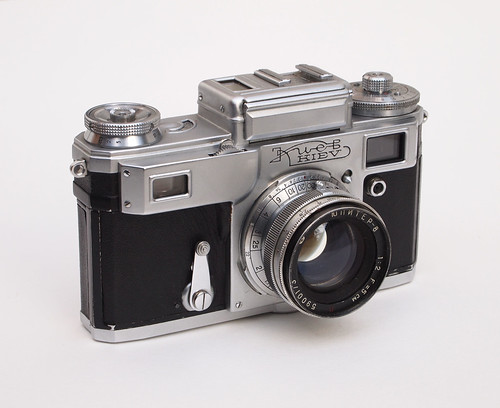
Kiev-4 rangefinder with Jupiter-8M f2 5cm lens
The Arsenal factory in Kiev produced a range of cameras almost all named after the city itself, in a variety of different film formats: 35mm, medium format, and subminiature; the model which began Arsenal's sixty-year history as a camera manufacturer was the Kiev rangefinder. Unlike many other Soviet-era productions, the Kiev rangefinder was not reverse engineered from existing cameras - like the FED and the later Zorki Leica copies - but instead was created from the drawings, dies, tools, and (initially) parts of the pre-war Zeiss Ikon Contax cameras. It's debatable as to whether the Kiev rangefinder should be strictly described as a Contax copy, as it was rather a direct continuation of the pre-war Contax, with a long, drawn-out diminution of quality during its extensive production run. The Kiev Survival Site has probably the most comprehensive history of the camera available online.

The first Kiev rangefinders are named Kiev II and Kiev III to correspond with the Contax II and III: both models designated III have an uncoupled selenium lightmeter. The Kiev cameras were then slightly modified by the addition of a PC socket for flash: these became the IIa and IIIa. The next iterations were the Kiev-4 (with light meter) and 4A (without meter), followed by the last cameras in the series, the 4M and 4AM. (There was also a Kiev-5, a comprehensive redesign from the Contax-based original, which had a relatively short production run). All the different models appear to have overlapping production dates, according to the details provided on SovietCams.com; the 4M and 4AM variants of the Kiev rangefinder were produced until the mid-1980s, remarkable for the fact that, although there were many changes during production, it was still recognisably Zeiss Ikon's camera of fifty years earlier.

Zeiss Ikon produced the first Contax rangefinder in 1932 as a direct response to the Leica. Later known as the Contax I, it was very much a work in progress with numerous changes to the camera while in production; the Contax II from 1936 demonstrated Zeiss Ikon's determination to better Leica in almost all specifications (Cameraquest has a detailed comparison between them), yet the Contax doesn't have the same legendary name or status that the Leica has achieved. Perhaps this is in part due to the post-war legacies of both companies: Leica concentrated on their famous rangefinder, aimed at a small section of the luxury camera market, while Zeiss Ikon AG had a large product range, attempting to cover all aspects of consumer photography, and were essentially put out of business by Japanese competition. Although Zeiss Ikon AG were relatively quick to produce the post-war Contax in 1950, as a camera system it wasn't subsequently supported and developed, while Leica produced the M3 in 1954 - which incorporated a number of features that the pre-war Contax had, with improvements in other areas.

In part due to cost, I'd never bought into the cult of the Leica. However, the Contax, and probably even more, the Kiev rangefinders have a following of their own - for example, there's a wealth of websites dedicated to the Kiev (see bottom of this post): the Kiev gives one a taste of the Contax at a fraction of the price (similarly, with Leica, there are also the FED and Zorki copies; and both the Contax and Leica have numerous cameras inspired by their designed, sometimes combined into one - like the Nikon). Late last year, a box arrived from Ukraine containing a Kiev rangefinder: I'd researched the model I wanted, and spent some time looking online before buying. Unsurprisingly, the Kiev is still largely to be found in its country of origin, and, although not expensive, the postage was half the price of the camera.


I'd found a relatively early version of the Kiev-4 model. The first two letters of the serial number designate the year of production: my camera dates from 1960, with a the standard Jupiter-8M 5cm f2 lens from a year earlier. According to Fotoua, this Kiev-4 is a Type 2b, defined by not having a stop bolt on the accessory shoe, and the "lines of rigidity" on the meter (the raised 'T' shape between the accessory shoe and the meter window). My initial impressions were that I had been expecting the camera to be bigger - it's smaller than an SLR such as the Canon A-1 for example - but also, externally at least, the quality and finish of the body are of a high standard; the aluminium lens barrel less so. Many of the comments in this post relating to the functions of the Kiev-4 are probably equally applicable to the design of the original Contax II/III, including some of its quirks, with a few caveats.
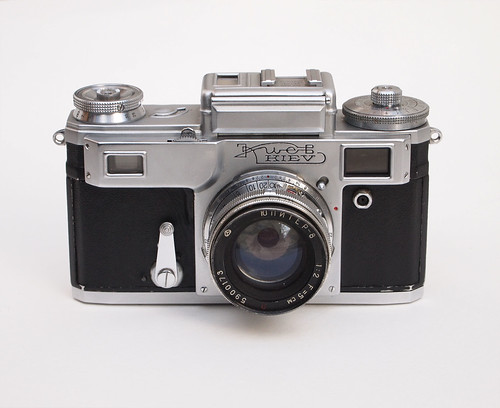
Kiev-4 with Jupiter-8M f2 5cm lens
I'd chosen the Kiev-4 partly thanks to the built-in light meter; early models appear to be fairly common, while it has some refinements over the IIIa. There may be reasons for preferring the meter-less versions, but I decided it might prove a useful feature. Presumably without any direct contact, the post war Contax IIIa prompted the Kiev-4 redesign, with a smaller, lower and simplified meter, and a smaller rewind knob and calculator dial alongside it (the Contax IIIa also had a smaller body with a shorter rangefinder base, neither of which influenced the Kiev-4 design).
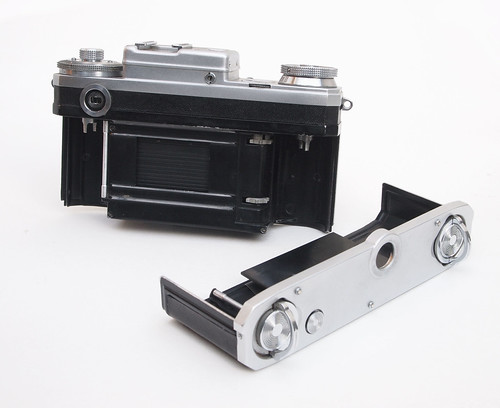
Kiev-4 with back removed for loading
The back removes entirely to load the camera; two flip-up, rotating handles on the camera base unlock the back. The original Contax camera was designed without a fixed take-up spool to provide flexibility: as well as Contax reloadable cassettes, which could be loaded in each chamber, removing the need to rewind the film, there were also 'Contax spools', with the film not in a cassette or cartridge, but with a paper leader and a trailer (rather like the 220 version of medium format rollfilm), this also did not need rewinding but required a removable take up spool; the camera could of course be also used with the (then new) Kodak daylight loading 35mm cassette. The Contax film spool does not appear in the post-war Contax IIIa manual, presumably having been discontinued. The Kiev rangefinders replicated this arrangement, including the metal reloadable cassettes, until the 4M and 4AM versions, which had fixed spools.

My camera came with a metal removable spool with a central slot for the film leader, and to use this would mean either cutting the film leader to a point, or taping it to the spool. Neither approach is entirely impractical but perhaps undesirable when out in the field. Initially, I attempted to use two 35mm cassettes, with the take-up cassette made up in mirror image, much like with the Belomo Agat18k, but this first roll of film tore as the sprocket holes in the film did not quite match up with the sprocket teeth.
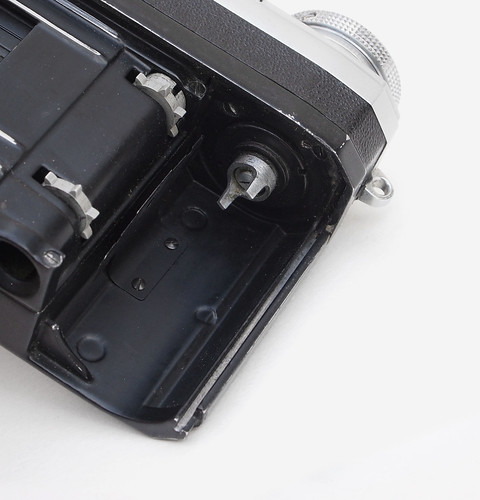
Take up chamber with film advance claw
On close inspection of both the metal spool and the camera itself, I could see why the film wasn't properly aligned: there is a raised rim around the base of the film advance 'claw' (as the Contax III manual describes it), shown above. This raised rim prevents a spool from a standard 35mm cassette aligning perfectly with the film path. I adapted the solid plastic internal spool from a 35mm cassette to use in the take up chamber, in a slightly different fashion than the advice on making a replacement Contax spool from Mike Elek's site, which appears on a number of Kiev/Contax rangefinder sites. In addition to cutting a slot in the plastic with a hacksaw to locate the film leader, I also removed the protruding rim around the base, to make this flush, as with the metal Kiev spool, illustrated below. This was a detail I'd not found while researching online; perhaps the Kiev is different from the Contax in this respect, perhaps not, but sometimes the internet isn't quite so good for minutiae such as this.
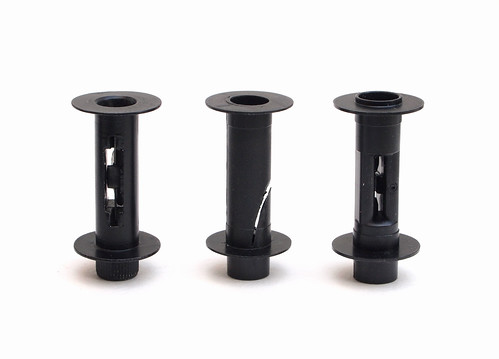
Left to right: original Kiev spool; modified solid spool; unmodified spool
Once loaded, the film counter has to be set manually, and counts up (I have read elsewhere that it counts down, so perhaps this isn't consistent). Shutter speeds are set on the film advance knob, in the centre of which is the shutter release; turning the knob to advance the film also cocks the shutter. To set the shutter speed, the knob is pulled up and rotated to locate an internal pin, which has to be done after the shutter has been cocked. If this is done once the shutter has been released, this internal pin might not be correctly located. As on the Contax II/III, the highest speed is 1/1250th, down to 1/2th, and 'B' (the later 4/4A models and the 4M/4AM versions had the top speed reduced to 1/1000th). On the Contax, using the 'B' setting with the self-timer achieved a shutter speed of 1 second; on the Kiev, this is a rather-less-than-precise range of 1-3 seconds: the Kiev manual recommends to "check its value before using". On my camera, it is around the three-second mark. The focal plane shutter comprises two curtains that are constructed from a series of interlocking vertical metal slats. These are remarkably quiet above 1/50th; at 1/50th and below, the shutter has a muted 'zip' sound.
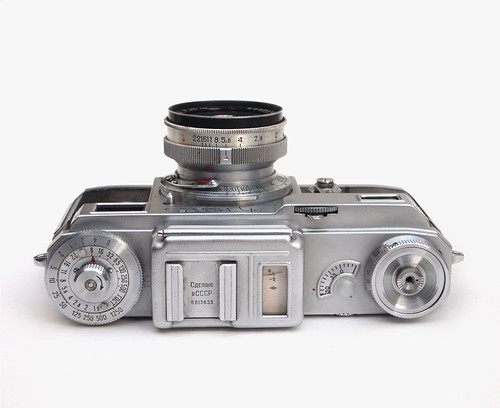
Kiev-4 rangefinder, view of top plate
The Kiev/Contax rangefinder has a very long base - 90mm - and this distance between the two windows makes for very accurate focussing. There are compromises with this: ergonomically, it's easy to cover up the rangefinder window while holding the camera (thus making the 'Contax grip' necessary and the Contax manuals describe how to place the user's right hand to take advantage of this); also, with the standard 5cm lens, the rangefinder's accuracy provides a high degree of rotation to change the focus from infinity to 0.9m. In comparison, the focus lever on the Kodak Retina IIa rotates 90º from infinity down to 3.5 feet, while on the Kiev-4 the 5cm lens rotates 270º from infinity to 0.9m. This makes switching from infinity to close focus not as rapid as it might otherwise be, notably when using the focus wheel on the body.

The Contax/Kiev lens mount has an internal and external bayonet: the internal bayonet is used by the 50mm lenses and has a built-in helical; other lenses use the external mount and this means that the entire 5cm Jupiter-8M lens rotates as it focus. The lens aperture ring thus rotates away from the user until it can no longer be seen from the top of the camera. Some 50mm lenses had the aperture scale engraved twice around the lens to ensure it's always visible, but my lens has only one scale. As the 50mm lenses do not focus themselves, the internal bayonet mount also has focus and depth of field scales engraved around it. There is an infinity lock on the focus, which has two release levers: the tab above the focus wheel on the body, and the sliding pin by the lens itself. To change lenses with the internal bayonet, the lens must be locked at infinity.

For writing this blog post, I've only been using the standard Jupiter-8M f2 5cm lens that came with my camera, but Arsenal duplicated the Contax range of Zeiss lenses, with the f1.5 50mm lenses - both the Zeiss Sonnar and the Jupiter-3 version - being most sought after and commanding the highest prices. With the 50mm lenses, both the wheel on the body or rotating the lens barrel can be used to focus the lens once the infinity lock has been released. It's not recommended to use the focus wheel on the body for other lenses due to their inertial weight. The rangefinder is clear and easy to use (the viewfinder has no frame lines or parallax indication, merely the square superimposed rangefinder patch), and I did find that I was deliberately choosing subjects to make use of its accuracy, isolating near objects and using wide apertures to throw backgrounds out of focus. The Jupiter-8M lens has a nine-bladed aperture diaphragm that no doubt helps in the smooth rendering of out-of-focus areas, such as in the shot below.
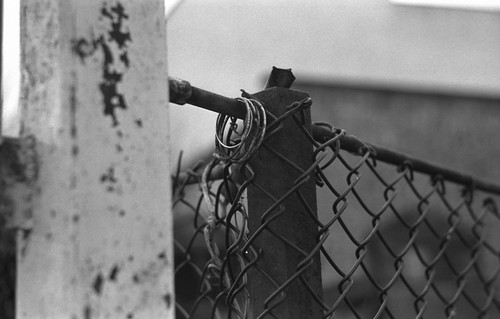
Kiev-4 with Adox Silvermax
For most of the shots taken to illustrate this blog post, I've trusted the built in light meter: cross-referencing with the 'Sunny-16' rule, the meter appeared to be functioning with sufficient accuracy for black and white negative film. As mentioned above, the Kiev-4's meter was based on that of the post-war Contax IIIa, although it differs from it in having 2x and 4x exposure marks, while the Contax IIIa only had one mark for correct exposure. The original Contax III had a light meter scale with markings for multiplying factors of 2, 5, 10, 20, and 40: I imagine that at the highest end of the scale, there's a potential for greatly magnifying a margin of error when using with insufficient light.
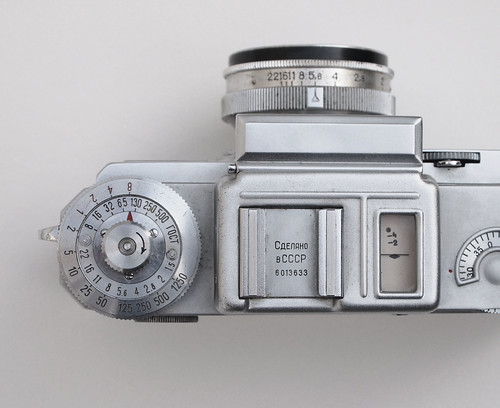
Kiev-4 lightmeter and exposure calculator
To use the Kiev-4's light meter, a pin by the cover's hinge releases the cover, which operates as a shade against the sky skewing meter readings. On the exposure calculator, film sensitivity is marked in the USSR's GOST scale, which is about one tenth less than the comparative ISO. The meter needle can be moved by rotating the outer ring of the calculator until it aligns with the rhombus in the meter window, or, in lower light, to the 2x or 4x exposure compensation marks, and then aperture and shutter speed combinations can be read off the lower side of the calculator dial. There's also a small circle to zero the meter, with a tiny screw on the back of the meter housing for adjustment. Although not very useful for low light situations, I haven't found selenium light meters to deserve the negative reputation that appears to be quite common online; perhaps I've been exceptionally lucky to get camera after camera with working meters.

Having used the Kiev-4 for just a couple of months, and with the standard Jupiter-8M lens only, this is by no means a comprehensive review of the camera. However, the results I've had so far have largely shown the camera to perform very well (the best perhaps are those shot on Adox Silvermax). Once I'd worked out exactly how to adapt a spool for the take-up side, using the camera was largely trouble free, although on a couple of occasions the frame spacing has been erratic, once with larger gaps than normal at the start of a roll, once with overlapping frames on a short roll of film. Operation of the camera isn't as intuitive as it might be, and takes a little getting used to, especially holding it without obscuring the rangefinder window. I've often found it more convenient to use the lens barrel to focus once the infinity lock has been released, although the wheel on the body is good for fine tuning the focus. I've missed having a yellow filter for some of the shots below, and although I generally use standard focal lengths for most of the photographs I like to take, there is the potential to acquire a range of lenses (and accessories) to take advantage of Zeiss Ikon's eighty-year old conception of this rangefinder as a complete professional system camera.
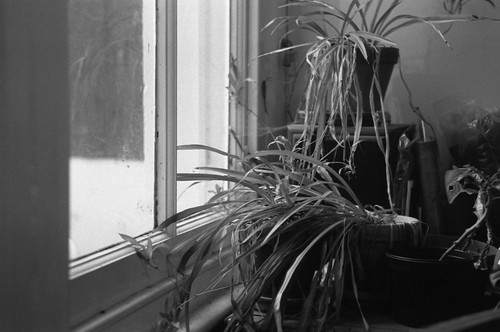
Kiev-4 sample image on Ilford HP5 Plus
Kiev-4 sample image on Ilford FP4
Kiev-4 sample image on Ilford Mark V Motion Picture Film
Kiev-4 sample image on Foma Retropan 320
Kiev-4 sample image on expired colour print film
Kiev-4 sample image on Adox Silvermax

Sources/further reading:
SovietCams.com overview of the Kiev/Contax
Kiev-4 manual translated into English
Kiev Survival Site
Kiev-4 schematics on USSRPhoto
Kiev-4 on Photoethnography
Kiev-4 on Matt's Classic Cameras
Kiev-4 on Camerajunky 
Kiev-4 on Early Photography
Kiev-4 on Classic Cameras
Contax manuals from Butkus.org