Showing posts sorted by relevance for query 127 Day. Sort by date Show all posts

Wednesday, 12 August 2020

127 Day Summer 2020

Rolleiflex 4x4 with Kodak High Resolution Aerial Duplicating Film
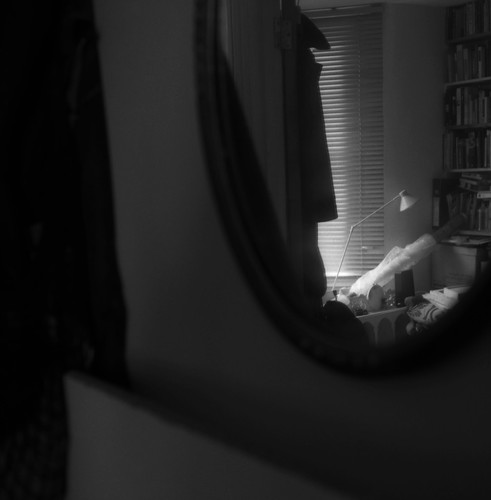
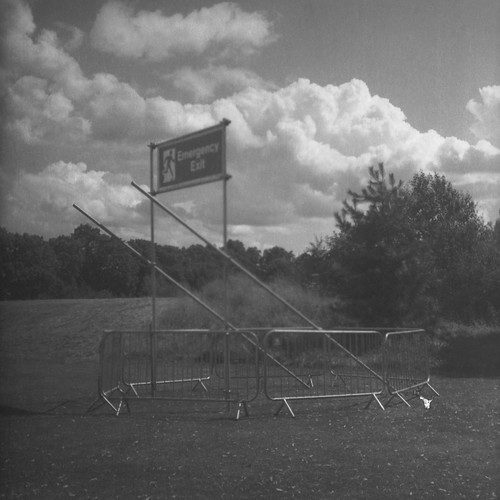
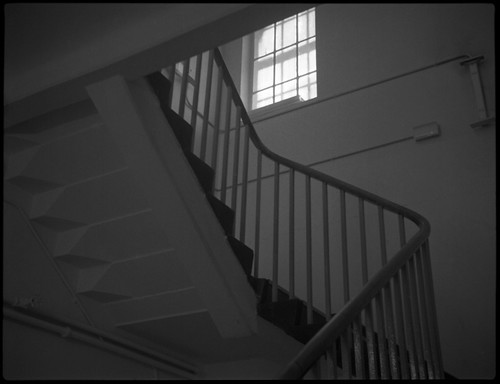
For last month's 127 Day on 12th July, I used the Rolleiflex 4x4 as I had done for 2019's summer 127 Day. This time I only used Kodak High Resolution Aerial Duplicating Film, as I didn't have any medium format film to cut down to 127 for the day, and cut this to size under safelights to roll it with 127 backing paper for shooting. I took some interior shots before taking a walk with the Rolleiflex (and a tripod).


Although I have been rating the High Resolution Aerial Duplicating Film at an exposure index of 2, I did attempt a couple of shots hand-held. Given the brightness of the sunlight mid-afternoon in July, this was just possible - the shot below was taken hand-held wide open (f3.5) at 1/15th; the reason for doing this was that the tripod I was using would not give me a high enough angle, and to help steady the camera I did brace myself for the shot against some convenient street furniture, and partly, I suppose, just to show that it was possible to shoot 2 ISO hand-held. (Most of the other images on this post were shot stopped down and exposed for a few seconds with a tripod in contrast to this).
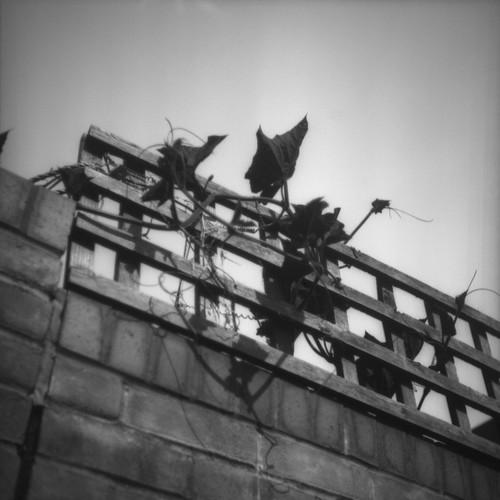

As the High Resolution Aerial Duplicating Film is blue sensitive - like photographic paper - in sunny weather with blue skies (or blue skies and brightly-lit clouds, as I had last summer's 127 Day), these tend to be overexposed and almost featureless. In the image above, the fact that the camera was pointing upwards into a very deep blue sky with a bright foreground negates this somewhat. Other shots, like that immediately below show this difficulty quite acutely; most of the photographs I took on the day were framed to avoid including much or any sky in the image.


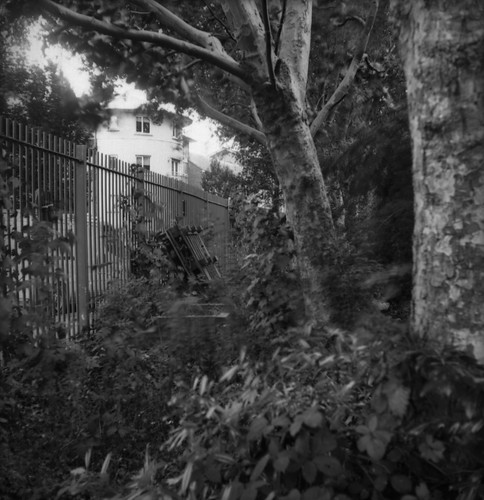
Having used the High Resolution Aerial Duplicating Film a fair bit more in recent months, I feel I've begun to understand how to handle it to get the best pictorial results (a purpose of which the film is not intended for). When I was first testing the film, I found it hard to control the contrast when developing the film with conventional film developers, and, at the time, I felt it was best suited to overcast conditions in order to achieve a good range of tones - taking photographs in bright sun seemed to produce negatives with blown highlights and little shadow detail, even when using Rodinal, which I thought would be ideal for the film at high dilutions. Since I've started using the film again more recently, I've been using Ilford Multigrade print developer, at quite high dilutions, with better results. Although I framed most of the shots I took on the day to avoid including too much sky in the frame for reasons outlined above, a number of shots did have patches of sunlight amid shadows, particularly those surrounded by trees and foliage, but these highlights aren't completely devoid of detail, which I would have feared would be the case previously.

The rolls I shot on 127 Day were tray developed by inspection under safelights using the 'see-saw' method in Ilford Multigrade paper developer diluted to around 1+50 (this wasn't very exact - I had already developed a number of paper negatives and sheets of ortho film in the developer in the same session, which I had diluted at about 1+25, and, before developing the Aerial Duplicating Film, I added more water to dilute it still further). The high dilution seems to affect development time more than contrast, but this does have the effect of making development easier by slowing it down; gentle agitation was provided by the slow see-saw motion of passing the film in and out of the tray of developer until the negatives looked dense enough. As the film itself is pretty transparent, or, perhaps more precisely, translucent, before fixing, it can be held up against the safelights to examine the development fairly closely.




Friday, 9 December 2011

127 Day - 7th December 2011

Cleaver Square Rooftops
127 Day is a calendrical encouragement to use 127 format cameras, on both 12th July (written 12/7 in little endian format) and 7th December (12/7 middle endian). Shooting with my Baby Ikonta, on the day I used a roll of FP4 with an expiry date of June 1976. Ilford no longer produce film in 127 format; my film was from a batch of three I bought online. I had used one of these rolls in my Foth Derby for the Summer 127 Day, and had been very pleased with the results from such an old film.  I rated the film at 64 ISO, half FP4's box speed of 125, to compensate for the loss of sensitivity with age, and stand developed the film in Rodinal at a dilution of 1:100 for one hour, with 30 seconds agitation at the start, and a couple of inversions at the half hour mark.

As I had been in July, I was working all day. With the limited amount of time I had to take photographs, especially given the short daylight hours, I took a number of night shots on my journey home from work to use the whole roll during the day. The daylight shots were metered with a Weston Master II; the night photographs were estimated.

London 2012 Olympic Site
Sutton Street, Stepney
A106 Eastway

See more photographs from 127 Day in the Flickr 127 Format Group Pool

Wednesday, 18 July 2018

127 Day Summer 2018

Kodak Brownie 127 with Ilford FP4 Plus
Of all the camera-themed days on the contemporary film photography calendar, 127 Day is the one I observe most often, and not just due to it appearing three times a year in its different iterations. I used the Kodak Brownie 127 for last week's version. The camera came with three rolls of film, two unexposed (the third, which had been exposed, I had previously developed and posted under Found Film 4). I had intended to use the two unexposed films on the day, both probably around forty years old. One was wrapped in its original inner packaging, which had the Kodak logotype and gave me hope that it might just be Verichrome Pan, but it was simply another roll of Kodacolor II once unwrapped; the other roll had its sealing band intact which was in German and English and had the letters 'CN S' and the film speed given as 20 DIN/80 ASA, but no other indication of what film this was.


I shot this film first, which was a misjudgment on my part. After shooting all eight frames, on reaching the end of the roll, advancing the film became very stiff - and in attempting to force the advance knob on the camera to turn, this broke. The knob is plastic, but sits on a square-section metal spindle, and the plastic was brittle enough for two sides of its square cap to break off entirely. The cause of the resistance I felt when advancing the film was the fact that the backing paper had rusted to the original metal spool. The rust suggested that, as the film was unwrapped, at the very least humidity had got to the roll, not promising much for the photographs I'd just shot.

Agfacolor Special backing paper
Information on the 'exposed' sealing band identified the roll as Agfacolor Special (the 'CN S' standing for 'Colour Negative Special'; Agfa introduced this film in 1968 and it was replaced by CNS II in 1975 according to the Agfa Colour page on Photomemorabilia). Due to its age, I stand developed the film black and white chemicals. As the Kodak Brownie 127 has no means of adjusting exposure, there was little I could do to compensate for the age of the film; only one image registered on the film sufficiently to scan it: I had pointed the camera directly at the sun mitigated by haze and a passing lower cloud. This image showed up as a faint positive on the film, not a negative as I had expected; this may just be the fact that with the film having a very dark base that did not clear on fixing, the negative density was sufficient to show up against this, very much as the principle behind the tintype.

Kodak Brownie 127 with Agfacolor Special
Having unloaded the Agfacolor film, avoiding the Kodacolor roll, I loaded the camera with cut-down Ilford FP4 Plus; there was just enough purchase with the broken advance knob to wind the film through the camera, though this became increasingly difficult as the film ran through the camera, and I had to put more force on the knob: each time this slipped, rather than turn the metal spindle, the plastic was abraded against the metal. As it was late afternoon into the early evening when I shot the roll of FP4 Plus, in development, I pushed the film one stop to compensate, which mostly worked well, even providing some shadow detail in one interior shot I made.

Kodak Brownie 127 with Ilford FP4 Plus
I risked one final roll, some cut-down Ilford HP5 Plus. Shooting this inside, in moderately low-lighting conditions, I pushed the film three stops on development; this gave rather underexposed images, as I had thought might be the case, but these had just enough information to scan them. The problems with advancing the film with the broken knob had become bad enough that I only shot four frames before I was unable to advance the film any further.

Kodak Brownie 127 with Ilford HP5 Plus
In hindsight, both the old colour negative 127 films would have been better saved for a camera in which I could adjust aperture and shutter speed to increase exposure, compensating for the loss of sensitivity with the age of the films; I might not then have broken the film advance on the Kodak Brownie 127, and, perhaps, I might have found myself with a better set of photographs from the day.

Kodak Brownie 127 with Ilford FP4 Plus
Kodak Brownie 127 with Ilford HP5 Plus

Friday, 19 July 2019

127 Day Summer 2019

Rolleiflex 4x4 with Kodak High Resolution Aerial Duplicating Film
After my recent testing of the Rolleiflex 4x4, I naturally wanted to use it on last week's 127 Day; I didn't have any film in medium format to cut down to 127 to use on the day itself, as I might normally do. However, in cutting down 120 film to the width of 127, as the film is also longer, there's always an offcut of three or four frames, depending on the frame size of course; I did have one such short roll of Ilford FP4 Plus, which I simply shot the same scene over three frames with bracketing.

Rolleiflex 4x4 with Ilford FP4 Plus
I also shot the roll of Kodacolor II which had originally come with a Kodak Brownie 127 and which I hadn't previously used: I had low expectations for this film considering its age and that the roll of Agfacolor Special which also came with the camera and that I had short for last year's Summer 127 Day had only yielded one poorly defined image (I might have used the Kodacolor II film then had I not broken the camera). Using the Rolleiflex 4x4 did mean that I could give the film much more exposure than that of the Kodak Brownie 127 which has a single shutter speed and aperture, and so I used a tripod and bracketed exposures, erring on the side of considerable overexposure - which did provide better results than I had achieved with the Agfacolor film twelve months ago.

Rolleiflex 4x4 with Kodacolor II
The metal spool that the film was on was rusty, and the backing paper was partially stuck to the film, although this seemed to be mostly on the reverse of the film, not the emulsion side, and could be gently rubbed off in the wash. I used stand development with the film to get a black and white negative image, successfully for a few frames, although in comparison with the image above, the one below is out focus in the central area, suggesting that film flatness was a problem, perhaps unsurprising given that the film itself had been tightly coiled around the 127 spool for forty years.

Rolleiflex 4x4 with Kodacolor II
Most of the photographs that I took on the day were with Kodak High Resolution Aerial Duplicating film cut down by hand to 127 size. This was rated at an exposure index of 2, and, having a lot of the film to play with, I also bracketed most of the shots, partially for exposure, but also, shooting long exposures on the shutter's B setting (again with a tripod), I was aware of either the possibility of inadvertent shake from holding the shutter release down (which is one reason for liking older shutters with a T setting), or from the breeze causing elements of the subject to move. As well as being very slow in terms of exposure, the Kodak High Resolution Aerial Duplicating film is also high contrast and blue sensitive, making for an interesting comparison with the black and white version of the Kodacolor II film; the shot below just holds some information in the sky, but essentially bleaches it. Other colours render in very different ways on the film: in the image at the top of the blog, the apples, although far from ripe, are a russet colour, which appears notably dark in the photographs. The look is quite different from the usual panchromatic rendering of most black and white film, and has a distinct feel, even when used for subjects where this effect isn't quite so clear. One of the problems I had when using the Kodak High Resolution Aerial Duplicating film straight after the Kodacolor II film is that there was a fair amount of dust in the camera caused by the rust from the metal spool, which caused a fair bit of spotting on subsequent frames, particularly at the edges from the spool flanges. The grain of the Kodak High Resolution Aerial Duplicating film is so fine as to be virtually invisible, at least within the scope of using a flat bed scanner with the film and this shows how well the Xenar lens on the Rolleiflex 4x4 performs: apart from the spotting - some of which may be due to development - the film's grain is so fine that there is a danger of banding in areas of smooth tonal transition, a problem I've only really experienced before with Kodak Technical Pan.

Rolleiflex 4x4 with Kodak High Resolution Aerial Duplicating Film

Sunday, 30 January 2022

127 Day January 2022

Zeiss Ikon Ikonta 520/18 with Ilford HP5 Plus
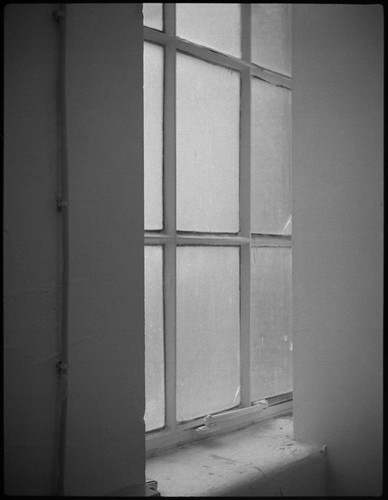
As I wrote in my entry for December's 127 Day, I rarely miss the opportunity of shooting 127 format cameras on the calendrical 127 days, and last Thursday's January iteration was no exception. It was however a working day, and in addition, the day began very dull and overcast, with very low light levels on the way to work shortly after sunrise–not dissimilar to the weather in December. I used the Baby Ikonta again, which has a moderately wide aperture lens at f3.5, compared to other 127 format cameras which I might have chosen had the weather been better. Partly as a result of the low light levels I took very few pictures on the way to work; then, with a busy day at work, I took fewer photographs than I might have done, just one roll of cut-down Ilford HP5 Plus, but the light did improve later in the day as the clouds cleared, and I made use of this, taking a few frames around windows before the light went. Had the day remained overcast, I might have been tempted to develop the film to compensate by adding a stop to increase contrast (I'd estimated exposure with reference to the 'Sunny 16' rule) but I went with box speed after the light improved, using Adox Adonal diluted 1+25 for 6 minutes at 20ºC.


Monday, 9 December 2013

127 Day - Winter 2013

Canalside Properties, Baby Ikonta, Ilford FP4
For last Saturday's 127 Day, I retraced my steps from last year, walking around the perimeter of the London 2012 Olympic Park. On this year's July 127 Day, I had used the last of my 'new' 127 format films, and also shot 35mm film cut and rolled to 127 backing paper. Since then, I'd bought a couple of expired films, one roll of Macophot UP 100 with a "develop before" date of 1/2004, and a roll of Ilford FP4 from December 1976. I had previously used 127 FP4 with a similar date with good results two years ago. I also had a roll of 828 Verichrome Pan (with a develop before date of August 1977) which I had removed from its backing paper and backed with 127 paper. 828 was one of Kodak's numerous film formats from the early 20th century, and was made well into the 1980s; the format uses unperforated 35mm film. I'd used old Verichrome Pan on a few occasions before, with mixed results. All three films were shot with the Baby Ikonta. The FP4 and Verichrome Pan films were stand developed, while the Macophot UP 100 film was developed according to the Massive Dev Chart recommendations. Of the three films, the FP4 was clearly the best, despite being the oldest film. Other than some pinholing, the film probably could have been shot at box speed, rather than at 50, which was what I rated all three films at to compensate for age.

Car Park, Baby Ikonta, Macophot UP 100
Drapers Field, Baby Ikonta, Macophot UP 100
The Macophot UP 100 had noticeably more fog, and a patterning which appears to have come from the backing paper: while hanging up after developing, I could also see the numbering from the backing paper, but this cleared on drying (this has been a manufacturing problem with a number of films in recent years). Additionally, both the Macophot UP 100 and Verichrome Pan films both had a very pronounced curl, while the FP4 was no worse than 120 film would be.

Verichrome Pan
The Verichrome Pan film had a patterning from the backing paper showing rather more than on the Macophot film and also suffered a little from light leaks. As 828 film is fairly short, this provided 12 images on the film rather than the 16 or 17 frames from conventional 127 film; the image above is from the very end of the roll with holes from the film clip for hanging.

At the end of the day, to finish the Ilford FP4 film, I returned to shoot a couple of the night photographs from two years ago, although I couldn't exactly match the second image below due to continuing work around London's Olympic site.

London 2012 Olympic Park, Baby Ikonta, Ilford FP4
A106 Eastway, Baby Ikonta, Ilford FP4