Wednesday, 27 February 2019

127 Day January 2019

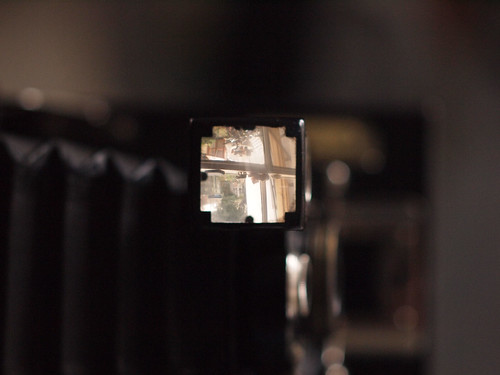
Zeiss Ikon Ikonta 520/18 with Ilford HP5 Plus
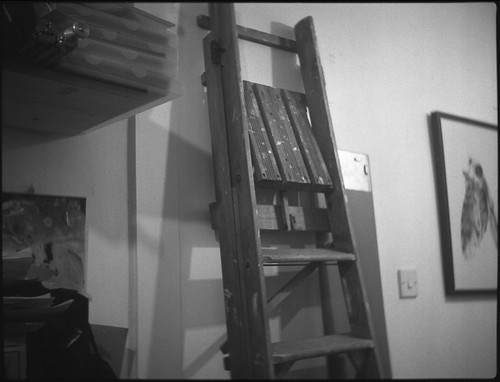
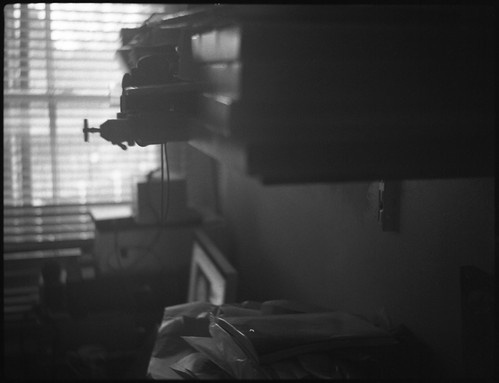
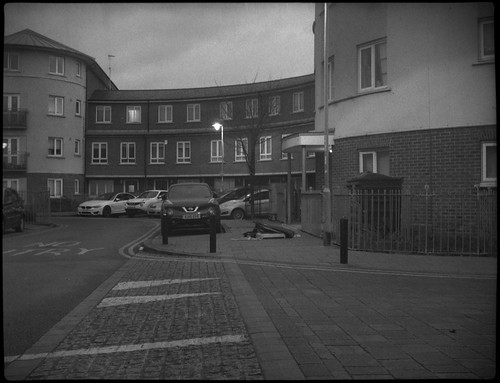
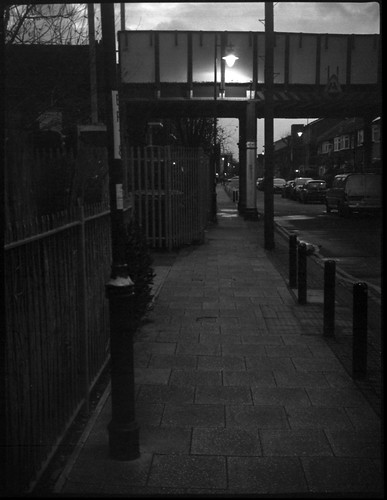
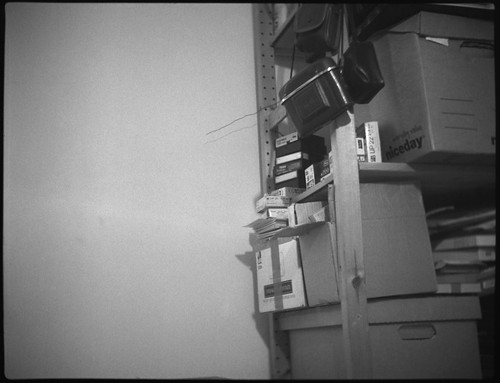
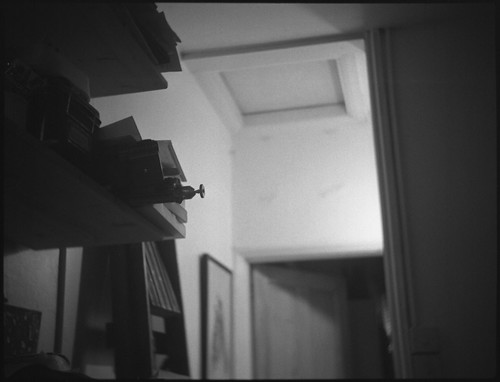
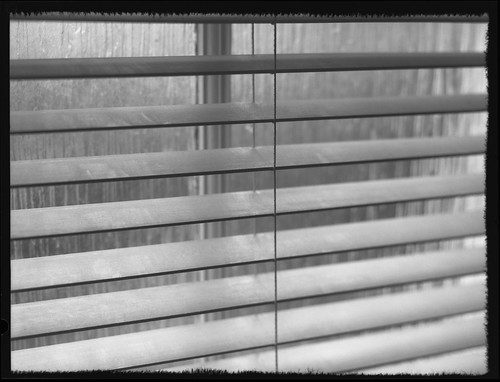
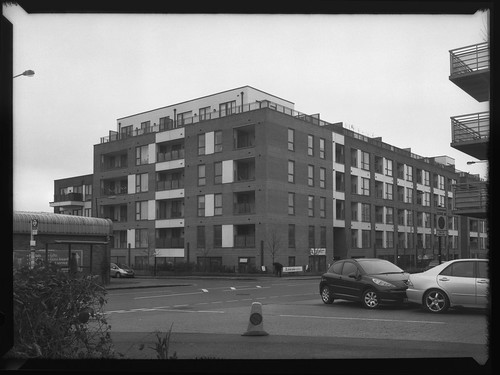
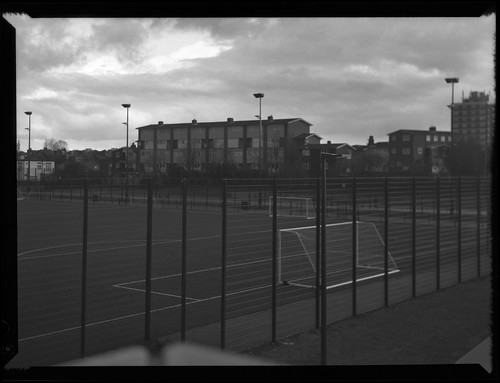
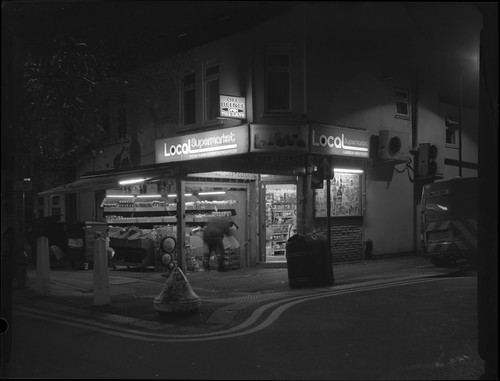
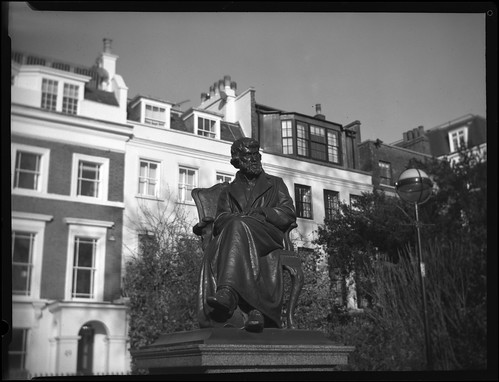
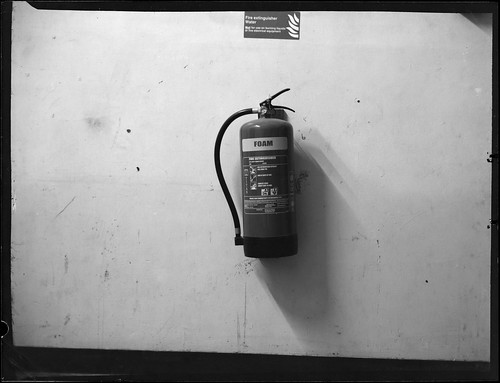
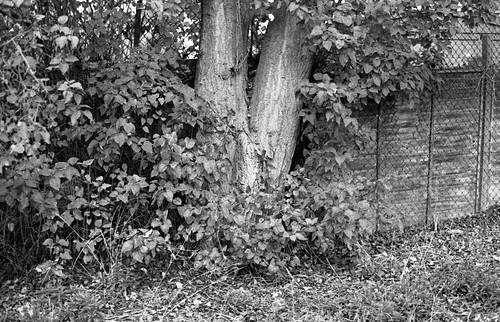
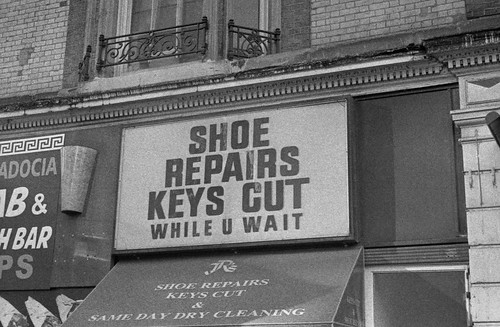
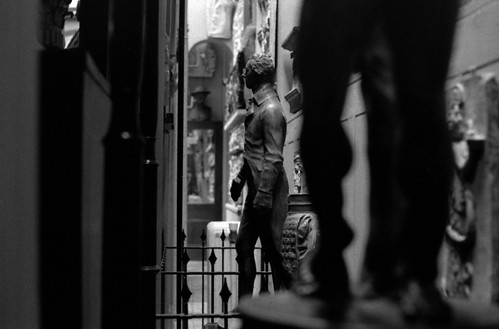
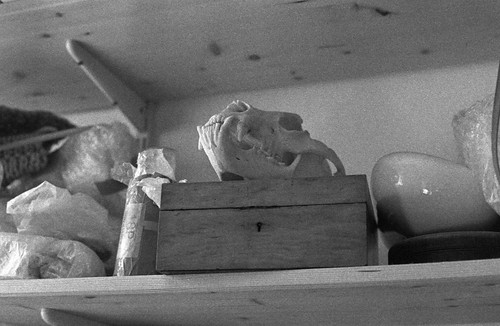
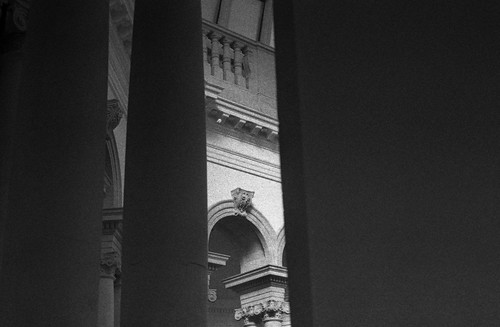
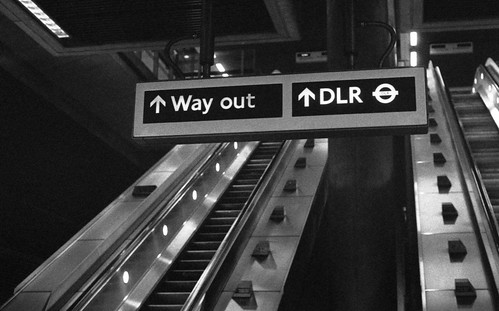
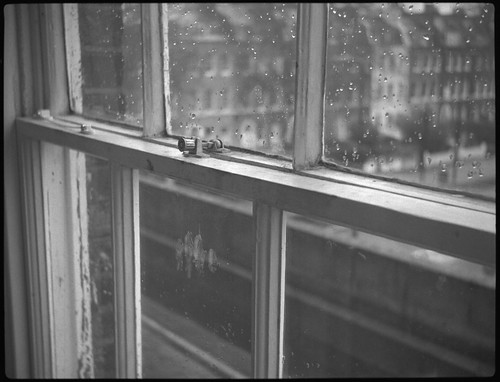
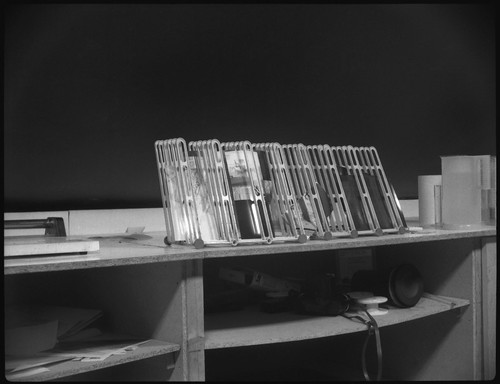
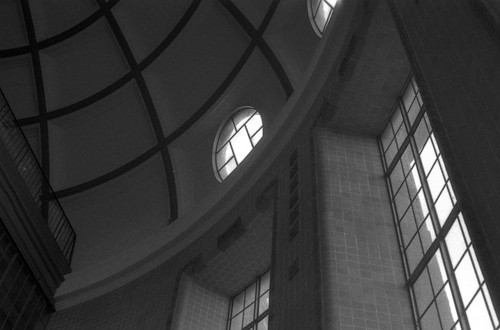
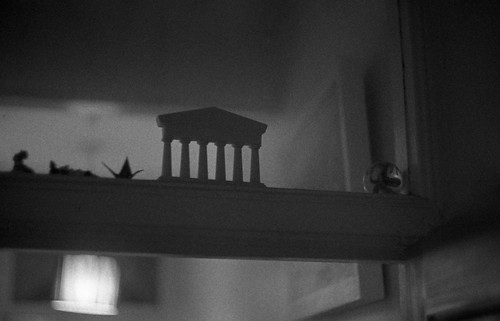
Last month's 127 Day was necessarily curtailed by the fact that I spent it working on a funding application all day. Nevertheless, I did take a number of photographs with the Baby Ikonta, on Ilford HP5 Plus, mostly at home (these circumstances meant a delay in developing, as I wasn't as keen as I might be to see the results). A brief excursion to the corner shop happened just as it was getting dark, still relatively early in the afternoon towards the end of January: one photograph taken outside was made balancing the camera on a bollard for a long exposure; the vertical image below this was handheld and a little underexposed as a result, wanting to avoid camera shake.
Zeiss Ikon Ikonta 520/18 with Ilford HP5 Plus

Sunday, 24 February 2019

#FP4Party February 2019

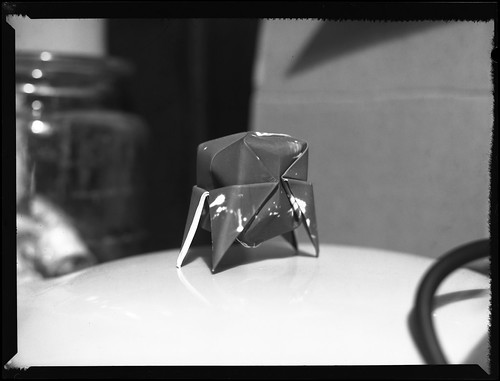
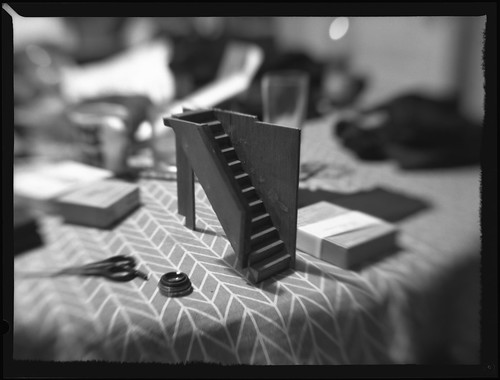
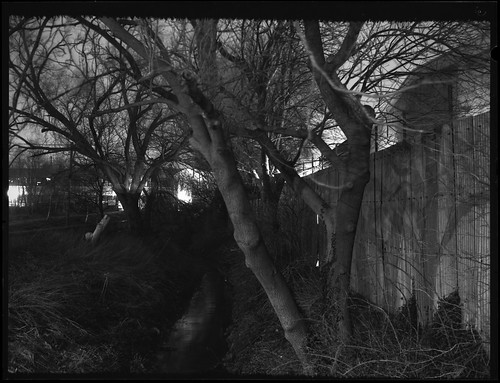
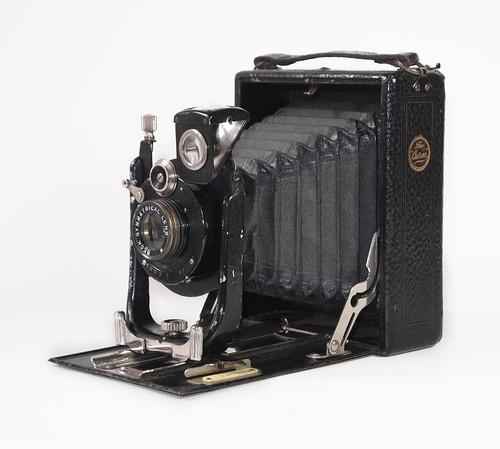
With February being announced as 2019's second #FP4Party, after shooting with the Cameo in January, it felt logical that I should use my other quarterplate-sized folding camera - the Ensign Folding Klito de Luxe No.9. Last month, I had set myself the task of simply photographing with two sheets of forty-year old Ilford FP4 each day during the 'shoot week', and so I did the same for February. The Ensign Folding Klito is a superior camera when compared to the Cameo; the most immediate difference in use is the rack and pinion focus on the Klito, rather easier to finely adjust against the Cameo's spring clamp. The Klito has its original ground glass focus screen with a hood; using the Klito with faster lenses than the Cameo also made accurate focus easier to achieve. Like the Cameo, it has front rise and cross movements, the rise controlled by beautiful circular gearing around the lens and shutter assembly.  Finally, the Ensign Folding Klito also has double extension bellows, allowing for close focus, without the need for a close-up lens attachment, as I used with the Cameo.

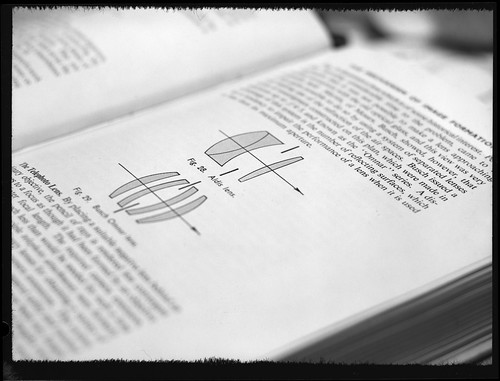
Over the first three days of the shoot week, I used the Klito with a 12cm Ica Dominar lens; the original lens is a No.2 Aldis Plano Anastigmat; I had replaced this with the Dominar lens while using the Klito to take night photographs on glass plates, being f4.5 against the f6.8 Plano: having a faster lens makes for a brighter image on the ground glass when composing and focussing, especially advantageous when working at night. However, wanting to use the Klito with this original lens, I reinstated the Aldis Plano, and shot with this for the remainder of the week. The Aldis Plano is a classic triplet design; while cleaning the thread on its retaining ring, I removed the rear element - and realised that it, a positive meniscus, formed an image on its own. The results (Thursday's image, with a diagram of the Plano shot for Friday) are very much as one would expect from a meniscus lens - it would appear that the front elements, a doublet, correct all the classic distortions present in the meniscus; the rear element on its own provides a wider angle - which I hadn't expected.

All the shots on this post were taken with a tripod. As in January, low light was a factor, but as much as the weather, being otherwise busy meant that a number of the shots were taken at home in the evening. Tuesday's photograph was taken on Fulbourne Road in Walthamstow, North London - the site of Houghton's factory - where the Ensign Folding Klito de Luxe No.9 was almost certainly made, a little over a century ago.

Monday
Tuesday
Wednesday
Thursday
Friday
Saturday
Sunday

Thursday, 14 February 2019

28th of February is 'Take Your Box Camera To Work Day'


A camera-related day that I've often taken part in in the past, Thursday 28th February is 'Take Your Box Camera To Work Day 2019'. Like the related 'Take Your Box Camera To Play Day', this is simply an excuse to get people using box cameras - and in an environment that one might not necessarily take such a camera. Many box cameras are still eminently usable, taking 120 medium format film, or with a little consideration, 620 film, and modern, faster emulsions make the situations one might use a box camera in more diverse than once was the case - although, in the past, I've often used long exposures on such days, for interiors, rather than instantaneous 'snapshots', easier to do in daylight, outside - obviously this very much depends on the working environment. I did miss it last year, but I'm keen to shoot on the day and promote it once again in 2019.
Box cameras above, from left to right: Baby Box Tengor; Lumiere Scout Box; Kodak No.2 Brownie; Kodak No.2A Brownie; The Midg Falling Plate Camera 

Sunday, 27 January 2019

#FP4Party January 2019/Revisiting the Butcher's "Cameo"

Ilford FP4 shot on Ilford FP4 with Butcher's Cameo and close up lens attachment
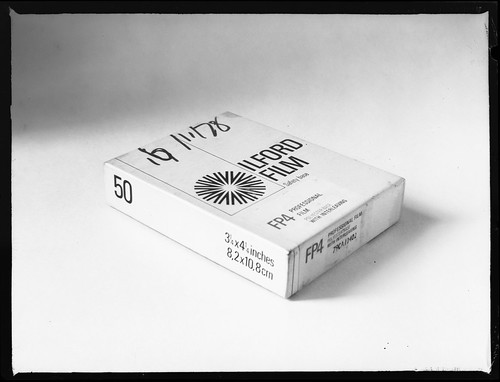
When choosing a camera for January's #FP4Party, a clear deciding factor for me was already having a fair stock of quarter-plate (8.2x10.8cm) FP4 sheet film. With one part or mostly used box of 50 and one unopened box, I decided not to buy any new rolls of FP4 and use this instead. Both boxes have a handwritten date of 16/11/78 (one box looks like it starts with 17/- which was then changed to 16); the film dates to well before the 'Plus' iteration was introduced in 1990 but I've previously used it with just one stop of extra exposure to compensate for age (I have also shot it at an exposure index of 100, and pushed the development by one stop instead). Possessing three cameras for the format: the Klito, Midg, and Cameo, all plate cameras, all of a similar age, over a hundred years old, I picked the Cameo, having used it for the first #FP4Party in September 2016, being the smallest and lightest of the three, and it seemed time to revisit it for this month's #FP4Party.

Butcher's and Sons "Cameo"
I restricted myself to expose just two sheets a day over the 'shoot week' (although on the first day I actually shot three sheets; I also didn't count the shot of the FP4 box in the total, but it made sense to photograph this on the film itself, using the lens attachment, during shoot week). Low light and short daylight hours in the northern hemisphere in January do not make for using a film rated at an exposure index of 50 necessarily sympathetic. In addition, using the Cameo handheld is not without a number of difficulties. Not entirely trusting the focus scale on the drop bed, to focus the camera using the ground glass screen requires one to use the spring clamps to position the front standard at the correct distance on the rails of the drop bed: it needs a certain amount of dexterity to put one's hand in such a way to move the front standard without obscuring the image on the ground glass with it: I miss rack-and-pinion focussing with the Cameo, particularly when using it hand-held.

Home-made ground glass screen; lens wide open
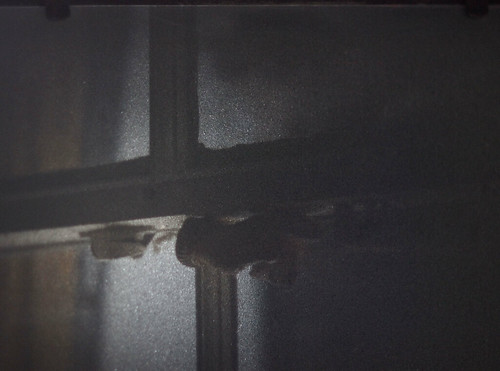
Even in relatively bright light, the Cameo's Beck Symmetrical lens produces a dim image: its widest aperture is nominally f8 (although it's most likely f7.7 when fully open beyond the f8 mark), slow by modern standards, and the screen is missing its hood to shade the ground glass, making this image difficult to assess. The ground glass was missing from my camera when I acquired it; I replaced this with some glass that I ground myself, but used too coarse a grade of grit, which adds to the difficulty in focussing. Once the image is in focus (as close as one can tell) on the ground glass, one then has to remove the focus screen and replace it with a plate holder, adjust both aperture and shutter speed to the desired settings, remove the darkslide from the plate holder, then frame the subject using the brilliant finder - and then gently press the shutter release lever. The Lukos II shutter has three 'instantaneous' speeds of 1/100th, 1/50th and 1/25th, and, while it would have been possible to get usable exposures at 1/25th, wide open on f8, for overcast, dull days, I only used the Cameo hand-held on a couple of days (Tuesday and Friday) when there was some winter sun, partly to use smaller apertures in the hope that a greater depth of field might compensate for any errors in focus.

Brilliant finder on the Cameo
For most of the shots during the week, I used a tripod or simply balanced the Cameo on a flat surface for long exposures, low-light shots, interiors and those at night. I also used the wide angle/close up lens attachment for some shots (Friday and Saturday) and the image of the box itself. I did my first batch of development during the shoot week rather than the 'development week' that followed. This acted as a check on my exposure and development regime: the first batch of film I developed with a one-top push - on top of the one and a third stop extra exposure - but developing the first few sheets appeared to show that extra development was unnecessary and the rest of the week's shots were developed in RO9 One Shot for the recommended time, 9 minutes, at a dilution of 1+25 at 20ÂșC.

Revisiting the Cameo, the quality of the results from the shoot week varied. Some of this was down to user error of course; other aspects were to do with the camera's limitations. When using the wide angle/close up lens attachment, there is clear vignetting, with a falling off of both illumination and definition towards the edges of the frame. This is less obvious when used as a close up attachment, as the lens' image circle would be wider the more the bellows are extended; when used as a wide angle attachment, the bellows are extended less than normal, making the image circle smaller. As well as the difficulties of focus set out above, there were also problems with film flatness (notably visible in the middle of the shot from Saturday); this might be due to the motley group of film sheathes I've been using, with some clearly home made, and others professional: some fit the sheet film better than others. The film itself stands up remarkably well: over four decades old, with only a little loss in sensitivity, the quarterplate-sized FP4 is still very usable.

Monday
Tuesday
Wednesday
Thursday
Friday
Saturday
Sunday

Friday, 14 December 2018

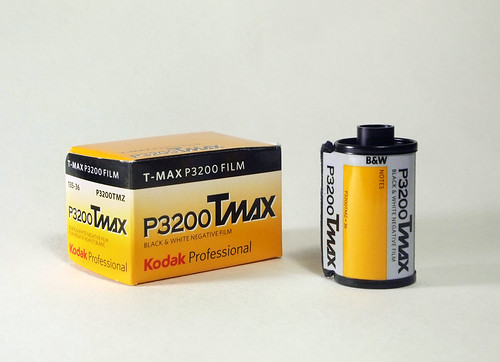
Kodak T-Max P3200 - back from the discontinued list

Kodak T-Max P3200
KODAK PROFESSIONAL T-MAX P3200 Black & White Negative Film ⁄ 3200TMZ is a multi-speed continuous-tone panchromatic black-and-white negative film that combines high to ultra-high film speeds with finer grain than that of other fast black-and-white films. It is especially useful for very fast action; for dimly lighted scenes where you can’t use flash; for subjects that require good depth of field combined with fast shutter speeds; and for handholding telephoto lenses for fast action or in dim light. It is an excellent choice for nighttime photography.
T-Max P3200 data sheet
When I wrote my previous post on Kodak T-Max P3200 it had been discontinued for two years; with Kodak's rationalisation of their product lines at the time, I would not have predicted that the film would be reintroduced just fours years later. Many online commentators are more excited by the reappearance of Ektachrome, and perhaps understandably so; some photographers - myself included - would like to see Plus-X return, but it could be argued that as Kodak do already have a medium speed black and white emulsion in T-Max 100, that being able to compete with Ilford's Delta 3200 at the upper end of the speed table makes sense in terms of a market strategy. T-Max P3200 was first introduced in 1988, a whole ten years before Delta 3200; like Ilford's film it is essentially a fast film designed to be push-processed. The data sheet states that T-Max P3200's nominal speed is EI 1000 in T-Max developers, or EI 800 in other developers - some commentators make much of this fact in online pieces about the film, but Kodak are open about what the film is: the P before 3200 in the name denotes that the film is designed for push processing. Of course, the film cartridge is actually DX-coded to 3200, so, in cameras with DX-coding it will be exposed at EI 3200 unless manually set. No doubt, without instructions to the contrary, labs would also develop it as if shot at 3200. Like Delta 3200, Kodak T-Max P3200 is essentially a versatile high speed film, with excellent latitude and manageable contrast - two factors that important to the ability to successfully push a film.

When I last wrote about T-Max P3200, I hadn't made any evaluative tests with it: I had used a couple of rolls of out-of-date film for that post, as well as reflecting of first using the film in the mid-1990s, before Ilford also entered the market for ultra-fast films with Delta 3200. With a new batch of the film, I thought it was worth revisiting T-Max P3200 and I began, as with testing most new films, by making a latitude test.

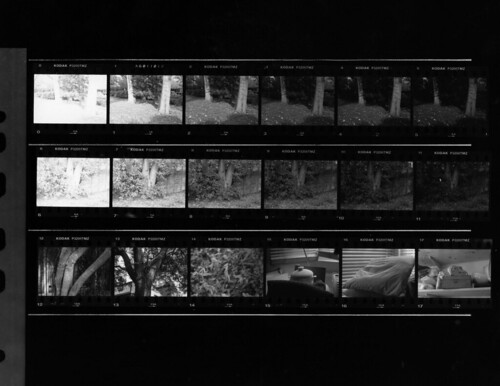
Kodak T-Max P3200 latitude test contact sheet
The results from this first test appeared to demonstrate that T-Max P3200 has excellent latitude: although developed at the recommended time for being exposed at EI 3200, almost all frames yielded a usable image. Shadow detail was thin at 6400 and clearly lacking at 12800, but this is dependent on the subject contrast: this was less of a problem in images with a narrower brightness range (when choosing the two different shots for comparison at different exposure indexes, I deliberately to framed one shot with a sunlit foreground in the frame and deep shadows; for the other set of six frames, the subject was all in open shade, and therefore less extremes of light and dark). Those shots at lower exposure indexes performed very well indeed, perhaps unsurprising given T-Max P3200's true speed, but even when rated at 400, there was no real evidence of highlights blocking out. For a film with great latitude, contrast was not as flat as one might expect (compare, for example, Ilford XP2 Super, while a very different film - for all the reasons described on my post - it has very low contrast which must in part contribute to its wide latitude). The two images below, which were scanned fairly 'straight', without much in the way of any adjustments, demonstrate a difference of 5-stops exposure, developed together.

Kodak T-Max P3200, rated 400
Kodak T-Max P3200, rated 12,800
Kodak's data sheet for the film list a number of Kodak's own proprietary developers - none of which I habitually use. For the latitude test, I used Fomadon R09 diluted 1+25, for 8 minutes at 20ÂșC, derived from the Massive Dev Chart; most listings are annotated that the data is taken from a previous version of the film, but there is no reason to suspect the new iteration of T-Max P3200 is any different. With R09, the appearance of the film's grain is quite pronounced, as one would expect; initially I suspected that I might not like the combination of T-Max P3200 and R09, but, despite it appearing obtrusive in some images, generally the combination did not seem too objectionable. Of course, a fuller review of the film would include testing some of Kodak's recommended proprietary developers; previously I had used T-Max P3200 with ID11, Ilford's equivalent of Kodak's D76: the grain here does appear smoother than with R09. The data sheet also warns that T-Max P3200 will exhaust fixer more rapidly than other films, this is presumably due to the emulsion density of the film, and is worth bearing in mind when processing.

Kiev-4 with Kodak T-Max P3200, developed in Fomadon R09
Praktica BCA with Kodak T-Max P3200, developed in ID11
One note on Kodak's data sheet in the section on spectral sensitivity caught my eye:
The blue sensitivity of KODAK PROFESSIONAL T-MAX Films is slightly less than that of other KODAK panchromatic black-and-white films. This enables the response of this film to be closer to the response of the human eye. Therefore, blues may be recorded as slightly darker tones with these films—a more natural rendition.
Having hardly ever used Kodak's T-Max films before, this was new to me. Some shots with Kodak T-Max P3200 in daylight with blue skies do look as though these were made with a yellow filter, as one might expect for most black and white films, however, Kodak T-Max P3200 is possibly the one film that might not feel like a natural choice to use for daylight photography in sunny conditions. The image below was shot on a bright autumn morning, and although the contrast between the brightness of the concrete and the sky enhances the effect, I was still impressed by the darkness of the blue sky without use of a filter.

Kiev-4 with Kodak T-Max P3200 at EI 3200, developed in Fomadon RO9
Instead of bright sunny days, Kodak T-Max P3200 is really a film designed for more difficult lighting conditions. At a rating of EI 3200, the film is usually sensitive enough for hand-held night photographs under street lights - with relatively fast lenses - or dimly-lit interiors (it's always seemed to be a popular choice for gig photography, for example). These situations often provide brightly lit but highly localised areas surrounded by deep shadows, conditions less than ideal when pushing slower films, as pushing increases contrast. When it was discontinued, Kodak recommended using T-Max 400, push-processed, instead, but did admit that "The exception [to replacing T-Max P3200 with T-Max 400] would be extremely low light situations where P3200 might be able to pull out some shadow detail that would otherwise be lost". As the data sheet specifies, with T-Max P3200 "...you will obtain better shadow detail and highlight separation when you expose it at EI 3200 or 6400 than you can obtain with 400-speed films pushed by 3 stops."

Kiev-4 with Kodak T-Max P3200 at EI 3200, developed in Fomadon R09
Kodak's data sheet includes developing times for rating the film up to EI 25,000; when making my tests, as well as shooting it at the 'box speed' of 3200, I wanted to test the film one stop either side of this, rating it at both 1600 and 6400. Judging from the latitude test, one could probably rate frames at both 1600 and 3200 on the same roll and develop this for the times for EI 3200 without any real drawback in quality: it's interesting to see on Kodak's data sheet how close the development times are for each stop in exposure, with some developers giving less than a minute difference between some stops. Quite possibly, most photographers developing the film themselves might have a margin of error in time (and temperature) that could encompass that amount of development fairly easily. Exposed and developed for EI 6400 does allow hand held shots in quite dark situations, which, when the film was new, must have seemed all the more impressive than perhaps it does today; I didn't find myself wishing for an extra stop or two, but further tests in the right developers at EI 12,800 and 25,000 possibly would not be as revelatory as they might promise.

Canon A-1 with Kodak T-Max P3200 at EI 6400, developed in Ilfotec LC29
Although the name of the film rather suggests naturally exposing it at an exposure index of 3200, Kodak's data sheet has the telling sentence, "Because of its great latitude, you can expose this film at EI 1600 and yield negatives of high quality. There will be no change in the grain of the final print, but there may be a slight loss of shadow detail [over rating it at EI 800]." Rating the film at 1600 would appear to be the best balance of speed against grain and retention of shadow detail. For the test at EI 1600, I wanted to use R09 at a dilution of 1+50, rather than 1+25, having seen a number of examples online where this looked as though the grain may appear a little less pronounced.

Canon A-1 with Kodak T-Max P3200 at EI 1600, developed in Fomadon R09
I shot much of the roll rated EI 1600 in the sort of conditions in which I would have first used the film two decades ago: in a museum, with low lighting, but with relatively bright, localised sources of light. The rest of this roll was shot in a variety of lighting conditions, and, overall, proabably gave the best results. A higher dilution of R09 may have helped the sharpness of the negatives; further tests at perhaps 1+75 and 1+100 may be instructive in this regard. Of course, I haven't made any tests with film developers recommended by Kodak for T-Max P3200, but rather I've tested those that I would habitually use instead. I also haven't made any direct comparisons with Ilford Delta 3200, as others have online (these look to show that T-Max P3200 has finer grain than Ilford's film): however, I've found this not to be exactly the case in my experience. Without making side-by-side comparisons (and, ideally, making darkroom prints of both), but looking at shots I've taken with Delta 3200 in 35mm, these may not have as fine a grain as T-Max P3200, but, to me, the grain of Delta 3200 appears softer, with T-Max P3200 harder, sharper perhaps, but perceptually more 'grainy' as a result.

Kodak Retina IIa with Ilford Delta 3200, developed in R09 One Shot
Kiev-4 with Kodak T-Max P3200, developed in Fomadon R09
For me, Ilford Delta 3200 has long been my ultra-fast film of choice, partly due to having been always available throughout most of my years of taking photographs, appearing on the market relatively soon after first I began developing my own negatives; that it is also produced in medium format gives it the edge over T-Max P3200. However, the return of Kodak T-Max P3200 is most welcome in what now appears a more volatile film market: some years ago, the variety of different films available was clearly shrinking, and T-Max P3200's original discontinuation was part of that - since then, even with other favoured films disappearing, there has been something of a small resurgence in the range of film currently on the market, a situation to which a company as dominant as Kodak once was has been slow to react.

Canon A-1 with Kodak T-Max P3200 at EI 1600, developed in Fomadon R09
Canon A-1 with Kodak T-Max P3200 at EI 3200, developed in Fomadon R09
Kiev-4 with Kodak T-Max P3200 at EI 3200, developed in Fomadon R09
Canon A-1 with Kodak T-Max P3200 at EI 6400, developed in Ilfotec LC29
Sources/further reading
Kodak T-Max P3200 data sheet (PDF file)
T-Max P3200 on the Casual Photophile
Richardphotolab.com all-about-Kodak's-T-Max-P3200-film
Kodak T-Max-P3200 review on Parallax Photographic

Friday, 7 December 2018

127 Day December 2018

Zeiss Ikon Ikonta 520/18 with Ilford HP5 Plus
Today's 127 Day was also, inadvertently and unavoidably, a 'take your 127 camera to work' day. I shot a single roll of cut-down Ilford HP5 Plus with the Baby Ikonta, mostly during a break at work; but for the weather I might have taken more photographs on my journey to work, and then the conditions turned bright and sunny - at the point in which I had no time to shoot a second roll of film. I finished the roll that I did shoot with a few of frames with long exposures in the darkroom itself, prior to developing the film there and then.

Zeiss Ikon Ikonta 520/18 with Ilford HP5 Plus
Zeiss Ikon Ikonta 520/18 with Ilford HP5 Plu

Monday, 12 November 2018

Rereading Christian Metz

MPP Micro-Technical Mk VI with Ilford FP4 Plus
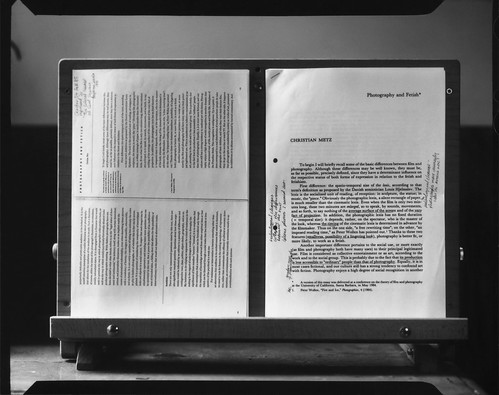
Rereading Christian Metz’s ‘Photography and Fetish’ (1984), which can be seen as part of the ongoing ontological project of conceptualising photography in the way Metz sets out the differences between film and photography, it is striking how historically situated his readings are. Possibly, at the time Metz wrote, the respective realms of photography and cinema may have seemed settled within the short history of photography and film. This appears to have been overturned, or at least greatly complicated since: a decisive shift occurred at the end of the twentieth century with the emergence of digital imaging technologies and their distribution. I first read ‘Photography and Fetish’ twenty-two years ago, while researching my undergraduate dissertation on ‘Photography and the Uncanny’. Then, digital cameras did exist, but they were thousands of pounds, and it would be many years before I even held one in my hands. Electronic moving images in the form of videotape existed, but generally as a poor copy of images originating in another medium - as indeed would be any digital images that I then worked with; in its linear construction, one can think of videotape as being a physical but non-indexical medium. Having retrieved Metz's essay online earlier this year, I subsequently found the original photocopy that I had made in 1996. I was initially surprised to find it printed in a landscape format, reduced from being reprinted in a larger volume, no doubt for reasons of economy. The juvenile appearance of my own handwriting also surprised me: at the time, writing by hand was an everyday occurrence: indeed, the first draft of my dissertation had been written by hand.

In ‘Photography and Fetish’ Metz discusses the medium of film largely in relation to the experience of such images within the cinema; television and, importantly perhaps, home video recorders must have been changing the relationship to the moving image at the time he was writing, but this is but lightly touched upon. Rather, a classical sense of ‘the cinema’ - coherent, discrete, but also with its attendant social practices - is used for the purposes of his argument (Metz does acknowledge that he is relying on generalisations). The differences between the experience of photographs and of film that Metz enumerates are now collapsing, or at least becoming less marked, with the access of digital technology and a few aspects of this collapse may be worth exploring.

There are several distinctions in ‘Photography and Fetish’ between photography and film that are not quite so clear today. Encountered more readily through a screen, a photograph in many people’s experience may no longer be understood as “a silent rectangle of paper”, changing its place in the “socialized unit of reading, of reception”, while, as a result of digital technology, film (or the moving image) is rather more equal in terms of its production, no longer “less accessible to ‘ordinary’ people than that of photography.” With the platforms of social media, Metz’s claim for photography having “a high degree of social recognition” in the domain of private, family life (“birthplace of the Freudian fetish”) feels diluted and complicated by uses which may have once seemed to properly belong to the private being turned inside out to a new kind of public face. As technology allows for ever-easier production of moving images, their consumption - and, importantly, access to their internal structures.
“Film subjected to repetition and return, when viewed on new technologies, suffers from the violence caused by extracting a fragment from the whole that, as in a body, ‘wounds’ its integrity. But in another metaphor, this process ‘unlocks’ the film fragment and opens it up to new kinds of relations and revelations.”
Laura Mulvey, Death 24x A Second
It no longer feels true to say, as Metz claims, that film is immersed in “a stream of temporality where nothing can be kept, nothing stopped. The emergence of a fetish is thus made more difficult.” Now film can be kept (stored) digitally, easily stopped, edited, re-edited, looped and fragmented. The easy availability of the digital image, its devices (and the attendant social media) put both photography and film more than ever in the hands of practically everyone, and allow far more control over the production, dissemination and consumption of images - of pictures - so much more than at any previous time in history. Yet what these images can be - the choices that inform how these images are made - must surely be determined by other structures: as well as how such technologies are designed, their use is formed by other pressures, social, political, and the idea of what possibilities can be imagined.

With the widespread adoption of the practices of digital imaging technology and its dissemination, one could argue that there has been something of a collapse between the moving image and the still image, even at the simple level of the devices that can accomplish both, embodied in the smartphone. (Intriguingly, some cameras produced early in the twentieth century after the invention of cinema were also designed to accomplish both: the Debrie Sept camera, for example, or the Bolsey 8, could record short sequences of moving images on film as well as shoot single frames; In Painting Photography Film, Laszlo Moholy-Nagy describes the ‘domestic pinacotheca’ which essentially embodies many functions of the smartphone: “‘domestic picture galleries […] brought out only when they are really needed.”) Indeed, in its most recent version, the ever present iPhone’s ‘live photo’ mode records 1.5 seconds of moving image before and after pressing the camera’s simulated ‘button’ on its interface. Early photography was always to some extant concerned with duration. Before the ‘instant’ photograph (which essentially emerged with the invention of the dry photographic plate) exposure times were counted in minutes, or at the very least, seconds, intervals of time that were within human perception, not outside of it, or perhaps more accurately, beneath its threshold, like the fractions of a second that photography became.

Perhaps one key relationship between the forms of photography and film as outlined in ‘Photography and Fetish’ that may remain largely unchanged is in the links that Metz makes between photography’s “immobility and silence” as signs of death, set against film’s signs of “livingness”; however some recent commentators (Garrett Stewart, Between Film and Screen: Modernism’s Photo Synthesis; Laura Mulvey, Death 24x A Second) have found less simplistic oppositions more fruitful, especially as film’s history lengthens. Film’s signs of “livingness” implicitly includes film’s incorporation of recorded sound as against the “silence” of the photograph; but this ‘silence’ can also now be seen in iterations of the moving image in current online practices. The animated GIF returns the moving image to a space where sound is no longer important. One might perhaps think of the moving image with synchronised sound as having always been a hybrid, although perhaps a ‘natural’ seeming one, its sound having such affinity with the moving image that it is easy not separate the two as being distinct while experienced simultaneously. However early cinema existed for thirty years without recorded synchronised sound: Rudolf Arnheim asserted that “No one who went unprejudiced to watch a silent film missed the noises which could have been heard if the same events had been taking place in real life […] People took the silence of the movies for granted because they never quite lost the feeling that what they saw was after all only pictures.” For much of the twentieth century, many people’s home movies before the advent of consumer video cameras would have been mostly without sound. Would this be seen as seen as a lack? Or would silent home movies be seen as more akin to photographs, albeit photographs that move. The occasions of the use of home movies are generally identical to that of the domesticated photograph - holidays, celebrations, and newness: a new baby, a new house, a new car, other new significant purchases.

However, when using the iPhone’s live photo feature the user is still intending to make something understood as a photograph - hence the name ‘live photo’ - and not necessarily a short film as such. A medium can be defined by its use, its practice, and the user’s intentions, as well as its constituent material. In ‘Against Post-cinema’, Ted Nannicelli and Malcolm Turvey argue against the conception of a digital 'monomedium' - with all that implies. 'Post-cinema' can briefly be summarised as the effect that digital technology has had on cinema - the divorce of the moving image from a physical strip of film (and for many commentators, this separates the moving image form the index) - meaning that with many practices being reduced or subsumed into digital technology, emulated by the interfaces of software (and these emulations becoming increasingly opaque), and that in so doing, cinema loses its distinctive qualities: Nannicelli and Turvey take issue with the "post-cinema thesis" which argues "not just that the cinema has been radically altered by digital technology, but that it is no longer a distinct medium because it has been subsumed by another medium. It has been dissolved into a broader medium in the digital era. Indeed, some proponents of this view intimate that digital technology has rendered the concept of a distinct medium obsolete..." Instead, Nannicelli and Turvey state that two senses of the term 'medium' are being confused; (quoting from Joseph Margolis) the medium is both “‘at one and the same time’” the physical material used and the "emergent work" being created. This emergent work is situated within a set of social practices that also define the medium (for example, the medium of paint can both be used to decorate or protect surfaces, or used to create something understood as a painting; one can imagine instances when making a discrete work of art through painting could possibly be confused with painting a wall, but this can be seen as an outlying use of practice); therefore the medium of 'cinema' can mean a distinct set of practices - production, distribution, exhibition and audience expectation (after all, audiences still physically travel in their millions to places called cinemas to watch productions - whether digital or not - called films). That there are crossovers between photography and film in the area of visual arts could be seen to be due to a sense of awareness of the historical practices bound up together with the medium's material characteristics (at the outset, each new medium tends to take on the forms or roles of those pre-existing historically, before an awareness of its own distinct qualities - which include distinct limitations - becomes consciously explored).

In a not dissimilar fashion, in his claims for film as art, Rudolf Arnheim's use of the term 'medium' is distinct from 'art' despite making categorical statements from a formalist position that recognises the properties of the medium as being its defining characteristics: “At about that time [the 1920s] I started to make copious notes on what I called Materialtheorie. It was a theory meant to show that artistic and scientific descriptions of reality are cast in moulds that derive not so much from the subject matter itself as from the properties of the medium - or Material - employed.” Thus, while anxious to place film as art, Arnheim was also aware that the medium of film could be used for other purposes which were 'not art': within the material constitutes of a medium, that medium can produce something outside of the realm of art. He lists: "coloured picture postcards [...] a military march, a true confession story, or a strip tease" as all being uses of mediums that can create art, yet these are not art, which implicitly recognises the social practices around the different mediums these examples conjure up (of course, one can now probably think of examples of all of these forms that are now firmly defined as art).
“Film is much more difficult to characterize as a fetish. It is too big, it lasts too long, and it addresses too many sensorial channels at the same time to offer a credible unconscious equivalent of a part object […] whereas a fetish has to be kept, mastered, held, like the photograph in the pocket. […] Most of all, a film cannot be touched, cannot be carried and handled: although the actual reels can, the projected film cannot.”
Christian Metz, 'Photography and Fetish'
With the touchscreen and its handling, animated by its swipes and other gestures, film is closer than ever to being ‘touched’. Experienced through digital technology, most of the qualities Metz ascribes to the photograph in ‘Photography and Fetish’ can now be applied to film: seen on a small portable screen, with internal access to its content, film can now possess “smallness, [the] possibility of a lingering look.” That a single device can contain both photographs and films, and can make both, opens the possibility that film can take on those qualities that Metz concludes as to how photography, rather than film (which plays on fetishism), is “more capable of itself becoming a fetish.” Metz places photographs in belonging to both “the ordinary sense of the word” fetish, as well as developing its relation to the Freudian meaning. Thus: “The familiar photographs that many people carry with them always obviously belong to the order of fetishes in the ordinary sense of the word”: now, in Freudian terms, the smartphone and all that it contains could be seen as a metaphoric phallus, cut off and kept in a pocket.


Bibilography

Rudolf Arnheim, Film as Art, Faber and Faber, London 1958. First published as Film als Kunst, 1933
Lewis K. Bush, 'The GIF of Life: Vestigial Film Formats as Documentary, http://www.disphotic.com/the-gif-of-life-vestigial-file-formats-as-documentary/ 10/10/16 retrieved 12/2/18 See also: https://www.360.agency/en/blog/the-return-of-the-animated-gif/
Christian Metz, 'Photography and Fetish', October, Vol. 34. (Autumn, 1985), pp. 81-90.
Laura Mulvey, Death 24x A Second: Stillness and the Moving Image, Reaktion, London 2005
Moholy-Nagy, Laszlo, Painting, photography, film, translated by Janet Seligman (Originally published as Malerei, Fotografie, Film, 1927) Lund Humphries, London 1969. Ted Nannicelli and Malcolm Turvey, 'Against Post-Cinema', Cinema & Cie, vol. XVI, no.26-27, Spring/Summer 2016
Garrett Stewart,Between Film and Screen: Modernism’s Photo Synthesis